DIALOGUE: Kevin Kane & Jackie Lopez
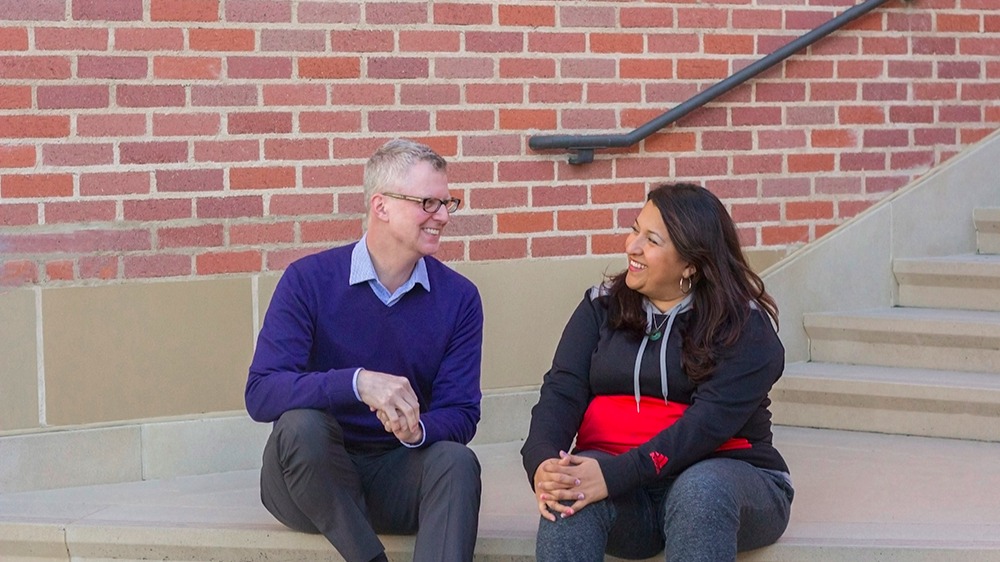
This DIALOGUE traces the relationship between Jackie Lopez (BFA ’04) and Kevin Kane (MFA ’03) both artists, teachers and community visionaries who first met when Jackie attended John Marshall High School in Los Angeles where Kevin was starting out as a young teacher. Over the course of more than 20 years, during which time they both received degrees from UCLA’s Department of World Arts and Cultures /Dance, their relationship has evolved and spiraled from teacher/student to mentor/mentee to collaborators, colleagues and co-conspirators.
This is their story as recounted one late afternoon in Kaufman Hall.
Kevin Kane: What’s your memory of when we first met?
Jackie Lopez: Memory. Memory. Well, we go way back. I'm 35 now, and I met you at 16.
KK: Almost two decades ago.
JL: As a student in high school, I loved the arts. You were a new teacher at John Marshall High School. I was in a drama class and I think you were looking for talent.
KK: My memory is that I was first your English teacher and I was looking for students interested in the arts. You were on my radar. I was brought in as an English teacher, which soon led to me to being able to offer a theater and dance course called Theatre Workshop. I was seeking out all of the nice, creative, fun, outgoing students and, at first, you turned me down [laughter].
JL: Yeah, I did. I didn't enroll right away because I was juggling so much. I was in Drill Team and another drama class and I worked at KFC from four to 11 every day after school. But I did finally join your theater workshop, and you were one of the first teachers to actually care about me. You wanted to hear my story, my background, who I was, and whether I wanted to go to college or not. You stood out because you were the first one to ask, "What's next?" You asked, "Do you plan to go to college?" I was like, "College? Me? I didn't think of that, but, sure, okay. If you think I could do it." I stayed in school because of your theater workshop program.
KK: I'm touched [laughter]. But, to be honest, I really had no idea what I was doing. I had, however, found the thing I loved and that made all the difference in my life and I felt like I could offer that to my students. I remember caring so much about it, and working hard to make it go well and to make sure the students could be really inspired by that work. I figured out very soon that the arts - performing arts in our case - was a place where everyone could belong, everyone had a story worth telling and worth listening to, and the performing arts could help shape that story so that it could be affirming, truthful, inspiring. We were at a school where we were lucky to have a real rich diversity of cultures, and languages, and backgrounds, and religions, and ethnicities. That really taught me a lot about the power of diversity and its potential for transformational experience in the arts and in society. So many of the students from those Marshall days had very little, if any, formal training in the arts, would you say that's true?
JL: Definitely. I don't think any of them had any formal training. Well, I think that was the beauty - you exposed us to all that. After I graduated, I enrolled in community college and was working a waitressing job wondering what was next for me. And then, you asked me to come be a teaching assistant for your theater workshop program at John Marshall. I became your first hip-hop instructor. Then I got a little sidetracked and got pregnant. You were so amazing and supportive. I stayed in school, had my son, and transitioned to LA Valley College. At the same time, you were looking into the masters program at UCLA and started here. When it was time for me to apply to a university, you introduced me to the World Arts and Cultures/Dance program at UCLA, encouraged me to apply and helped me get in by writing a recommendation letter, which to this day, I still have!
KK: I think it’s really interesting that both of us have been transformed by our journeys in the arts. I see now that we both committed ourselves to three simultaneous practices. One is arts education, the other is staying engaged with our community - really being involved with the youth that are hungry for and love these opportunities, and can start to imagine their own futures in the arts and because of the arts. And then the final thing I think we've both continued to practice is our artistry. Continuing to grow as artists and, in my case, as a scholar. I went all the way through to my Ph.D. program because this work became more and more important to me, and that phenomenon of transformation in the arts became more and more urgent for me to be able to understand and describe. I think UCLA has provided both of us with the opportunity to figure this out.
JL: Big time, and I'm so blessed to have had you as a mentor throughout the whole experience. When I came to UCLA, I needed mentorship. Nobody in my family had ever graduated high school, let alone gone to college, let alone gone to UCLA. I'm here, a single mother to top it off - my son was only two at that time. It was really, really tough, but that constant mentorship, stimulation, and inspiration that I got through you and your work helped me find my way in the department. I felt so little and out of place: there were only two Latinas in the department and I was one of them. But people like you, or David Gere, Peter Carpenter - really opened me up and made me feel comfortable. And then, of course, your repertoire ensembles allowed me to explore and show my talent in a different way.
KK: As you know, I was also the first in my family to go to college, and I also came from an economically disadvantaged background. So, somehow, I guess, I had an instinct, an intuition, that later became something I could articulate, to be able to use the arts to help, guide and support, challenge, too, but in a supportive way. Our story is really kind of unbelievable - two people who met in the way that we did. You’ve gone on to be a really inspirational artist and teacher, and with the incredible support of Angelia Leung and the whole Department of World Arts and Cultures/Dance (WAC/D), we went on to co-create the Dance/Performing Arts Summer Institute in the department.
JL: Yeah, we did. I was with you from the beginning.
You and I made a really good team. I think there was an advantage in that the people we were recruiting to participate in the summer program were people with whom I identified - African Americans, Latinos, the inner city kids. I was right away able to share my story with and, hopefully, inspire them to continue the legacy. As soon as I graduated UCLA, I went to teach at a middle school for a few years. I recall bringing my students from the middle school to watch one of your shows, because you were still here.
KK: Yes. I had finished my MFA and was on the faculty.
JL: You were teaching. It had been a couple years and I remember not being entirely happy in my work. I came to see one of the shows and remember feeling completely inspired. At that time you had just co-founded the Flourish Foundation and I felt like I could really help you. I wanted to continue my career as a dancer and as a performer and that's when you offered me a position as Program Director with Flourish and also invited me to be the assistant director for the Summer Institute program.
KK: The summer program for high school students gave us an opportunity to prepare students of all different backgrounds, including those students from public high schools, and urban settings, who wanted to be artists, but didn't know that there was even such a thing at the college level, or at the university level. The high school intensive gave us a chance to initiate those ideas, those thoughts, those conversations, so that they would not be brand new once these high school students got to college.
JL: You created this pipeline.
We really discovered what a real educational, social, and artistic pipeline is, and not just in theory. It became clearer and clearer each year what the possibilities were.
KK: I really found my true calling and my true passion in teaching. It's a cliché, the hardest job you'll ever love, but I love it everyday, and I think it's important for me to hold on to teaching as a laboratory for my research.
JL: I love teaching and I love performing. There's still a part of me that, to this day, I'm 35 and I'm trying to balance that out, because I love both very, very much. I think the reason I even created my dance company, Versa-Style and then Versa-Style Next Generation – was because I felt what made an effective teacher was a teacher that was constantly there. I wanted to be a part of these young peoples lives. I wanted to see them every day and create some kind of momentum.
And to circle back to the topic of pipelines, I've had some of these students for up to ten years. One of them, his name is Ernesto; I met him as a middle school student. When I left, he continued my Friday community classes, and the same way Kevin mentored me, I mentored Ernesto. I wanted to give him all the opportunities. He was involved as a dancer, and then it came time for him to apply to college. Luckily, we have the UCLA Dance/Performing Arts Summer Institute, so I was able to expose him and give him an introduction to college life and what it means to create shows outside just hip-hop dance. I was able to introduce him to that program through the Flourish Foundation and now he's here at UCLA. He's going to graduate in June.
KK: --and I have to add, just because so many of those students that were inspired and engaged by what we’ve done, so many of them go on to imagine themselves to be teachers. I'm proud to say Ernesto is minoring in the Visual and Performing Arts Education Program (VAPAE) where he is training to be a teacher himself and is already teaching at a middle school in the community.
JL: It's all about relationships. Many of my students from Versa-Style are in college now - a lot at UCLA actually. And some of these are also pursuing a minor in the VAPAE program – and hope to become teachers. I think we’ve learned that being a part of their lives throughout the whole process is crucial. That’s part of what motivated me to come back to teach at UCLA. I wanted to be in touch with the Ernestos, and the Jackies, and the Janelles, and the Lilys, and the Chantys - and all the names I'm saying are people that came to UCLA or are currently at UCLA. And they came through the pipeline we created through Versa-Style, the Flourish Foundation, and through the UCLA Summer Institute.
KK: There is now a great, somewhat large group of students who have been involved in all or many of those programs and projects that we're talking about. I think it is important to mention that, while we have been at UCLA, we have both also been very blessed to be a part of the Flourish Foundation, which I co-founded with my best friend Monica who, of course, I met in a 10th grade theater class. Flourish has allowed us to give scholarships and opportunities to these students and many others who might not have otherwise been able to come to UCLA.
JL: Yes. It’s true.
KK: What UCLA offers—
JL: --is very unique. We are able to take different classes and different styles. It is not just focused on traditional western models of dance. In my undergrad I was able to take Afro-Cuban, Bharatanatyam, and a modern class, for instance. When I was doing research into colleges at the time, it was all predominantly ballet, modern, conservatory schools and I automatically knew I did not fit into those schools. So, this department always stood out and, to this day, it still stands out. I’ve led a lot of our students to come here.
KK: While I was teaching at John Marshall High School, I became interested in the possibility of a couple key values but I didn't have access to the research and the scholarly engagement while teaching full-time. I really became drawn to issues of access, inclusivity, and diversity. And, of course, UCLA is a public university, so it stands for those ideals. I wanted to explore them in the ways that dance and the arts can be an ideal space for all different kinds of students to feel like, "Hey, I could be in this. I could do this.”
It turns out that's way more complicated than I originally thought. I thought I was here at UCLA, which was diverse and inclusive and there was total access, and I could guide lots of talented and dynamic students into the school, only to find out over the last ten years or so, maybe more at this point, there's more applicants to UCLA than any university in the country. It’s very competitive to get in . . . So, it’s become really important for us to do more interventions in the community and identify even earlier, and provide, not just informal mentorship, which is critical, but weekly tutoring for incoming first year and second year students who are entering the UCLA system - like you did, who could really use a mentor. And now we - through the Flourish Foundation and with the support of WAC/D and VAPAE – have figured out ways to support students once they get here.
Another epiphany. When we're talking about diversity and donors who want programs and departments like this to succeed, and for a new generation of teachers to be prepared to go into the communities, it’s often times because they themselves are the product of high quality arts education that changed their lives. And a place like UCLA is really a select destination school – it attracts a lot of different kinds of people who can come and feel proud of the connections that they make here. In the summer intensive, in your hip-hop class -- where ever these intersections of all different kinds of people exist. It brings a sense of possibility and is why UCLA is key - it’s where people are coming together, coming from different parts of the city, the state, the country and the world and, I hope, valuing those intersections.
But UCLA is key - it’s a very prestigious school, a destination site where all kinds of people are coming together, coming from different parts of the city, the state, the country and the world, and, I hope, valuing those intersections and exchanges.
JL: What's next for us Kevin?
KK: I'm learning how to be the Associate Director of VAPAE and that learning curve is very exciting but also humbling. Before you can expand any organization or foundation you have to learn what it already is and I'm in that mode right now. And I can honestly say that under Barbara Drucker, the program is unique and impressive and very much needed. So many artists we know are going to end up with a teaching practice in one way or another. Oftentimes, a teaching practice becomes core to artistic practice and vice versa.
JL: Yes, what is the other thing to do as an artist? I feel like it's either teaching or you perform—
KK: It's usually a combination of both. So, I’m proud that the VAPAE program is simultaneously helping them develop a teaching practice, and giving them experiences in the community to exercise that practice, and then giving them feedback, and mentorship on that teaching practice, so that they can keep getting stronger and better. As Associate Director of VAPAE, my mission is to strengthen and help grow this program. Teaching is not necessarily an innate talent, but it doesn't mean it cannot be developed and supported.
JL: What’s next for me is to continue to give opportunities, not just to the ones that come to UCLA, but to teaching artists all around. We need to see more diversity too. I am one of the only Latina teachers. Where are my African American teachers? Where are my Latino teachers? I want to figure that out. And I am, I think little by little. Right now, there's only one Ernesto, there's only one Jackie, there's only one Lily. I want to multiply that because there's a desperate need to have more diversity. I want to change that. I want teach these teachers not just to be great performers, but to think of all the opportunities they have and how it's their job to give back, you know? To go back to the question: why I taught? Because a teacher changed my life completely. I want to do the same. It's that simple. And I feel like if we keep multiplying the Jackies - the Ernestos in that way, it could change the world and that's definitely the next step. And it's big but getting closer.