DIALOGUE: Harold Williams
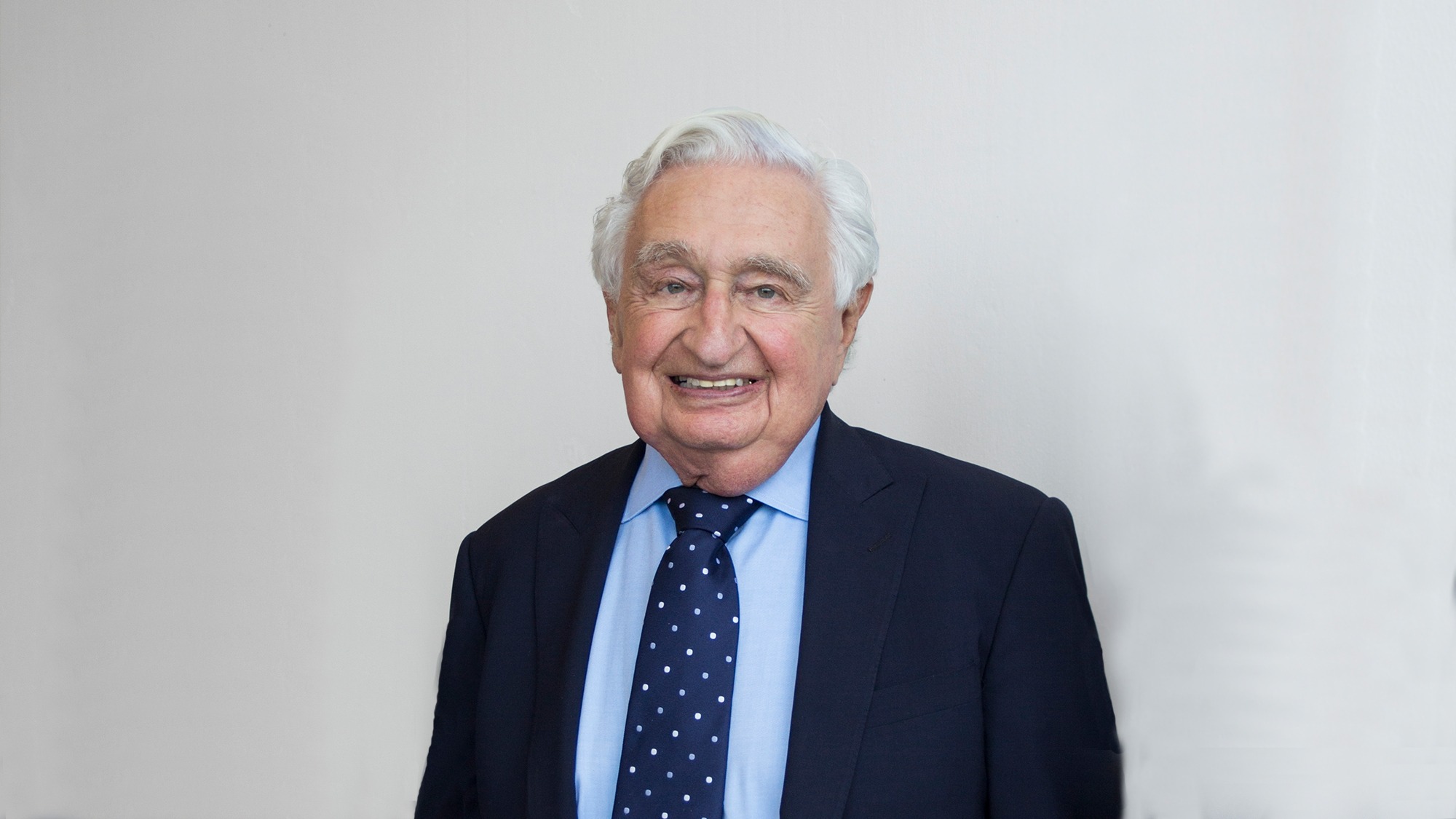
This past October, UCLA Arts honored entrepreneur, arts advocate, public servant, and philanthropist Harold Williams ‘46 with the UCLA Arts Award in recognition of his accomplishments and his contributions to the arts at UCLA. The UCLA Arts Award is the highest honor bestowed by the School of the Arts and Architecture and was presented at the school’s Board of Visitors meeting on Tuesday, October 27.
This fall, Anne Marie Burke (M.Arch ’98), sat down with Harold Williams to talk about his life; accomplishments; and his unique contributions to the arts, education, and Los Angeles.
Anne Marie Burke: What brought you to UCLA? You are originally from Philadelphia. Why did you come to UCLA to pursue your undergraduate degree?
Harold Williams: My family came west in the thirties. It was not as much a matter of choice. My father was in the real estate business and went bankrupt in the Depression. My brother, who is twelve years older than me, graduated from one of the best public high schools in Philadelphia, with outstanding grades. He was admitted to the University of Pennsylvania, but was not offered a scholarship, so we couldn't afford it. The only place he received a scholarship was USC. So, we came west.
AMB: How old were you?
HW: I was six years old.
AMB: Where did you live in Los Angeles?
HW: Right near USC. One block east of Vermont.
AMB: Where did you go to high school?
HW: Roosevelt High. East LA.
AMB: So, UCLA was a local choice—in the neighborhood?
HW: It was more than in the neighborhood. It was the only place I could afford to go to college. It really worries me about the University of California these days. When I was a Regent of the UC (1982-1994) and to this day I fight for accessibility any chance I get. Young people today who are financially in the position I was back then can't afford to go to UC, and the UC is failing those kids as a public university. This is a public university, and those kids should have access.
AMB: Do you still think the ‘public-ness’ of the institution—despite increases in tuition—is significant and has impact?
HW: The ‘public-ness’ has diminished because the public support has diminished, but the strength of the institution, I think, was created as a public institution and we have a responsibility as a state to maintain and serve this public function. I can't blame the efforts to raise tuition. I recognize that public funding is much less meaningful or significant and that the university cannot survive without this funding. What do we do about that? I say we can't let it be that way.
AMB: What do we do?
HW: We need more public funding to make it possible for young people who are otherwise academically qualified to afford to go to the university.
AMB: Why is this access to public education important to society, important to the state of California?
HW: It's enormous. That access to the public university is becoming more difficult contributes to the two-class society that we're concerned about. I don't think anybody looks at it that way, but it's there. And we don't solve that by admitting more out-of-state students or foreign students. That makes it worse.
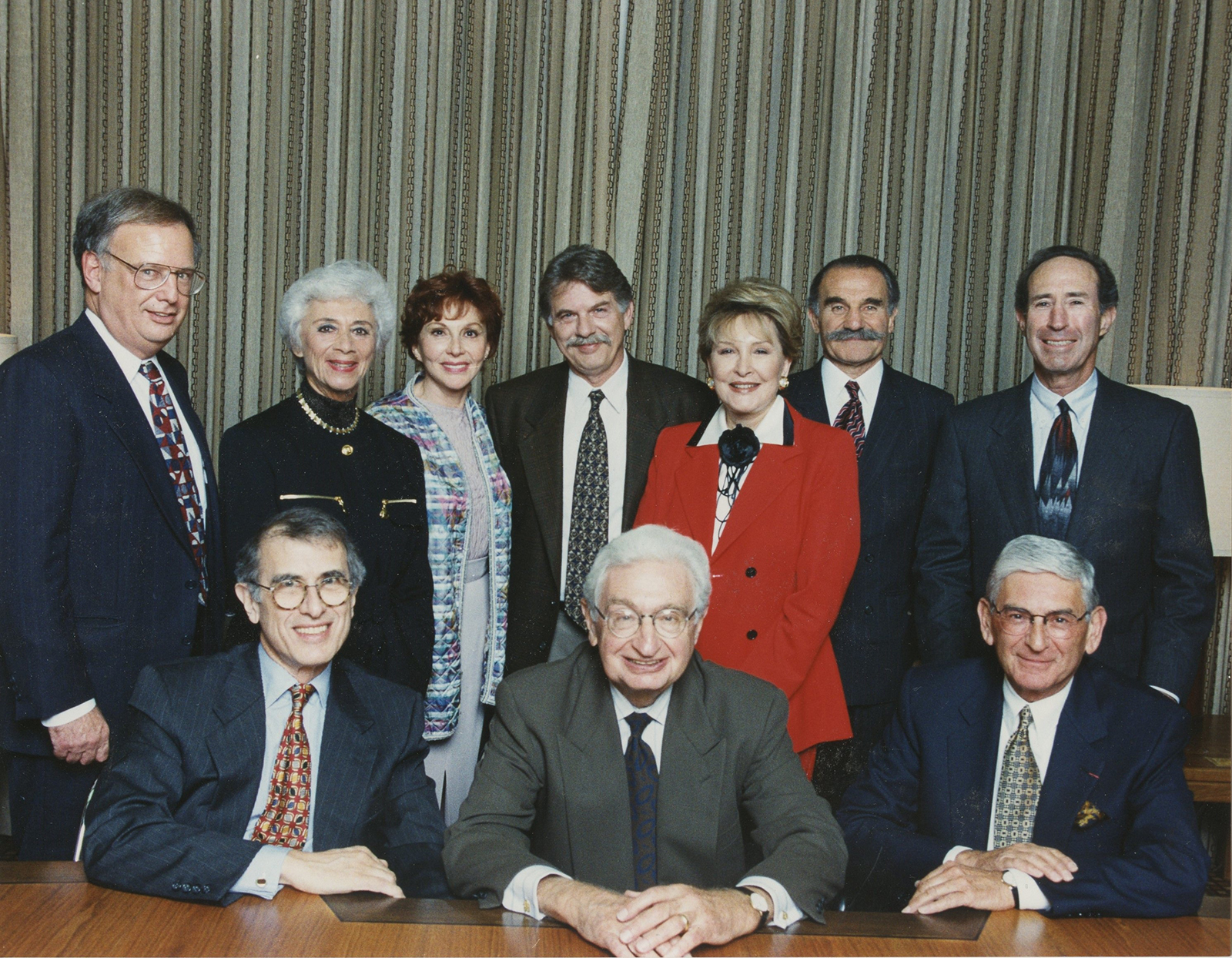 The founding Board of Visitors for the UCLA School of the Arts and Architecture.
AMB: What about the School of the Arts and Architecture, more specifically, what drew you to the School and what compelled you to take a leadership role on the board?
HW: I've been with the school for ages. I knew the dean, Robert Blocker, and I was aware of what was going on. I'd been involved with the Design for Sharing program and a few other things. I was a contributor and a long-time patron of Royce Hall. There was an effort going on to get Eli Broad to fund the renovation of what was then the Dickson Arts Center and that effort had been totally unsuccessful. I got into the picture and began talking to Eli. I don't recall what I said or did, but over time, we put the package together. The university put up some money from the earthquake fund, and Eli ultimately put up, I think, $23 million. When we formed the board, I think it was Eli who came up with an idea that he and I, alongside Daniel Belin, would join the board as co-chairmen. And, I agreed. Over time, I inherited the board and the chairmanship. I care about the school. I care about the arts, and most of all I care about UCLA.
AMB: You’ve had an incredible life and have accomplished so much in so many areas? How did you start out?
HW: I got my B.A from UCLA in 1946 and I have a law degree from Harvard. (J.D., Harvard University, 1949). I started out practicing law for a lawyer who had a good practice. I was interrupted by the Korean War and then came back to practice and then went into industry as a tax attorney for Hunt Foods. I was in the company for fifteen years and worked closely with Norton Simon. Ultimately, I ended up as chairman of the board.
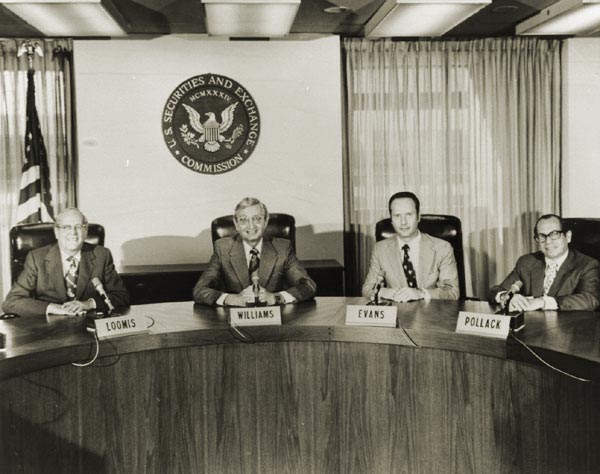 Harold Williams, chairman of the Securities and Exchange Commission in 1977.
Image courtesy of www.sechistorical.org
AMB: And, after that?
HW: After that, I came back to UCLA to be the dean of the management school. Then I was appointed the chairman of the Securities and Exchange Commission under Jimmy Carter. After that, in 1981, I became the president and CEO of The Getty.
AMB: You are trained as a lawyer. You ran a major food company, headed a business school, and were the chairman of the U.S. Securities and Exchange Commission. Where and how did you become passionate about the arts?
HW: When I was growing up in Los Angeles, all we had were Pinkie and Blue Boy at the Huntington. That was it. Music was much more my interest. I played the cello and used to go hear the LA Phil. When I went east to Harvard, I had my first real exposure to art in the museums of New York and Boston. In my last year at law school at Harvard, I sat in on art history classes at the college. When I was called in to service during the Korean War, I was exposed and incredibly drawn to contemporary Oriental art. I didn't collect any because I didn't have any money. After the war when I went to work at Hunt as a tax lawyer, I was involved in a number of different activities and was based in Norton Simon’s office not at the Hunt Foods headquarters. His office was full of art. He was in the early days of his collecting. He was the kind of person who asked everybody what they thought about the art. He’d have a piece of art that was on loan that he might buy, and anybody who came in his office, he'd ask "What do you think of it?" It might be his driver or the person who's vacuuming the floor, or anyone. He was looking to see how people were reacting to it, what did it mean to people? I got involved with that, and over time I became heavily involved. If there was a piece of art that might be available, and I was traveling east, I'd go look at it first, and see whether I thought it was worth pursuing. Ultimately, I helped establish his foundation and became a trustee. That was also what kept kindling my interest, if you will.
AMB: That's so interesting. Was it just that the opportunity came up and you found yourself, in your professional life, at the center of culture and art?
HW: The amazing thing about my life is that so many of the things I have gone on to do have come out of left field. I did not apply for the position at the SEC. I didn't look for the Getty job. It came to me. As I was leaving the SEC, I didn't know what I was going to do.
AMB: This was 1981?
HW: Yes. Norman Cousins [political journalist] was an old friend. I talked to him over the years and, when I was moving on from the SEC, he had some ideas and I called John Gardner [6th United States secretary of health, education and welfare]. I called Franklin Murphy [UCLA chancellor, 1960-1968 and chairman and CEO of the Times Mirror Company]. He was an old friend as well. In fact, we had breakfast together in Washington when I was still in D.C. When he got back to L.A., he had a call from the chairman of the then Getty Board, saying "Do you know anybody that would fit this bill?" Franklin said, "Yes, I do."
AMB: Thus begins the journey.
HW: Yes.
“Harold is a remarkable person. He's one of those
people whose breadth is extremely great. I could call
on him for almost anything I was involved in because
his breadth is really unbelievable. He's a Renaissance
man in many respects, but he's not a showman.”
Charles E. Young, Chancellor Emeritus, UCLA
“I think Harold is one of the few really wise people I
have met—a person of sufficient breadth to
be able to put things in a real perspective.”
Steven D. Lavine, President, California Institute of the Arts
AMB: Many people have commented on your wisdom and the remarkable breadth and depth that you have. Where do you think this comes from?
HW: I don't know what's chicken and what's egg, but I was about seven or eight years old when my cousin outgrew her 20-volume Book of Knowledge and gave it to me. I used to get colds a lot and mother would make me stay home. Over the next several years, I read all 20 volumes. If I didn't have natural curiosity would I have read the 20 volumes? Or did the 20 volumes instill in me the curiosity and the breadth. Where it comes from, again, I'm not sure, but I'm still a voracious reader and my reading cross-pollinates, and ideas connect. It's how my mind works. If I am thinking about a problem, I seem to bring a lot of different pieces together. Or, I move into a new or strange situation and I adapt very quickly. I seem to have a pretty good sense of who I can trust to learn from.
When I started as dean at UCLA, I told the faculty at my first faculty meeting, "I'll be here between six months and eight years. We'll know in six months if I've made a mistake, and by eight years I'll have probably accomplished what I could, explained away what I couldn't, and it'll be time to go do something else."
“Harold was a great dean. He really moved the school forward.
He was a great leader in the school, admired by the faculty.
Someone who really dug in and got things done.
I would have been quite happy to have Harold to stay on forever.”
Charles E. Young, Chancellor Emeritus, UCLA
AMB: So, what was it like when you joined UCLA to be the dean of the business school. Coming from a position of leadership in the corporate world to a position of leadership within an academic institution, what were the challenges?
HW: When I came on as dean, it wasn't even a school of management. It was a school of business administration: the graduate school of business administration. It needed an enormous amount of work, a major re-organization. They didn't have a real M.B.A. program. They had 19 Master of Science programs.
AMB: Did you say "19"?
HW: Each little cluster of faculty had their own M.S. program and the departments were all over the place. So, I spent the summer, or before summer even, talking to each individual faculty member. I pulled together a small group of faculty that I thought I could count on. We spent the summer designing an M.B.A. program. When the entire faculty came back in the fall, we presented it to them and they bought it. We went ahead and implemented the program and I did something I'm sure I had no authority to do. I eliminated all of the departments. I said, "We're going to be a one-department school."
AMB: Wow, that's bold leadership. Remarkable.
HW: We changed the name to the Graduate School of Management. We totally transformed the organization.
AMB: How do you go about making these kinds of decisions?
HW: They are driven by vision. They are not made arbitrarily. One motto I've had, and this is only a piece of what you're talking about, is that ‘no decision is a decision.’ One can procrastinate too. There's always something more. One of the important changes we made at the management school was creating a first-year, three-course sequence about decision-making. The first course was about individual decision-making: "What are you doing here?" The second piece was about a more complex level of decision-making. The third course in the sequence was what I called “leap of faith decision-making," because the big decisions management has to make can't be made from data. There's a stopping point when all the facts are there and you still don't have an answer. Those are the decisions that count.
“To be a great leader, you've got to be a psychologist.
You've got to understand how to get the best out of people,
how to work with people and make them think
the ideas that you're putting into effect were their ideas.
Harold is a master at this.
He is able to figure people out, understands how to
approach them, and is able to draw from them their
very best work. Harold creates confidence in people.
He is someone most people are very comfortable with. He doesn't
try to upstage anyone. He doesn't try to put people off.
He tries to put people on. He's a great advisor.”
Charles E. Young, Chancellor Emeritus, UCLA
AMB: You've provided visionary leadership in many arenas throughout your life. What does it mean to be a leader? What makes a great leader?
HW: That's the ultimate question.
AMB: I thought you might be a good person to ask.
HW: It's my own personal version, but when I look back and ask myself why I think I succeeded as a leader, I think about how in each of the positions I've held that have required or called for leadership, I’ve had a vision of what I wanted the institution to accomplish and become. So, having a vision of what one wants to accomplish is, in my view, essential to leadership. I think the next challenge for a leader is to find the right people to implement that vision. People who, ideally, bring more credentials to the task than I do and who buy into the vision and are excited about it. Those are the kind of people I have always looked for. And, people who, as best I can tell, have big motors and basically good values. If I have one quality over others that I think has helped me succeed, I think it’s that I am more of a psychologist than anything else.
AMB: And why is this important?
HW: It helps in the selection of people, understanding what motivates them, what helps them succeed. If we've accomplished what we set out to do, we've accomplished a lot, probably more than we expected to. The people who have done it have achieved more than they themselves ever expected to, and that's very satisfying.
Beyond that, what can I say? It makes it sound very simple. I'm sure in some ways having grown up in what today would be called poverty or near poverty, and in very mixed neighborhoods where my playmates and friends were everything – Jewish and Korean and Dutch and Mexican and Armenian and Russian – I started off in life feeling like people are people. I think that helped.
Human behavior plays a role, more broadly.
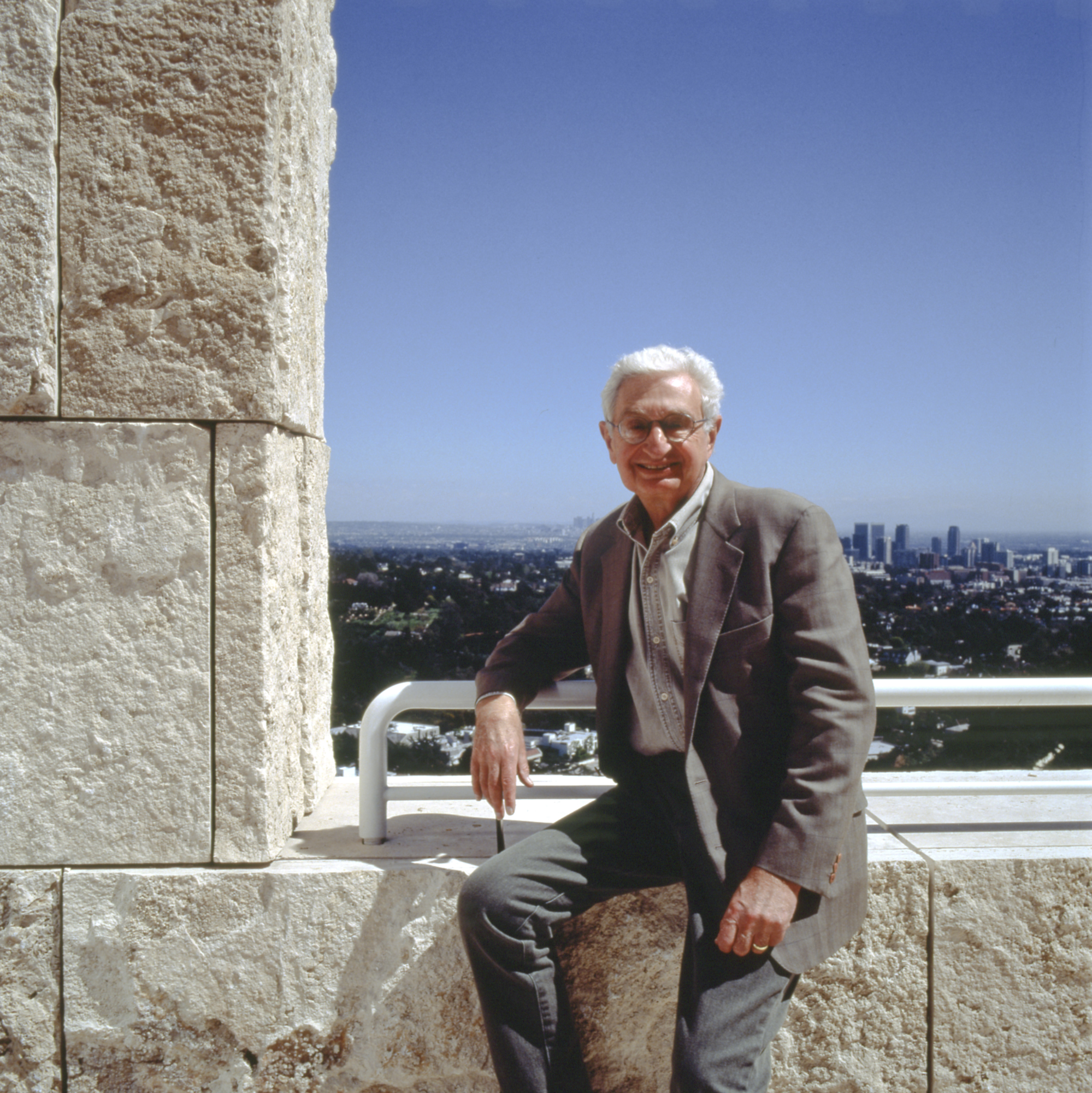
Harold Williams at The Getty
AMB: Not everyone is attuned to that, are they? How do you think one creates or builds a great institution? How did you do it?
HW: I find it easier to do than to talk about. But, to the extent that I've done it a bit at The Getty, or at least The Getty is the place I probably came closest to doing it, it starts with a vision. At it's most theoretical or philosophical, it's: "This is going to be a great institution.” Then, it gets more specific around what could make it great and values. Some of the vision and values get articulated over time but it’s not necessarily something you're entirely conscious about initially. You have to articulate it far enough for it to have substance, and then you begin to build an organization. In an oversimplified way, it's the people who get excited about the vision who create the culture that can make it great.
AMB: So that vision and culture become the shared language that everybody—
HW: It's a shared vision, but it's also got to be people who, as best you can tell when you bring them in, are people of integrity, and as I like to say, people with big motors who know more about their areas of work than I know or would ever want to know, and are respected for that in the field. Then we live the vision. What does "living the vision" mean? It's everyday stuff. It’s creating a mission that everyone is excited about and buys into.
This was true with The Getty. Excitement pervaded the place. In fact, it was so exciting that people weren't going home. We had a lot to do. Everyone was working his/her tail off. It was very stressful but also exciting. At one point, I remember saying to the staff at a time when many organizations were struggling, "We're all under stress, all organizations, but at least our stress is upbeat stress." The next day, people came in wearing t-shirts that said, “Upbeat Stress.”
Later on, I was concerned about the stress level, about how hard they were working and all, and I announced that going forward we would be closed every other Friday. And, wow, that had an impact.
AMB: Clearly, you knew something about cultivating culture.
HW: It was fun. That’s maybe the most important gesture of recognition I ever made to the staff.
“Harold built The Getty. And, by that, I mean not only the
physical structure, but the whole concept of
what The Getty is and what The Getty could be.
No one will ever be able to say that again.
That's the most extraordinary thing.
He was given this opportunity to conceive of
an institution that could do good in the world.
He had a vision. To me it's a great lesson about vision.
When this place opened in '97, many people were critical of it
for being up on a hill, away from the city, isolated.
He knew he wanted to create a destination for people
because he knew that there was a benefit
for the programs to have access to a natural setting,
to gardens, to vistas, to fresh air, to good sunlight.
It was going to be good for the workers.
It was going to be good for the visitors.
And that was Harold.
It's now the most visited cultural institution west
of Washington D.C., and people come, in large part,
because of the site, the location.”
James Cuno, President and CEO, The Getty Trust
AMB: What was your vision for The Getty in terms of its relationship to the city and its relationship to other institutions?
HW: In relation to the city, museums typically are on a city block, and I didn't want that.
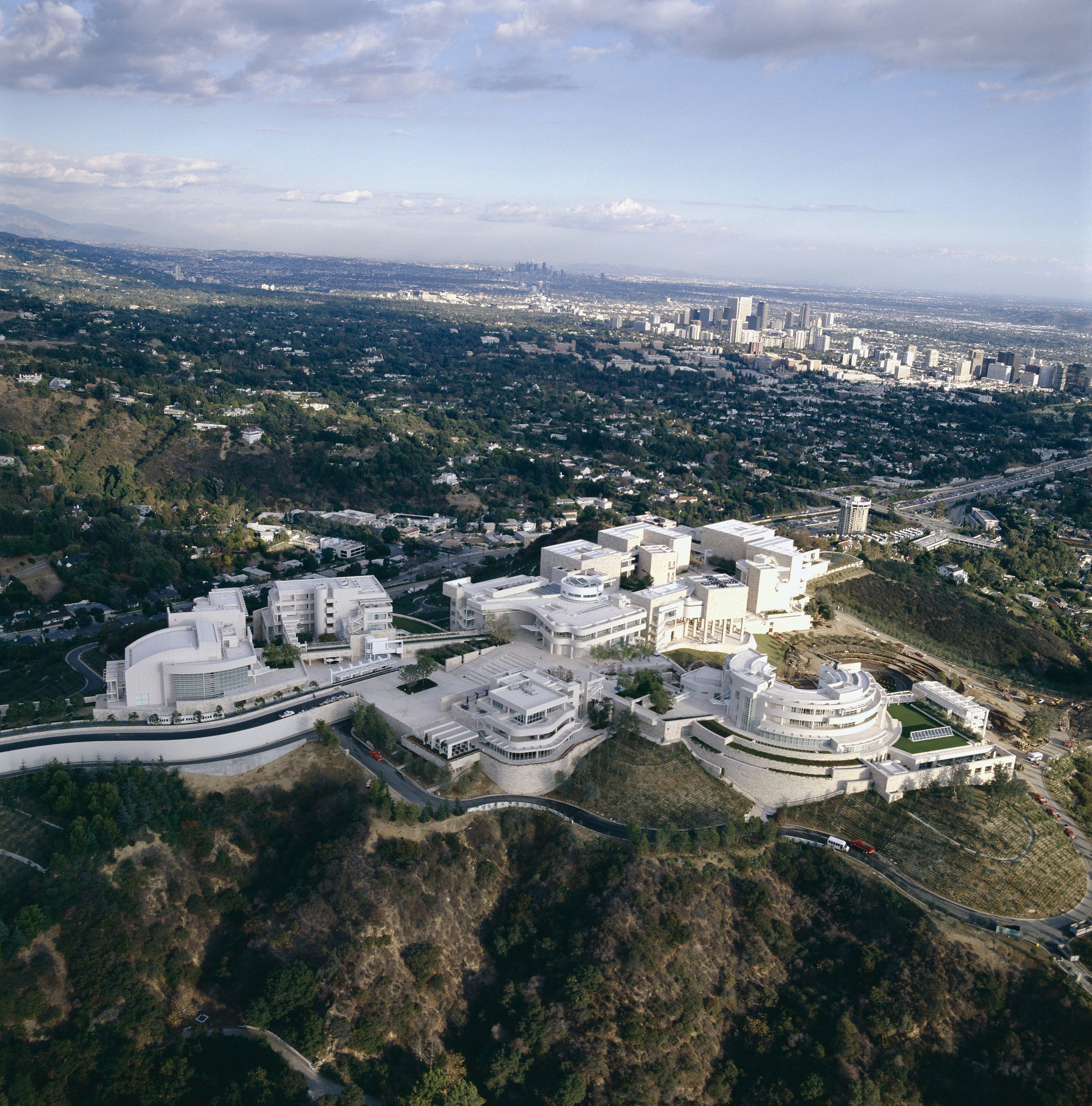
Aerial view of The Getty Center
AMB: Why?
HW: It’s too confining, particularly in a city with no real public transportation. It would have been very limiting for people to get there. I also wanted more space to create something special that would attract people and would create a cultural and contemplative environment for the staff and visitors. I didn't want to build a museum for art aficionadas. I wanted to see us build a museum that had a chance of attracting people who are not natural museumgoers from all socio-economic and cultural backgrounds, and they wouldn't be attracted to a museum in a city block that was only a museum. That's what motivated us to locate The Getty where it is now. Before I left for Washington when I was still dean at UCLA, I was on the board of the L.A. Chamber of Commerce. When I got back to L.A. to create The Getty I called a fellow I knew from my Chamber days who was with Coldwell Banker. He had retired, but I said, "I need a favor. I'd like to know of every parcel of property, 25 acres or more, from downtown L.A. west." He came up with a map that included four parcels. One was the Ambassador Hotel, and I got into discussion of a possible acquisition, but they wanted too much money for it. The second was the Veterans Administration property, which I thought was possible because the Reagan administration was interested in raising money selling properties. The third was what is now Playa Vista. And the fourth one was where we are now. To cut the story short, the fourth one was right. It gave us space to create. But it also, traffic-wise, was accessible to the Valley as well as most of L.A.
“There is nothing more inherently frustrating
than trying to improve the school system.
Harold really seriously took this on in terms of arts education.
Everyone had accepted defeat and wanted to propose something
modest that they thought could actually get accomplished,
but Harold said, 'No, we should actually try to move the dial,'
and he brought in Lani Duke who came up with a ten-year plan that
added, in the end, roughly 500 new arts teachers to the school system.
And even though that was not enough to transform the system, it moved the dial.”
Steven D. Lavine, President, The California Institute of the Arts
AMB: Why are the arts important?
HW: Why do the arts matter? The arts, and the humanities, are what builds a society. The arts are everything, what constitutes beauty, what gets people thinking about beauty, history, expression. To me, it's what makes a technical society a humane society. It's what makes a civil society.
AMB: Do you think the arts have a role in addressing some of the profound challenges we face as a society? Can they help?
HW: The arts would have a more significant role if they were stronger. I am disappointed that the arts are not more valued—I am very concerned about the state of the arts today. They are not respected and nourished. This lack of deeper appreciation and respect translates into a lack of funding for the arts, a scarcity of vital arts education programs in our schools, and much more. As such, the arts are limited in the impact they could and should have. If we look at history, the arts have played an essential role in society and have been deeply valued. So, from my perspective, we have got to ensure the vitality of the arts and the strength of our existing institutions. We need to nurture developing young artists. That's why I've supported arts education for years. Ten years ago, a woman I knew was running for the L.A. Board of Education. She asked me, if she got elected, would I help her get arts in the schools. I said, "Sure." We then embarked on a program that was designed not just to teach art making but to contribute to the development of higher order thinking skills, creativity, and problem solving abilities that carry over into all studies—as essential to the educational process as math, science and languages. The school board unanimously approved the plan. We got standards established, that the state then adopted. We recruited a leader, and embarked on a ten-year program to get arts in the public schools. It was coming along nicely after five or six years. Then, a new superintendent came in and said “I respectfully appreciate the arts, but we haven't got the money." The program was ended. And at The Getty, we developed a program in arts education, as well. It was national, and it really was having an effect. I thought it was probably the least costly program of the programs that we were running, but also the one with the potential to have the most significance and impact. Sadly, that program is not running any longer either. I've been and still keep pushing arts education every chance I get.
AMB: Why does arts education matter? What impact does it have on society?
HW: For expression, for nurturing creativity, for appreciation of beauty, for experiencing collaboration, for becoming potential artists, for becoming arts advocates and art supporters, to grow up.
If kids have a spark of creativity, then it will bring it out. That's enough right there. If you go beyond that, they can become reasonably good artists. If they're not going to become artists, at least they have an appreciation for them, whether it's in their lives, or whether it's an appreciation of something beautiful, or a greater appreciation. For all of us, decisions we make on a day-to-day basis are influenced by what we see and how we react to it. The arts have a role to play in shaping us and how we view the world.
So, arts education, I think helps keep the arts alive. It helps to build appreciation. It adds values that these kids wouldn't otherwise have.
AMB: Do you think the arts provide a medium for greater understanding amongst people?
HW: Yes. I do believe the arts are all-pervasive and play a role in giving back.
AMB: If the arts have a role to play in shaping how we view the world, can and in what capacity do the arts play a role in addressing the challenges we face individually and collectively?
HW: The arts and the humanities shape who we are as human beings. I think ethics and morality are shaped by our sense of the humanities. Experience in the arts helps you learn how to see and cultivates an appreciation of beauty. And the arts do, I think, sensitize us in many ways that we're not even conscious of. The production of the arts creates teamwork, collaboration of all kinds. And works of art can influence people’s views and opinions. Look at the film The Big Short right now. There's a work of art that might make a big impact.
AMB: Do you believe the arts can play a role in encouraging tolerance?
HW: The arts have the power to transcend barriers of language, culture, race, and ethnicity. I think an appreciation for Islamic art at this point, for example, doesn't create tolerance because it isn't appreciated enough. There is still very little understanding of it. I think to the extent it was understood and appreciated it would create a degree of tolerance.
One thing I've always thought is that the arts should pervade the campus.
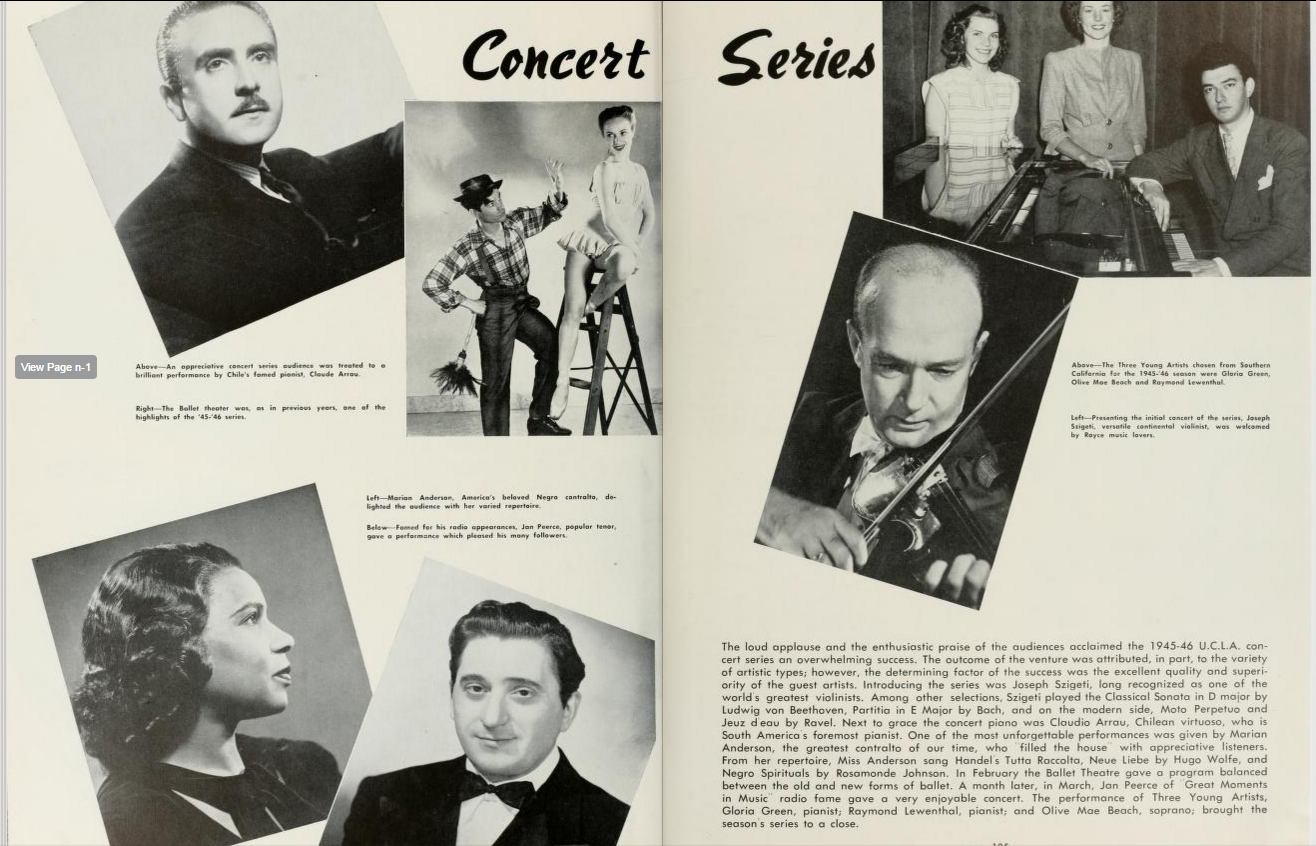
Concert Series spread from 1946 UCLA Yearbook, Williams's senior year
AMB: How do you envision the arts pervading the campus?
HW: I think we need an organized arts program on campus for non-artists.
Everything from concerts on campus that are for students, which they used to have when I was an undergraduate at UCLA to providing opportunities for students who have any kind of inclination in the arts to engage them. I would like to see us try to develop more courses at the school that are specifically designed and available to non-majors. What would happen if we offered a three-unit music course at the medical school? We need to give non-artists who are participating in the arts a greater forum in which to participate. We ought to be nourishing this. I want to see these things patronized by students in the engineering department or the sciences. I think we can do more. It doesn't take that much money either. But this needs to be a priority for the campus and someone needs to have the vision and take leadership. I think a vice chancellor for the arts would go a long way towards moving this dialogue and support for the arts forward on campus. I have been advocating for this for a long time.
AMB: How would you advise a young person getting into the arts today? Someone who wants to be an artist, or an architect, or a dancer, or a musician, a media artist?
HW: That's a hell of a question. It worries me. It worries me because this conversation is missing in the schools. It isn't just a matter of offering a business course to arts students. I'm not sure quite how it ought to be structured, but we need it. The one thing I know is that we don’t want to compromise the quality of the training, the intensity of it. When I was dean at the school of management at UCLA, we eliminated the undergraduate accounting program. I didn't think kids should take accounting as undergraduates. I thought they ought to take courses in the humanities instead.
In a sense, this is almost the reverse, because I think, number one, students in the arts today ought to become great artists, as great as they can be at that stage of their development. Then, we've got to find a way to help them think about how to live in the environment they're going to inhabit. I don't have an answer, but I know we don't prepare them for it. I'm not sure that it's a course. I think we need ongoing dialogue in our institutions.
"With Harold you always feel like you are dealing
with a grownup. He is absolutely my model as I think about
how am I going to make myself useful in the future.
I look at the consistency with which he has acted on that
which he believes and how he continues to act on those
beliefs through to the present day—it’s exemplary.”
Steven D. Lavine, President, California Institute of the Arts
AMB: What are you most proud of?
HW: Well, in my personal life, my family and my kids. In my professional life, the Getty was such a unique opportunity to build something from scratch. That sense of accomplishment is important. And, I am most proud when I walk around there on a weekend and see the demographics of the people who come to The Getty. We wanted it be to a destination for everyone and it has succeeded in being that.
Another way to look at it is, on both the professional and the personal side, I think I’ve lived a life worth living. It could've been better, could've been different, but I feel good about it.
AMB: That's a beautiful thing.
HW: Yes. It is.