Dialogue: BRETT STEELE AND DAVID ROUSSèVE

Earlier this fall, Professor David Roussève, who served as Interim Dean of the School of the Arts and Architecture from 2015–17, sat down to welcome Brett Steele into his new role as dean and discuss his views on the future. Their conversation, in abridged form below, touches on many topics including Los Angeles, public education, the importance of dialogue and experimentation, why slowness and small rooms are important, the role of the artist, the importance of envisioning the future, and much more.
David Roussève: I am thrilled that you're here with us, Brett, bringing with you a different perspective and a different background to move the School of the Arts and Architecture forward.
Brett Steele: Thank you, David. I'm as thrilled to be here. I genuinely am.
David: Let’s start with Los Angeles. Although you were born here in the States, you’ve been in London for quite some time. I don’t know about you, but for me—coming from Texas by way of the east coast—it took quite a while to get a sense of Los Angeles. Do you have any thoughts on LA as your new home, as the home of our school? On the cultural scene here?
Brett: I'm struck most, I suppose right now, by the—it's going to sound odd—but by the shocking similarity between London and Los Angeles.
David: Interesting. How so?
Brett: They are physically opposites—the vertical stacked Georgian city of London that I inhabited for many years versus this horizontal city, unlike any I've ever experienced before. But if you set those physical attributes aside for a minute, the key geographical similarity of course is that they're both port cities on the edges of oceans or seas, which puts them in the realm of global cities connected to the world in ways that very few other cities or settings are connected. The 19th and 20th century model of London, in relation to Europe and the continent, is not dissimilar to how Los Angeles has established a relationship both to the east and west as this century goes forward.
David: That’s absolutely true. I think what we are seeing is that this condition is already charging the creative fields here in new and unexpected ways.
Brett: I guess what excites me about Los Angeles is that it’s a horizontal city and a radically new form for me personally. But it's also strikingly like London in the way it asserts and understands itself in relation to a larger world. It does that in very different ways here than London i.e. LA does it less through international financial markets and more through the entertainment industry and other types of culture, but it exerts that same will to understand and express itself within a larger framework.
David: What is that larger expression, that framework?
Brett: I don't know yet. What attracts me and excites me is the incredibly diverse creative landscape that one finds here—the different fields and disciplines and the varied experiences one can have. There just aren't enough cities with this kind of complexity and diversity. It’s very important to me to learn from place, and this sense of place, understand it and its implications for the rest of the world. Los Angeles is an incredibly important model for cities in 21st century.
David: That's really interesting, and very much related to that—whether in the UK or the US—it makes me think of the university itself and how it is situated within a larger, at this point, I would say challenging cultural and political framework. At least in the US, it seems we have entered a time of tremendous complexity around how we define knowledge, understand whose knowledge we are defining, and what type of knowledge is valued. The discourse around what we call ‘alternative facts,’ for example, is in and of itself staggering.
Brett: Absolutely.
David: It surely is a complex time not only to be within academia, but also to situate oneself and one’s research within a larger social, cultural, political framework. I wonder if you've thought about that complexity and a school’s, or an artist’s or architect’s responsibility within that larger framework?
Brett: That’s a really important question, David. You’re absolutely spot on in terms of our needing to register the fact that it is a moment in which that thing we refer to as a university or a school can be viewed in very different ways. Having grown up one the west coast, around a public university, what I've found interesting is the recent shift in dynamics—certainly from my generation. My conclusion at this point, in this reality, is that we have an obligation to explain ourselves and not simply be ourselves.
David: In a way, that's not so different than being an artist.
Brett: Yes. And since an institution operates at a completely different scale than our individual careers—I'm so used to doing this kind of articulation at the individual level—it is a project to approach with confidence at the scale of a school or a university. Some people might say that this is something we shouldn’t have to do, or don't need to do as an institution. On the other hand, if we believe in the value of schools like this within a larger setting—within society—then being able to explain who we are, and why we are, and how we are should simply be a part of the project, part of our activity.
We as artists do it routinely within our own careers. We justify and explain what it is we do and often why we do it to varying degrees to our audiences. Well, as far as I am concerned, this is simply part of what a school or university needs to be doing today. Again, this is simply attached to our belief that they matter in the world. I don't think we're going to get terribly far by just asserting that fact. It’s our responsibility to provide a more complicated and nuanced narrative about our role in the world—to help people understand the tremendous value that places of learning have to offer to the fabric of society.
David: Having lived for so many years in London, I wonder what the transition back to the States has been like?
Brett: Me too. I think the United States is experiencing an interesting moment in its own young history—a moment that's going to require an awful lot of optimism to get through. I've never, in my adult life, lived in a moment in which I can't turn on the evening news, for example. It's just so hard to listen to. I find it a bit like the way AM radio used to be. It was a strange other thing. I'm going through the moment of adjusting myself to the reality that the way America is representing itself—and I would argue that it is about representation more than it is about how America really is—is different than what I'm used to.
David: Interesting. Say more about this representation.
Brett: To a shocking degree, America represents itself right now as having a view of the world that seems out of alignment with much of that world. It's staggering to see how it portrays itself from afar.
David: How has this affected your views?

Brett: It hasn’t made me lose faith in what this country really is. Again, we're living in a moment in which representation is playing out in so many new, complex, and unexpected ways that sometimes they're tipping far beyond what one would expect or imagine is even possible, but the future is something to construct and not simply surrender ourselves to.
David: I could not agree more, but how do we do that?
Brett: To a huge degree, it’s tied up with all kinds of complex questions about representation. Again, because these kinds of questions sit so centrally within our fields, I'm excited by this moment, by the opportunity to take on this critically important project of moving a school forward, believing that we can make the world better, and working with others to see this country through this period.
We all have strengths and weaknesses. One of my strengths is being optimistic about the world at a time in which being optimistic is harder and harder to do, or really even imagine quite frankly. Having a faith or a confidence that we can, collectively, move a school and a university forward—in terms of the role that the institution can play in a larger societal landscape—is something that's incredibly important right now, an incredibly important project to believe in. Having the ability to make decisions that we know will enhance our ability to pursue that project—even if they're difficult—is a really big thing. I couldn't enjoy it more, and I couldn't look forward to it more here. You all, by the way, are the ones that have paved the way so brilliantly for the school to do this.
David: Thank you, it does feel like the dialogue between the school and the campus, and between the school and the broader community has increased. These dialogues and questions are definitely happening within departments and I am thrilled that they have begun to happen across the boundaries of the school as well. It’s been exciting. People really seem to be finding fertile ground for the school’s future in the dialogue and engagement. I think they are also finding food for thought for their own research, which is amazing.
Brett: I love this idea of dialogue. The arts are extraordinary when you look at them in relationship to other forms of knowledge in that knowledge in the arts is so often produced through dialogue—dialogue largely between individuals, individual creative minds, and their audiences. This kind of vibrant dialogue presents a model for how a school can think of itself. Our job as a school is to produce and to foster great talent within a faculty and student body, but like those individuals, the school also sits within a larger world, and it is critical that the school understands itself in relation to and in dialogue with that larger world.
David: Absolutely. I could not agree more. Thinking back over the past two years, a pivotal moment for me happened around a moment of dialogue. We hosted our first “Lunch for 10 strangers,” an informal get together for faculty that, by design, had no agenda other than bringing colleagues together to chat over lunch.
Brett: Terrific.
David: We didn't talk about school at all. Everyone went around the table talking about their research. It was really incredible. Barbara Kruger was there. Peter Sellars…Dana Cuff…This great group of faculty that happened to be the first ten who responded to our invitation.
Brett: Amazing.
David: Just amazing. That was when—through no agenda, in a small conference room, talking about whatever—the school came into complete focus and made sense to me. I think everyone in the room had this experience. You could see the light bulbs going off in each person’s mind. Just going around the room and hearing about the different projects everyone was working on, the core questions that were being asked…you recognize a commonality with someone that you might not have realized was there. You recognize the depth of the questions being probed even if you don’t know anything about your colleague’s field. These are the questions that they are asking and here's how they are answering them. We may be answering them in different ways and the questions may not be precisely the same, but they are absolutely ones into which we can all sink our teeth. There’s a community that gets built through that questioning.
Brett: Well, that's a nice twist. The idea of reframing ourselves around questions and not presuming or needing to know the answers right away, let's say. It is a very important idea you bring up, David. If you think about the role of a school—our role as teachers—it is imperative, really as a first principle, that we instill in our students, for their lives to come, a faith and confidence in asking questions.
David: Yeah, that's what it's all about.
Brett: It's hard to do.
David: Well, that may be so, but one of the things that I find so interesting is that you bring with you such an incredible track record of creating these dialogues and cultivating a culture of critical inquiry in really interesting ways, and in particularly surprising interdisciplinary ways at your former institution, the Architectural Association. I'm so excited that you bring that history of fostering dialogue with you. I wonder if you could talk about how you did that at the Architectural Association and share any thoughts you have on how you might apply that here?
Brett: One of the ways to think about the world today, particularly in higher education, is that the arrival of all kinds of new audience making technologies, platforms, venues, necessitates that we rethink how we understand ourselves in relation to those audiences. These venues and platforms are emerging in ways that nobody could have predicted a few years ago. I believe that it is incumbent upon us to re-evaluate all of the traditional ways that schools have reached out to the people around them whether in print media and publications, or through the holding of special events, and so on. There are just so many different things happening in so many different forums today. The job of a school is to experiment with these new forms, these new tools.
David: Absolutely, and this is what also makes having a school comprised of so many different disciplines exploring these new platforms and tools in different ways so interesting and exciting.
Brett: For sure. And just having the confidence to embrace and experiment with them is a way in which schools can advance, and by the way, learn from their students and not the other way around. Because we know that the students are on the front lines doing this from the ground up. They're confronted with a million different ways to try and connect themselves to everybody around them and their lives. Rather than a school thinking of itself as an institution whose job is to make that happen for students, it's almost, for me, the other way around: students are teaching us. We need to think completely differently about how we operate in these larger landscapes of ideas.
David: Can you talk about how this played out at the Architectural Association during your time?
Brett: At the AA, all we did was create platform after platform by which to experiment with this idea of how we situate ourselves within the world. And this was not just about disseminating and broadcasting ideas out into the world. It was really the other way around. It allowed us a means to receive and develop ideas that we might not have otherwise seen. It's just a relentless, never ending circus of experimentation to which one, or an institution, has to commit. It's one of the reasons why I think the modern history of experimental art and architecture schools is so interesting. In the late nineteenth, early twentieth century, new technologies, particularly communication technologies, were being industrialized in North America and Europe. You saw the proliferation of a kind of avant-garde experimental form of practice as the basis for organizing schools. This happened at just that moment, and it happened in very few settings, but it happened in those places where people wanted to experiment with the idea of what the form of a school is, and how it situates itself in a larger social, cultural setting.
That’s what we're seeing again today, in a very interesting way, as the world goes through a completely different wave of industrialization—a wave that is less about advances in building materials and transportation and infrastructure, and more about things like communication. It is a super interesting moment for schools.
David: What you are talking about is the idea of building platforms—not so much if you build it they will come, but if you offer an opportunity to build it, they'll come build it.
Brett: Yeah, absolutely.
David: And these platforms, in a great and very important way in this day and age, are really platforms for conversation. Is this something that you see carrying forward here at UCLA?
Brett: Definitely. And, as I said earlier, I am thrilled to continue to build on what you guys have already started so beautifully. To take this line of thinking further, what’s most important is figuring out how to capture and make useful the things that you learn through the building of these different platforms and ideas. It's very much an experimental form of practice, and like any creative practitioner or mind, the project isn't just about going out and doing it, it's making sure you ask the critical questions—what do you learn from the experience and that feedback. I would suggest that it's a relentlessly iterative project.
David: For sure. Clarifying our vision as a school these past two years—recommitting ourselves as a place where experimental platforms can exist and thrive, calling ourselves a progressive think tank—has been really exciting. And, it definitely has been a relentlessly iterative process, as all creative processes are. And amidst this, being able to see the larger picture and the importance—and sometimes the challenges—of also then situating ourselves within a broader institutional framework that is perhaps not always as progressive as we are…that, in itself, is an interesting dialogue.
Brett: Well, friction can be a great inspiration. It is part of the dialogue.
I think the idea of knowledge being produced in dialogue form is a really important conversation to be having in the early 21st century, let's say in a time that's dominated by monologues and PowerPoints and one dimensional, one directional thinking. As an architect, I'm probably incredibly old-fashioned in the sense that by dialogue, and I really mean this kind of a dialogue that you and I are having right now, is the one I understand. That's where ideas emerge. You say something that makes me think about it an hour later, and then that might lead down a route that I wouldn't have otherwise gone this morning if we didn't have this exchange.
David: I completely agree.
Brett: Right? And I think putting people in rooms together and making the rooms as small as possible is an incredibly important educational strategy today. I think the world is full of too many big rooms. Big rooms in which we all get lost and become passive audience members and find ourselves just listening to a monologue and drifting off like we're at the cinema or something. And, one of the great things that the arts bring to the world is a belief that dialogue is a way to foster ideas and develop them in ways that other fields don't tend to emphasize. It's an asset of a school, and one of the interesting things about this school is that that dialogue occurs not just between an individual faculty member and student in his or her field, but of course, across the different disciplines, maybe even to the point that the hard lines around disciplines soften or disappear at times, and there can be a kind of open conversation just between people. That's a terrific feature of this school, and something for us to be thinking about is how to foster and develop this even more.
David: I am thrilled to hear you say this. I really am, as this has been such an important aspect for me in my time as dean.
I'm often asked, "As an artist, where do you get your inspiration?" I'm excited by how you’re describing being an academic leader as a creative process, that it’s a creative process in and of itself. Whether it's your research or academic leadership, I wonder where you get your inspiration?
Brett: It would be a total cliché to say it's everybody I work with, but this is the case. My world is simply the people I work with within the school. They are the source of ideas and inspiration. I can't imagination where else you'd want to look, right? It sounds like a total cliché, doesn't it?
David: No. It's great.
Brett: It's totally true. It really is. My background as an architect is useful. Because, after all, this is nothing but a design project. Leading a school is designing a school, and any creative intelligent form of design is done in an intensely collaborative way with everyone around you whether you call that person a client, a partner, a team member, whatever they are...that's where knowledge should be produced. In the collaboration.
That's my version of it anyhow. It's a fairly strong version of social epistemology the idea that knowledge is only that thing which people treat as knowledge. All those other 20th century tests fell away quite a while ago. There is no verification. It's whatever we treat as knowledge is knowledge in our fields. That's the great thing about it and the game is really about what we choose to do and how we go about doing it. Working with one another.
David: Listening to you speak about the process and the things that happened in London and the things that might happen here, it feels like you have a genuinely collaborative nature, which I find is such a large part of leadership at the university. I’m very much interested in ideas and how you facilitate your own, but also other people's ideas.
Brett: One of the exciting things for me about coming to UCLA is the landscape of creative minds and thinkers all around us, not just within the school, but across the university. Brilliant, interesting people. Our job should be finding ways to sit down with them and talk about possibilities and see what ideas emerge. Like your impromptu meeting—your lunch—in the conference room.
My discipline, architecture, is insanely collaborative to the point that sometimes it's hard to see what else architects do than talk to one another about what should be…thinking of the future. Architecture is a peculiar field in that it's wedded, almost obsessively, with the idea of the future.
David: This is why our architecture department belongs with our particular dance department belongs with our design media arts department and our art department…because we're all asking those same questions. What I find inspiring is that it leads you to a series of philosophical questions that I selfishly get to consider while making my work because the dance department is, indeed, asking, "What's the future? How do you address the concerns of the future?"
Brett: Yes. If everybody was happy with cities as they are, with buildings as they are, architects would have nothing to do. We would just live in the world we've inherited or been born into. Our job is to imagine a future that will, in some way, never arrive in the form that we draw pictures of or write ideas about, but that nonetheless, architects can help the world realize. I think it's a mistake for most architects to think they can ever actually predict that future. I could spend the rest of this conversation talking about the bizarre versions of the future that architects never delivered. The job isn't one of accurately predicting where we will be in five or 10, or 15 years’ time, but one of working with the world to arrive at that moment and to have faith in that future project.
We live in times in which the future has taken a pretty bad rap. You could say even architects have largely surrendered the belief—the conviction—that their role is helping envision where the world should be going just because that world looks like such a scary place. It's a very slow-moving career. If one begins and finishes a project within a five-year time frame, for example, that's a pretty fast project. Most of us will draw proposals, draw ideas and every few dozen might actually get to the point where we get to stand within that room or that space that we’ve envisioned and understand it. What I've always told my students is to see that slow moving emergence of a future world as an asset and as a useful trait within the field that distinguishes it from many other fields in which projects begin and end much faster.
David: That's deeply inspiring, personally and professionally, to me. I wonder how your own research and experience might inform how you see the future of our institution?
Brett: One might say that the lesson of the end of the 20th century was that the scaling up of things, the making bigger of things, is a terrible model for the future. There are always limits and different ways to evaluate something as simple as the size of a school, which, in my mind, isn't a question that is answered simply by measuring how big or small something is. It's about setting the criteria by which you even measure something like size. Is it counting bodies? Is it the kinds of and the amount of interaction between ourselves and those around us? Is it all the air miles that people from within our community are traveling bringing ideas in and out of the school? There are a million different ways one can try and define the question of size.
One of the interesting features of this school is our relationship with the university. It’s a big university and for me that is a new and interesting dimension to life. I believe deeply in the role of a public research university and what it can offer the world as an important part of the larger community, whether that’s the LA basin, or the State of California, or frankly the entire west coast in relation to other geographies.
David: I'm wondering about the transition you have made from a private institution to a public one and what might be exciting or not so thrilling about that transition?
Brett: I'm excited by it very much, in part because I think a public institution is becoming increasingly endangered in a world in which private interests are given greater and greater—if not reward—recognition in defining the world. At a personal level, I feel like I owe a great deal to having grown up alongside a public campus, a public university, in the small college town where I was raised, which explains how it's possible I could have traveled half a world away.
David: This was in Oregon?
Brett: Yes. Eugene by way of Idaho. I simply can't imagine ever having left without that exposure. A publicly funded university is an incredibly difficult, complex institution to manage and operate today at the level of success that a place like UCLA has been fortunate to enjoy. Promoting that model, explaining that model, fighting for the value inherent in the public educational setting is an incredibly important thing to do. It’s a valuable asset to society.
David: What is the artist's role in society?
Brett: More than anything, an artist’s capacity for vision is something that we take for granted within creative fields. Artists have the ability to envision a world as something other than simply what we see sitting here in a room. That's what artists do. I think that's what they do best. They can envision things that, in our busy everyday lives, we sometimes miss or overlook in our experiences. Having faith that envisioning the future matters is a struggle today, but I do believe that it is key to our fields.
David: I wonder—maybe even with that in mind, or with so much of this dialogue in mind—10 years from now or even five years from now, what would you consider a success in your time here…what would be fulfilling to have accomplished or pushed forward?
Brett: That's a great question, David. That we've found some way to articulate beyond how we are doing it now? The ways in which a school like this can situate itself productively in a larger audience or community of interested, creative, intelligent, committed individuals. I think that's one of the hardest challenges for schools today. Not just for us as individuals. We ask the same questions of ourselves as artists, but how can a school at the scale of an institution that, at any moment might be made up of more than a thousand different people, different voices, articulate and express itself. It's a difficult project, right? It's much easier at the individual level for us to do this, but how does a school do this? If we've made some progress on that over the course of the next decade, we'd be happy.
WATCH: Dean Brett Steele on the role of cities, artists, and education in the 21st century.
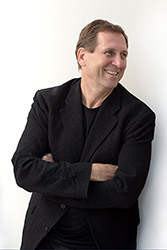
Read more about Brett Steele. (Photo Credit: Valerie Green)
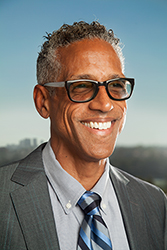
Read more about David Roussève. (Photo Credit: Christopher O'Leary)
JOIN THE CONVERSATION
Stay engaged. Follow us on Facebook, Twitter and Instagram. Use #UCLAarts to stay connected.
This story is a part of the December 2017 UCLA Arts Newsletter. Subscribe to our mailing list to receive this quarterly newsletter directly to your inbox!