Designing for Performance
A Q&A with Professor Jennifer Steinkamp and Associate Adjunct Professor Georgina Huljich
What changes when a creative work is presented in a new context? Can animation and digital modeling become choreography? How can a physical container shape our understanding of a seminal text? How does the experience of interdisciplinary collaboration affect what artists—and audiences—get to carry with them after a performance?
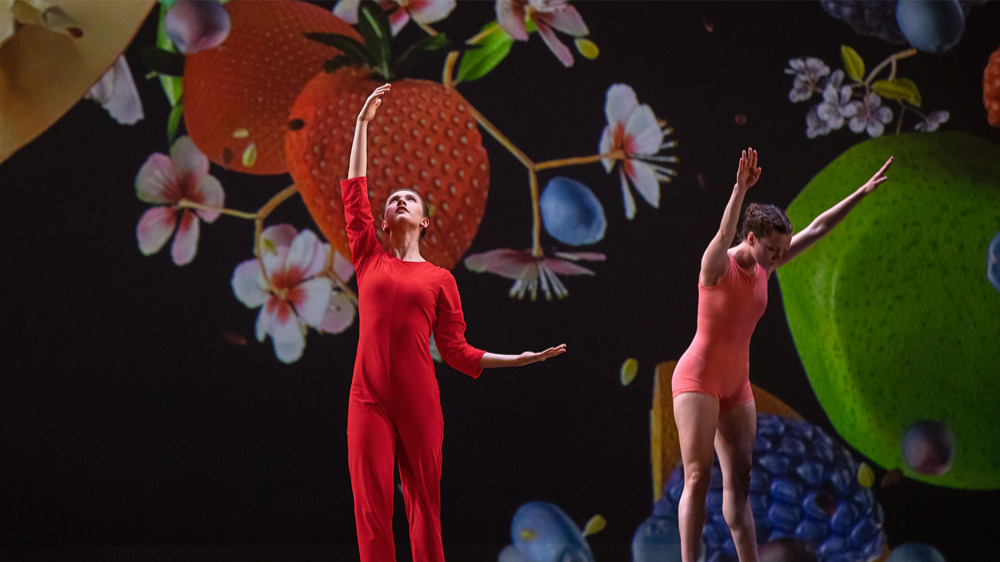
This month, two esteemed UCLA School of the Arts and Architecture faculty members—an architect and a media artist—each collaborated with performers and theater technicians to design sets for two productions at UCLA’s Center for the Art of Performance: Architecture and Urban Design Assistant Adjunct Professor Georgina Huljich designed the set for Lars Jan’s production of The White Album by Joan Didion, and Design Media Arts Professor Jennifer Steinkamp presented her work as the scenography for CAP UCLA’s presentation of Night of 100 Solos honoring Merce Cunningham’s centennial.
Huljich and Steinkamp shared with UCLA Arts their respective experiences stepping outside their typical mode of production and working across disciplines on a collaborative artistic work.
How did this particular collaboration begin? Can you describe the vision?
GEORGINA HULJICH: This collaboration began through Kristy Edmunds’ vision, leadership, and commitment to UCLA’s Center for the Arts of Performance and her ambition to generate and support different kinds of artistic collaborations. As a member of the executive producer council at CAP UCLA, I am devoted to the excellence of the center by bringing the architectural expertise, vision, and resources of my practice. In this case, the collaboration was between the artistic vision of Lars Jan’s production of the White Album project with the architectural inventiveness of our studio, PATTERNS, which I lead with my partner Marcelo Spina.
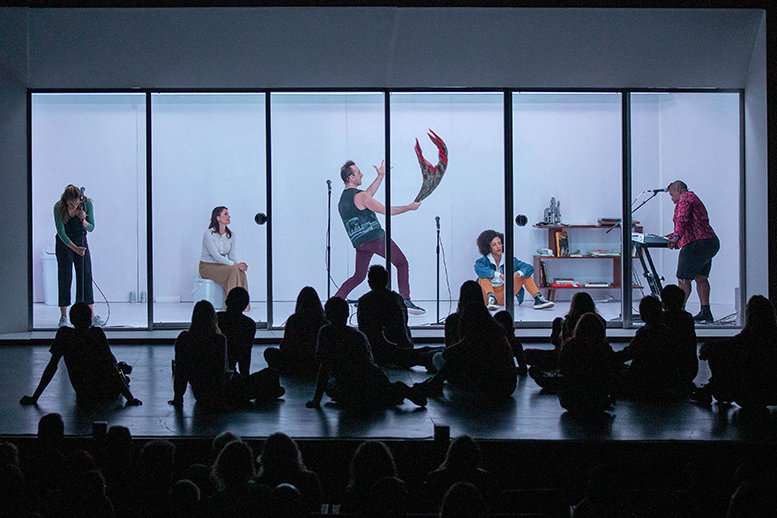
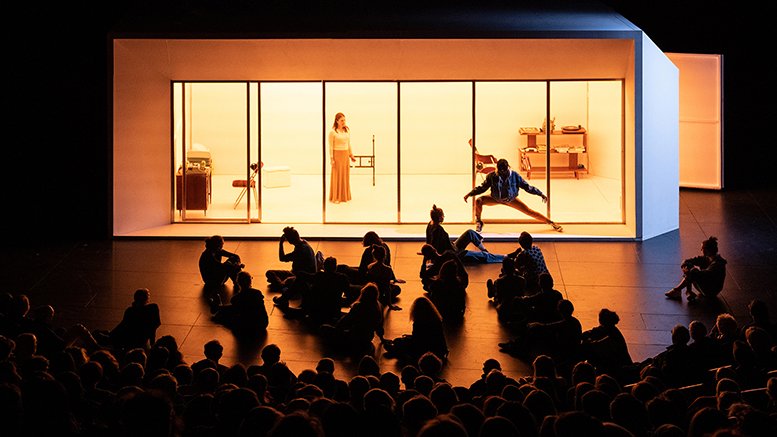
The vision of the project was to conceive an architectural framework that would embrace Lar’s fascination with the essay, specifically with Joan Didion’s quote: “We tell ourselves stories in order to live.”
The design of the set had to embrace that notion. The space needed enough of a physical presence to work as a container for the artists on stage and allow for the public audience to be subtly driven through perspectives and angles of vision. At the same time, it had to be neutral and mute to allow for the artistic expression of the performers.
Night of 100 Solos, performed at Royce Hall.
JENNIFER STEINKAMP: Kristy Edmunds saw a relationship between my art and Merce Cunningham’s choreography and invited me collaborate on the performance. It was Kristy’s genius.
Describe your creative process when designing for performance. How is it different than your typical process?
GH: Designing for performance, different than a typical architectural process for a building, is based on conceiving an architecture that is temporal, an architecture that relies utterly on the subjectivity of the observer and the observed. It is seen and perceived as an object that must offer an intimate relationship with the performers through all senses.
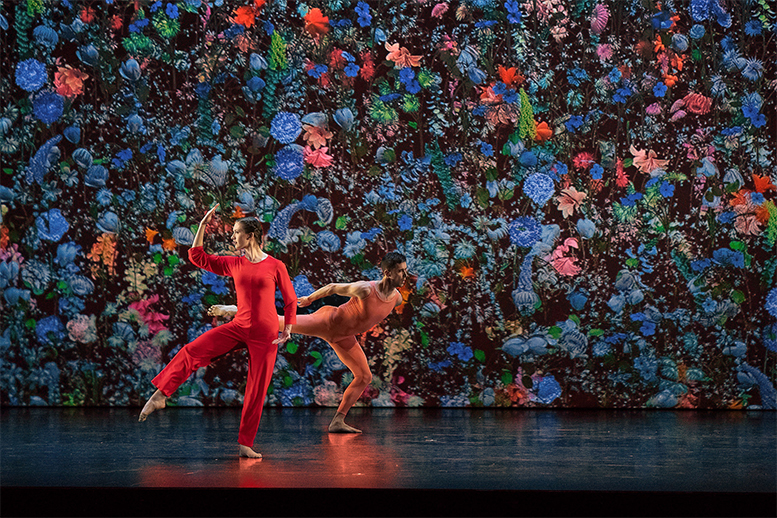
JS: We were actually kept separated in keeping with Merce’s “common time” approach in which choreography, visual art, and sound and are developed independently of each other, coming together during the “common time” of a performance.
Two days before the show we were brought together—musicians, dancers, the choreographers, the producer, and crew—and we ran through the show many times and tweaked it. I prepared a lot of material before and edited it down.
In some ways, this is very similar to my typical approach to showing my work. I create an animated physics simulation, render it, and decide if it works. A lot of chance and random surprises end up becoming the final art. This is true for the performance as well.
The White Album by Joan Didion, performed at the Freud Playhouse.
Does making and viewing your work in this context make you think about it differently?
GH: Most definitely. As architects, sometimes we look at our own work in isolation, and just within the parameters and constraints of an arduous process of design as well as a final and finite object.
Designing for performance suggests a different relationship between the different constituencies.
JS: I like to place my work in different contexts because I get a chance to learn something new. This is what an installation artist does. I love the new realizations. This context certainly changed everything from the architecture being a stage rather than a museum or other public space, to having an audience, to relationships with dancers. One of the dancers told me that dancers might learn empathy more readily than other professions because of the way they relate to each other. I love that idea.
What is the most challenging part about creating work for performance?
GH: In this case, both it's temporality and complexity—the fact that it needed to travel and be assembled and disassembled many times.
JS: The lighting was the number one most difficult aspect. Perhaps under different circumstance with more time to work together, it would have been easier, but I do value the way that the freshness of the collaboration is preserved with Cunningham’s technique.
Cooperation with other opinions was also challenging. I gave up quite a few ideas. It makes me wonder, with more experience would I still have given in?
How does the work presented in this context relate to the rest of your body of work?
GH: The presentation of The White Album made us look far more closely to the aspect of ‘use' in architecture, and the consequences that this has for both functionality and aesthetics. While these are both essential issues of our work, we had the chance to observe them literally “perform” over time having a huge impact on not only the story, but the narrative itself.
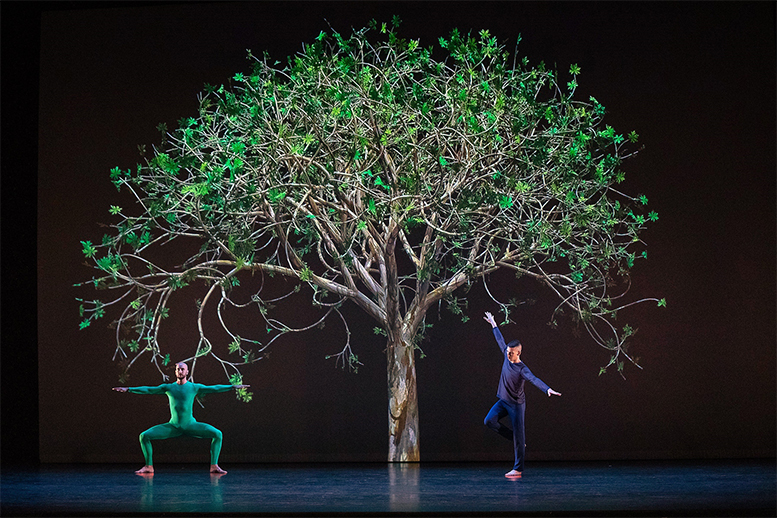
JS: Much of my work that was included in the show already existed and had been shown in other contexts. Many of the pieces were retooled scaled a bit larger than usual. My work has always been about your bodily relation to the architecture and the projection, but in this case you are watching someone else’s body rather than experiencing your own.
What is most rewarding about designing for performance?
GH: There is a certain ephemerality, which is liberating. Working with artists, especially theater artists who know their way around lighting and all sorts of visual and sensorial effects we couldn’t even dream of producing in architecture, afforded us a degree of creativity, which is uplifting. This project is also about the integration between form and narrative, a relationship that we think a lot in our work, and something that theater and performance brings to the foreground in tangible ways.
JS: The gratitude of the audience, who all experienced the work together at the same time, might be the largest difference and the most rewarding aspect of this experience.
Stay engaged. Use #UCLAarts to stay connected.


