Design media arts professor creates neuroscience-based installation
Victoria Vesna, Ph.D., is an Artist and Professor at the UCLA Department of Design Media Arts and Director of the Art|Sci center at the School of the Arts and California Nanosystems Institute (CNSI). Trained as a painter, her curious mind took her on an exploratory path that resulted in work can be defined as experimental creative research residing between disciplines and technologies. With her installations she investigates how communication technologies affect collective behavior and perceptions of identity shift in relation to scientific innovation. Her work involves long-term collaborations with composers, nano-scientists, neuroscientists, evolutionary biologists and she brings this experience to students.
"It may not be possible to read other people’s minds, but viewers can now see what two people are feeling through the art installation “BrainStorming: Empathy.”
Victoria Vesna, a design media arts professor and Mark Cohen, a neuroscience professor in residence created “BrainStorming: Empathy,” a piece of performance and experiential art, after four years of work. Vesna and Cohen said the work serves as a means to blend the arts with science in its efforts to display nonverbal communication and empathy through neuroscience technology.
“(The project) is a discussion and it’s bouncing ideas off of each other,” Vesna said. “It becomes this melding of different worlds.”
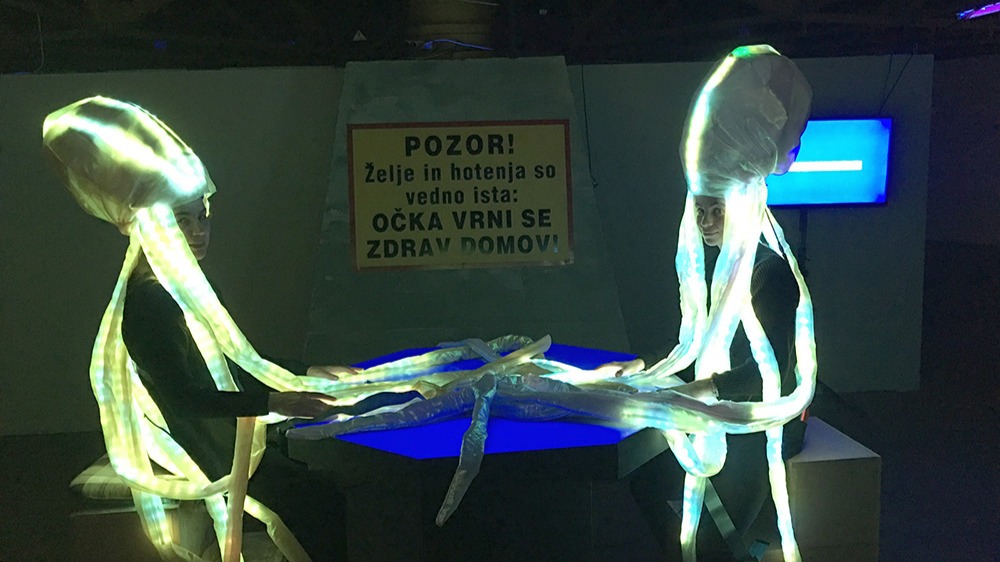
In “BrainStorming: Empathy,” two participants wear headpieces that resemble octopuses and can record their brainwaves through an electroencephalogram, the tracking and recording of electrical activity within the brain. The brain waves are then translated into colors and a cappella sounds that correlate with certain mental processes, such as feelings and emotions. Vesna and Cohen will showcase the performance art piece at the LA Art Show in the Dialogs booth from Wednesday to Sunday. It has previously been shown at the UCLA Meyer and Renee Luskin Conference Center in 2016, as well as an art festival in Slovenia and an exhibition centered on synesthesia.
“BrainStorming” came into its present form by exploring nonverbal communication across species with the scientific research that guided the project. Participants wear EEG-equipped octopus headpieces and wordlessly communicate through LEDs that reflect their brain waves, fostering empathy in a live performance, Vesna said. The two participants sit across from each other at a table and are instructed to empathize and feel their partner’s emotions."— Cameron Vernali, Jan. 9, 2018

This post is an excerpt, read the full article at the Daily Bruin website.