Creativity in nature at Sage Hill
Design media arts students use peaceful corner of campus as inspiration
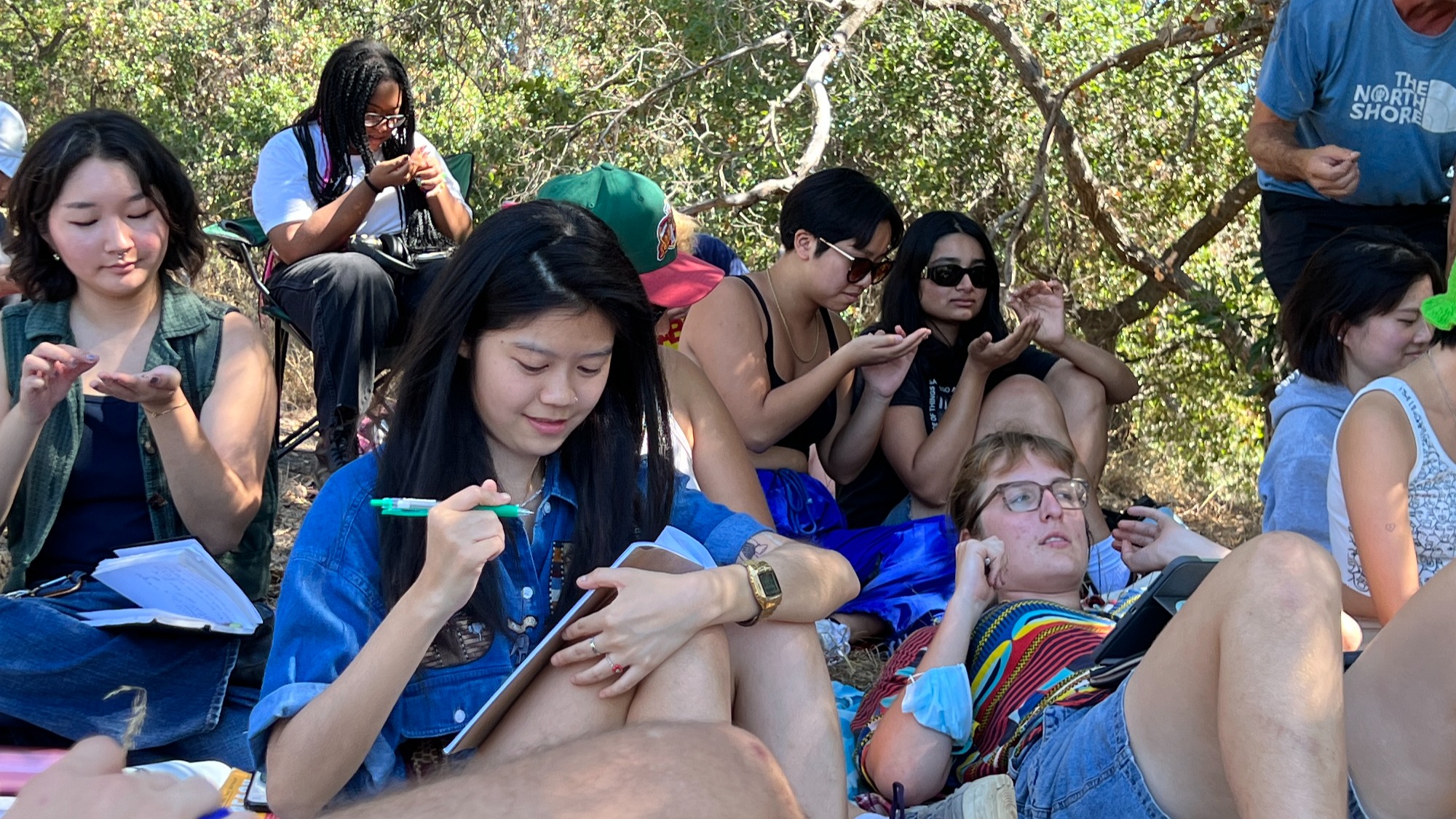
Sage Hill is a uniquely peaceful slice of nature at UCLA, where students can enjoy a quiet moment and reconnect with wilderness in an expanse of green space that hosts a diverse array of plant and animal life.
Located in the northwest corner of campus between Bellagio Drive and Veteran Avenue, the 3.4 acres of native California habitat serves as an outdoor learning space for students in all fields.
“Some of the students in my class call it ‘Narnia.’ The students go there to exit normal, UCLA-regulated life and meet in a place that's part of the natural world where they can get out of the structures of the university,” said Erin Cooney, a lecturer in the Department of Design Media Arts teaching a class this fall focusing on Sage Hill, native plants, and graphic design.
Cooney is also an affiliated faculty to UCLA’s Counterforce Lab, a research center that uses art and design to engage with the climate crisis and environmental injustices.
Cooney first learned about Sage Hill from J. Cully Nordby, the associate director of the UCLA Institute of the Environment and Sustainability, which oversees Sage Hill. Cooney became interested in its role as a site for teaching and research in biodiversity and conservation.
“It is now the largest undeveloped piece of land on the West side that still has a native plant presence,” Cooney said. Native grasses, including giant wild rye and purple needlegrass, grow there alongside coastal sage scrub. “Native plants are important because they are the things that support the insects and wildlife of our bioregion.”

Sage Hill, courtesy of the UCLA Institute of the Environment and Sustainability.
The students are working in small groups to develop projects for an exhibition at the end of the quarter that will be presented at Sage Hill and at the Broad Art Center.
“Students are working with staff at Sage Hill and hearing what their vision is for the space and how they might be able to facilitate having some of those things come to fruition, and how to facilitate bringing more students and more faculty and more awareness to the space, as well as how to treat the space in a really respectful manner,” said Bobby Joe Smith III, a graduate student in design media arts and the class’s teaching assistant.
Class discussions were based on readings that included a history of the Indigenous presence and Western settlement of Southern California, essays on environmental racism, and appreciations of bats, lichens, fungi, and other natural elements.
Early in the quarter, students toured the site with Nordby and Thomas Gillespie, a professor of geography and co-chair of the environmental science and engineering program. Gillespie pointed out native plants traditionally used for their healing properties, such as the fragrant sage plant. That inspired one group to create a Sage Hill candle made from natural locally-sourced materials. The candle would be accompanied by packaging and a brochure that the students will design.
“The students are currently talking to [Gillespie] right now to see if they can harvest [the sage] in a responsible and ethical manner,” Cooney said. “And the thing we are using as our guide for that is Robin Wall Kimmerer's book, “Braiding Sweetgrass,” and the “honorable harvest,” where we ask for permission from the ecosystem, from the plants themselves: ‘are there enough plants to go around? And, would it be ethical and reasonable to harvest this place?’”
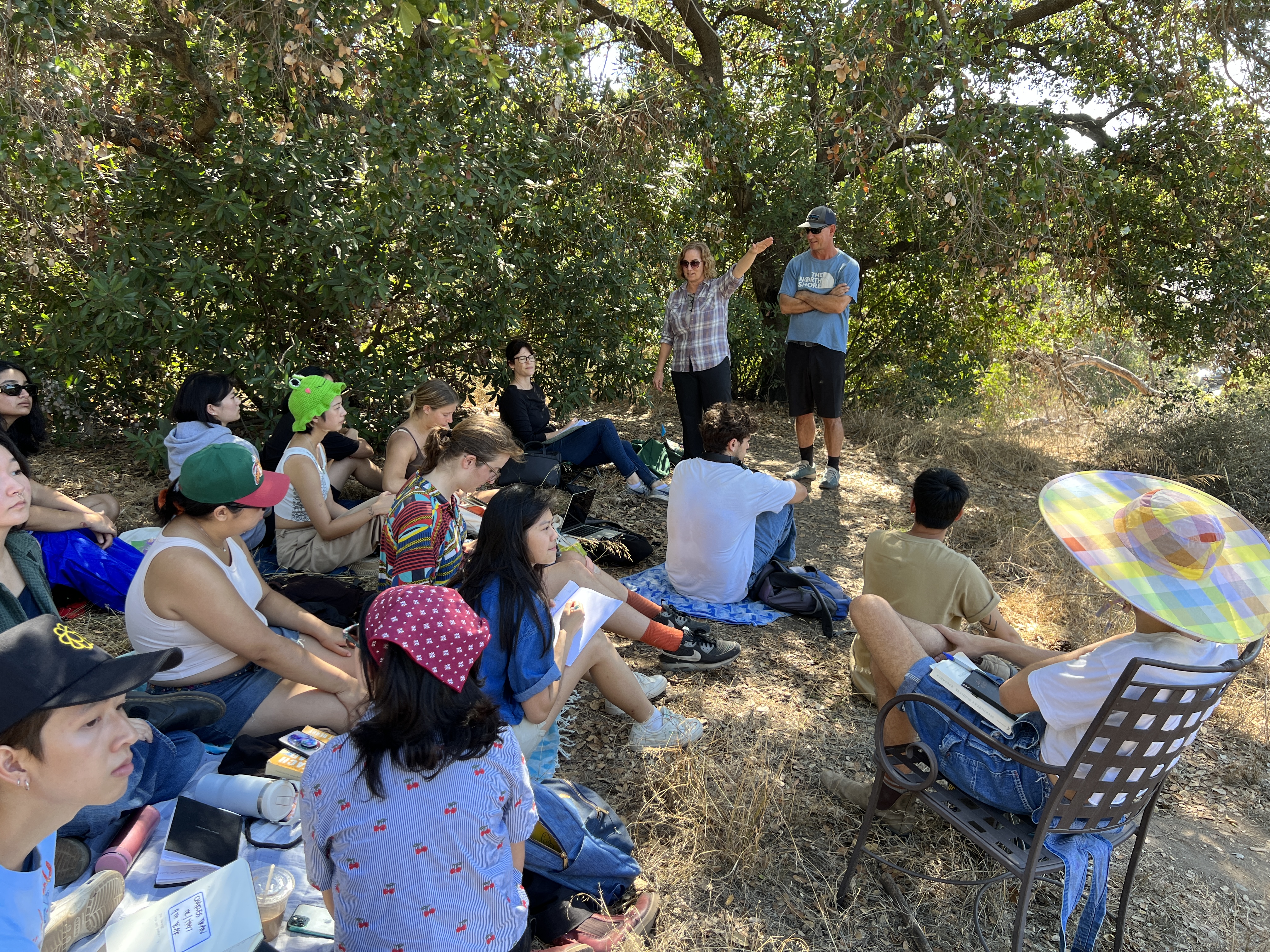
UCLA’s Cully Nordby and Thomas Gillespie introduce the design students to the biodiversity of Sage Hill. Photo courtesy of Bobby Joe Smith III.
Nordby, Gillespie, and others are working with Tongva community members to honor and continue the Indigenous presence on the land, an aspect of Sage Hill’s history that the students are encouraged to explore in their projects.
Ruth Lee, a fourth-year student majoring in design media arts and communications, says that learning to see the environment from an Indigenous perspective is something she will take with her from this class.
“I was just so moved and touched by the really inclusive and very non-linear ways in which the Tongva people saw the connection between themselves and spirituality and animals and plants,” Lee said. Her group is developing a web-based interactive map of Sage Hill for visitors to orient themselves.
The student projects are taking a variety of forms. One student with an interest in graphic design is creating typefaces for Sage Hill, while another is creating a visual logo and branding. Other students are creating a sound installation, a comic book, and a postcard series of botanical illustrations.
Henry Barbera, a fourth-year design media arts student, is making a 3D animated film that combines poetry with audio-reactive visuals that respond to sounds of traffic and helicopters at Sage Hill.
“The project is about the noise pollution that's present in the space and the way that the order of things is disturbed by human interaction,” Barbera said. “Birds will call to another in different tones. Certain insects will be unable to locate things. Mating rituals are disturbed. There's a whole array of issues that come with the way that we've polluted this space with noise.”
The design studio is deeply rooted in the past, present, and future of a physical place and the people it serves.
“A number of students, when they've gotten stuck on their projects, have just said, ‘I just need to go back to Sage Hill. I just need to be in that space, to be reacquainted with it, to hear what's there, to smell what's there, to touch things, to get that inspiration from the actual land itself,’” Smith said.
Cooney hopes the studio inspires the students to bring an enduring interest in environmental stewardship into their design practices.
“The 21st century is about ecological crisis and justice, and we need designers who are grounded in these questions,” she said.
Stay engaged. Use #UCLAarts to stay connected.


