Creating Opportunity
Straus Conservation Scholarship & Internship
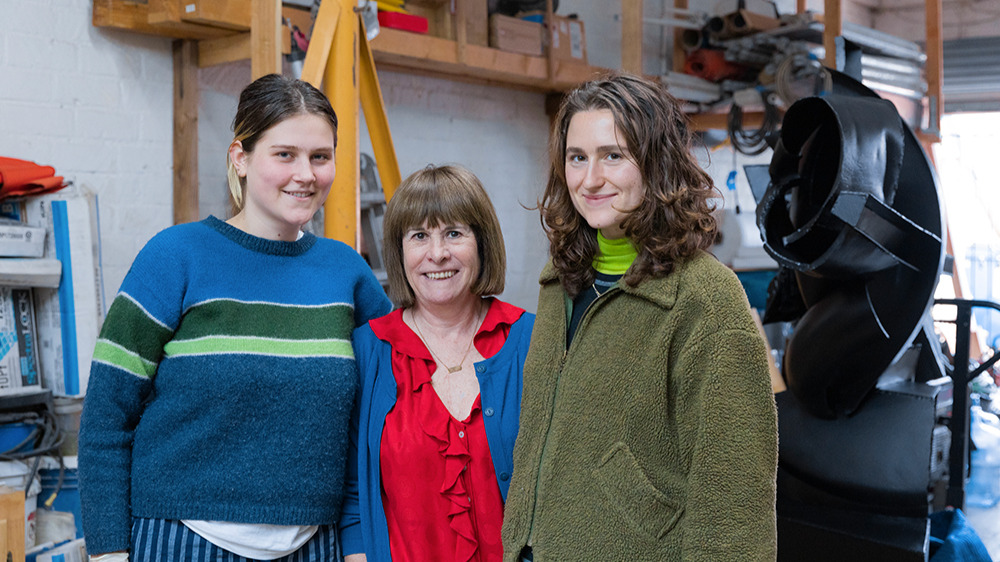
In January, Department of Art undergraduate student Maya Buffett-Davis showed up to the site of The Burbank Family Tiara, a public artwork by William Healy in Burbank on the first day of her conservation internship. Los Angeles art conservator Andrea Morse Straus asked, “are you afraid of heights?” and, after a crash course on cleaning the sculpture, sent Maya right up in a scissor lift to get started when she said she wasn’t.
Maya and her fellow art department student Stella Lamar are the first two recipients of the Andrea and Joe Straus Conservation Scholarship. Created by Andrea and her husband, Joe Straus (who got his Ph.D. in geophysics at UCLA), the scholarship and hands-on internship at the Sculpture Conservation Studio introduces UCLA undergraduates to the field of art conservation. “UCLA gave us a good start in our careers,” said Andrea. “We both want to give back to the school where we started and to support resources in our specific fields that we could've used when we were at UCLA.”
“The Straus Conservation Internship is a great example of how students develop skills and perspectives they couldn't have anticipated they would acquire when they began as art majors,” said Hirsch Perlman, a professor in the UCLA Department of Art who serves as the interns’ academic advisor. “That surprise discovery reflects the extraordinary values of a liberal arts degree at a public research university.”
While Andrea studied art and art history at UCLA, she only learned about conservation through a high school field trip to LACMA, she did not encounter the field again until after she left UCLA. When she realized that teaching positions in the arts were rare and difficult to come by, she came back to conservation, apprenticing at the De Young Museum in San Francisco as part of her master’s degree program at San Francisco State University, and has been working in the field ever since. Andrea has performed conservation work for many private clients and institutions across Southern California, including the State of California, LACMA, the Huntington Library, Disney and the Franklin D. Murphy sculpture garden at UCLA, along with other sculptures on the UCLA campus. “I was very excited [to be able to take on the sculpture garden] because I went back to my roots of being a college student. It’s a lot of fun. I love to see the ways the students and the public interact with the work in the garden.”
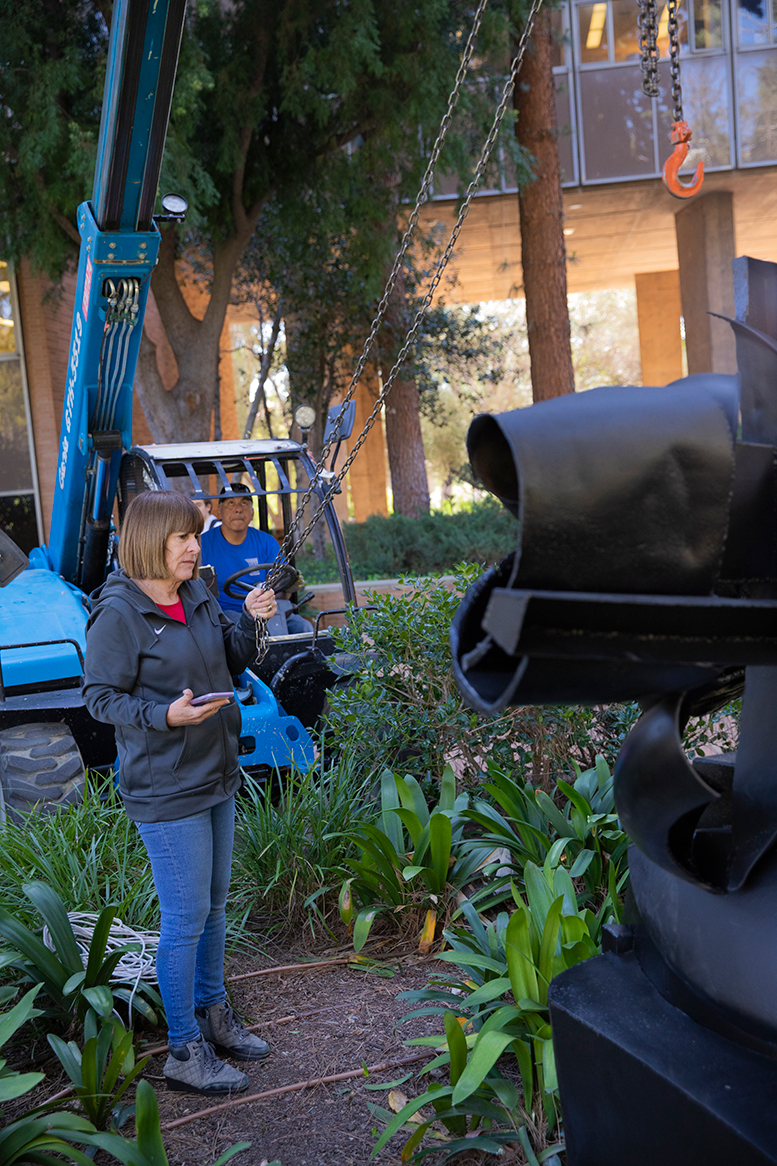
Andrea reinstalls Autel (Altar), by Robert Muller, 1962-64 in the Franklin D. Murphy Garden after conserving the sculpture in the Sculpture Conservation Studio with Maya.
In 2017, Andrea approached the School of the Arts and Architecture with an idea of how to expose more students to the field of art conservation and to make the practice more accessible and hands on. “At the Sculpture Conservation Studio, we’ve had interns through the years who are graduates of masters programs in conservation. After three years of study, while they were very, very smart kids with book knowledge of the field, they had never touched anything.” Thus the Straus Conservation Scholarship and internship program was born—giving undergraduate art students at UCLA the unique opportunity to learn some of these skills without first going through a three-year master’s program.
“In school, you go through this gradual, progressive quarter-long process of learning step one, step two, step three etc.,” said Maya. “Whereas this internship allowed me to immediately go hands-on and learn by doing and then sort of retroactively understand more of the steps, which for me has really worked. The hands-on quality amplifies the breadth of things we can learn, because you're in it and you're working with experts. There's no step-by-step leading up to this big moment. It's happening all the time.”
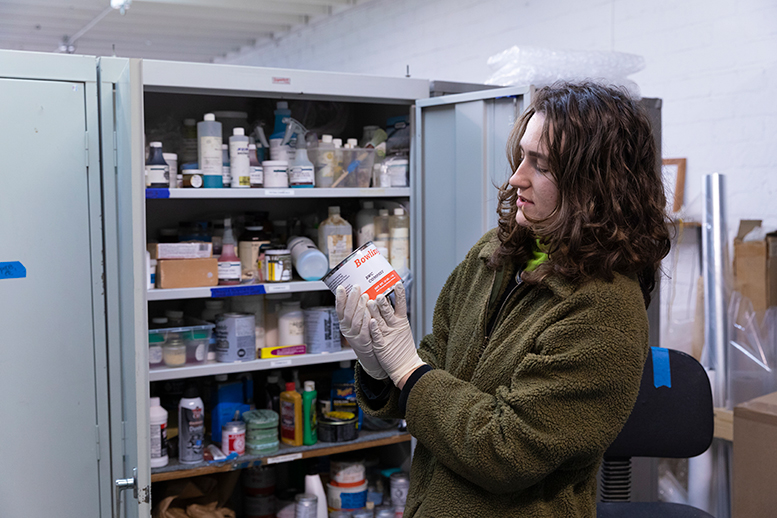
Maya working in the Sculpture Conservation Studio.
There are significant opportunities for art conservation across Southern California. One reason it was so important to Andrea to introduce young people to the field is that it connects us with our surroundings and with our history. “Los Angeles was known for tearing down the old and putting up the new,” said Andrea. “People always say that in Los Angeles, we don't have a lot of history. But we do. The best part about being a conservator is you get to go to all these areas in Southern California and see exceptional private collections or state collections, and you realize how important it is to really conserve and keep our history alive.” Andrea has now passed these messages on to her student interns, who she says have set a very high bar as the first two recipients of the scholarship.
“Before this internship, I would walk around the sculpture garden at UCLA either not really paying attention or seeing the surface of every sculpture as being sort of uniform. Now when I’m there, I’ll look at a sculpture and think ‘Oh wow, that one needs help,’ said Maya. “I’m able to look around and know what's going on, what could be done or what process would be used to fix an issue. I'm almost more in tune with the possibility for conservation than the piece itself, because it's art that I have seen every day for three years. It’s like turning a new leaf and allowing me to look at it again, because I had begun to take it for granted, and now I'm paying more attention.”
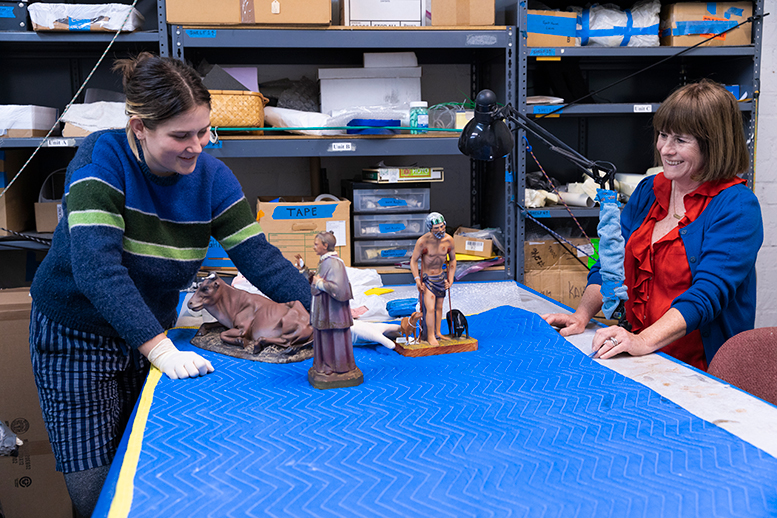
Stella and Andrea examine one of the sculptures that Stella conserved over the course of her internship.
Stella and Maya feel their own educations and practices have been influenced and enriched through the internship and are eager for more opportunities to engage with the field. Both are considering future conservation internships, and have found conservation to be integral to their understanding of the lasting impact that art can have on society, both on a personal scale and more broadly. “My dad used to make art when he was in his early 20s,” said Stella. “He has all of this work sitting in his studio that he still lives in and it's been sitting there for 30, 40 years. It doesn’t look like much now, but it's something that I value intensely and something that I need to preserve after he passes. In that sense, one of the that things this internship is teaching me is how you can put value and time into things that you care about and how you can conserve them. How the process of conservation helps allow other people to access that work and how you're keeping it true to what the artist had in mind for the work and not just letting it crumble as day-to-day life goes on.”
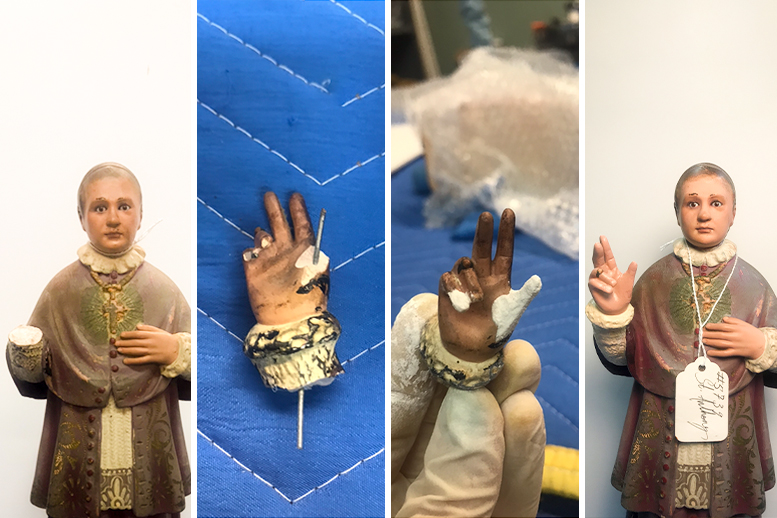
Documentation of one of the sculptures that Maya conserved over the course of her internship.
For Maya, “art serves as this reminder of humanity over and over and over again, it provides an opportunity to respond to the world how you see it without rules or facts. Conservation is not replicating the action of making art,” she said. “It doesn’t feel like I am making my own art piece at all. It doesn’t feel like, ‘now the artist is whoever made that and me.’ Conservation is able to preserve and perpetuate actions and mediums that have already happened. That’s important if art is emblematic of humanity and how people have reacted to the world. I feel like I owe it to the artists who came before me to say, ‘I'm going to look at the medium and pay attention to what you were doing and I'm not going take ownership over it, I'm just going to take responsibility for taking care of it.’ I think it's a really beautiful thing to do.”
Stay engaged. Use #UCLAarts to stay connected.


