Cooperative, gentle, generous: The radical society of Meredith Monk in ‘Cellular Songs’
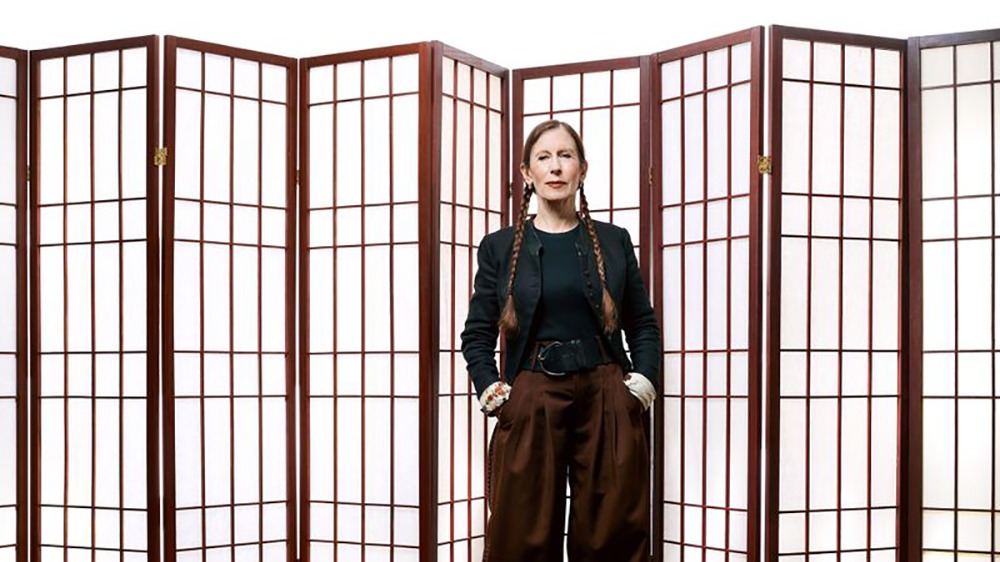
Meredith Monk has spent more than five decades exploring and expanding the capacity of that most essential instrument—the human voice. Cellular Songs is the newest in a series of her music theater pieces that explore our interdependent relationship with nature while seeking to evoke the ineffable. Joined by the women of her acclaimed Vocal Ensemble, Monk combines some of her most adventurous vocal music to date with movement, light, instrumental music, and lm, as well as a video installation designed specifically for each space. The work, at once playful and contemplative, draws inspiration from such cellular activity as layering, replication, division, and mutation, and looks to underlying systems in nature that can serve as a prototype for human behavior in our tumultuous world. Conjuring cycles of birth and death throughout, Monk once again reminds us of her vitality as an artist who cuts to the core of experience, continuing to share the genius of her discovery and innovation. Meredith Monk performed Cellular Songs at Royce Hall on March 2, 2019.
"Meredith Monk is a woman who practices. Vocalization. Physical movement. Artistic creation. Buddhism. These practices have shaped her days and informed her creative output for decades.
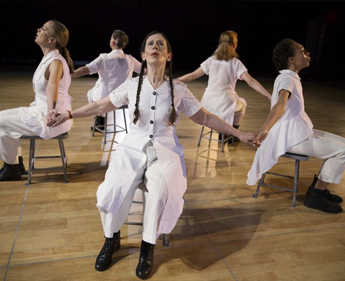
Meredith Monk with her performers in "Cellular Songs." (Julieta Cervantes) An artist who rose out of the experimental downtown Manhattan creative scene in the 1960s and ’70s, Monk is in Los Angeles this week to perform “Cellular Songs,” her latest piece of interdisciplinary musical theater.
Presented by the Center for the Art of Performance at UCLA on Saturday night at Royce Hall, “Cellular Songs” is an intimate, lovely work inspired by the complex biological processes of cells.
Monk says that what fascinates her about cells, apart from the fact that they are the fundamental unit of life, is that “for a cell to operate, everything cooperates.” All the molecules are working in harmony.
“To perform some of the pieces in ‘Cellular Songs’ is so challenging,” she says. “We all have to roll up our sleeves and dig our hands into the garden. So I wanted this piece to be a prototype of a new society, one that is cooperative rather than competitive, gentle instead of violent, generous instead of greedy.”
These concepts are embedded in the work’s DNA, presented abstractly rather than outlined concretely. Here, as in so much of her work, Monk explores ideas through non-verbal vocalizations linked to physical gestures. To observe “Cellular Songs” in its slowly unfolding entirety is to be drawn into Monk’s meditative practice. This is art as ritual and ceremony, art that invites intuitive, feeling responses rather than intellectual analysis.
Which is not to suggest that “Cellular Songs” lacks intellectual rigor. The idea for the piece came to Monk while she was reading Siddhartha Mukherjee’s “The Emperor of All Maladies,” a lengthy medical history of cancer. As she read and learned about the ways cells replicate, communicate and react, she started to imagine these processes as musical and physical forms."— Catherine Womack, Mar. 1, 2019


This post is an excerpt. Read the full article on the Los Angeles Times website.
Stay engaged. Use #UCLAarts to stay connected.


