Conductorless orchestra trades hierarchical structure for collaboration
"One. Two. Three. Four. What’s the tempo again?
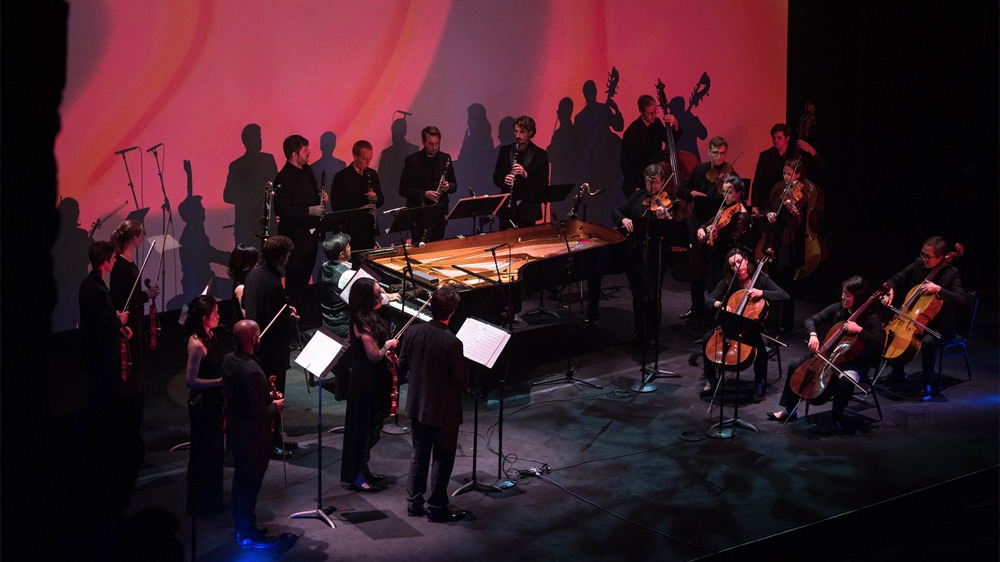
The Kaleidoscope Chamber Orchestra performs without a conductor. The group uses other communicative methods in order to keep tempo and eliminated the common hierarchy of typical orchestras. (Courtesy of Benjamin Mitchell) Los Angeles’ Kaleidoscope Chamber Orchestra must face the issue of synchronization without direction, because they have no conductor.
The orchestra will perform a concert at the Hammer Museum at UCLA on Thursday. Kaleidoscope’s president and UCLA alumnus Benjamin Mitchell runs the orchestra and said his goalwas to facilitate an open-minded collaboration between musicians. The unconventional orchestra frequently performs free concerts at local venues, featuring classics as well as more recent music from Los Angeles composers. While performing without a conductor has brought its challenges, Mitchell said, the group has managed to bypass these issues by emphasizing the importance of inclusivity and unity.
“Our goal is to create an orchestra where everyone works together in a democratic, collaborative way,” Mitchell said. “Everyone gets a say.”
Kaleidoscope’s method comes in contrast to the typical monarchical orchestra with one conductor who calls the shots. In a normal orchestra, if a musician were to raise theirhand or object in any way to the conductor’s orders, they could be fired, said Kaleidoscope violinist Alex Granger. Kaleidoscope’s collaborative process encourages everyone to share and values their input equally, Granger said.
However, this style of performance raises apprehension among others outside of the group, Granger said. Musicians often doubt the plausibility of Kaleidoscope’s structurebecause of its atypicality and lack of tempo instruction.
“The status quo is always an obstacle when you’re trying to do something that’s never been done before,” Granger said. “Not everyone believes in this mission.”
Some student musicians are among those who disbelieve. Christian Israelian, a former president of Whittier Area Youth Orchestra, said the ability to perform without someone directing the group seems unrealistic. The first-year public affairs and political science student said the conductor is the focal point of every orchestra.
“(Performing without a conductor) is impossible. I look to the conductor for everything,” Israelian said. “How am I supposed to keep time?”
Yet timing is not a problem for Kaleidoscope. In fact, it was an obstacle that opened doors for them to communicate through nonverbal cues, such as body language and eye contact, Mitchell said. The musicians will sometimes imagine smaller notes within the notes to better keep time, Granger said."— Max Kieling, Feb. 13, 2019


This post is an excerpt. Read the full article on the Daily Bruin website.
Stay engaged. Use #UCLAarts to stay connected.


