Commentary: Two LA museums hold art looted during an African massacre a century ago
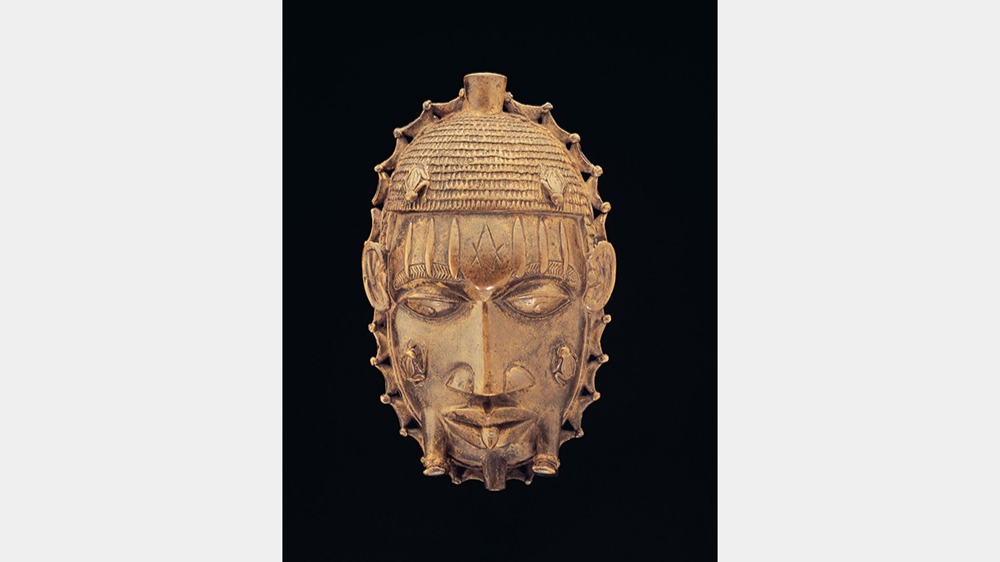
Sculptures stolen from the Benin kingdom by British colonists during a 19th-century massacre have been sitting quietly in two Los Angeles art museums for the past half-century. The Fowler Museum is currently tracking the provenance of its collections, but formal deaccession is a lengthy process.
"At least six sculptures, potentially as many as 19, stolen during an 1897 massacre by British colonists in Africa have been sitting quietly in two Los Angeles art museum collections for the past half-century.
An 18th century belt mask by the Edo peoples is decorated with frogs. (Don Cole / Fowler Museum at UCLA) That status is likely to change. Pressure has been building for longer than a decade for the return of thousands of objects looted from the Royal Palace in Benin City, located in what is southern Nigeria. Repatriation of Benin art is as essential as restitution for art looted during the Holocaust, which this theft resembles.
Britain’s invading imperial forces were after natural resources, especially the rubber and palm oil necessary for industrial expansion, when they targeted the palace. Mass murder at the seat of the Edo peoples’ nonindustrial African kingdom, together with the city’s virtual erasure, confiscation of its sacred relics and their triumphal display in Europe’s museums, carried with it a symbolic assertion of the superiority of Queen Victoria’s white Christian realm.
Most attention has focused on demands for repatriation from major museums in London and Berlin, capitals of countries directly engaged in African colonization at the end of the 19th century. Germany’s Foreign Ministry is reported to have recently begun negotiations for the return to Nigeria of more than 250 Benin sculptures in state museums. (A formal agreement is expected by summer.) The British Museum has been more equivocal.
Sacred plaques, carved ivory tusks, royal body ornaments and other objects are in the collections of at least 161 global museums — two-thirds of them in Europe — in addition to an unknown number of private collections. But stolen Benin art has been scattered far and wide over the last 124 years.
The Albright-Knox Art Gallery in Buffalo, N.Y., snared a record public price for a Benin sculpture in 2007 when it notoriously sold a deaccessioned bronze head at auction for $4.74 million. (The price was more than three times the high estimate.) The Sotheby’s catalog said it had been “owned by a member of the British Punitive Expedition, 1897-1932.”
At least 38 American museums house more than 120 examples. Some of the largest and most significant holdings are at New York’s Metropolitan Museum of Art, Boston’s Museum of Fine Arts, the Field Museum in Chicago and the Smithsonian’s National Museum of African Art in Washington, D.C.
By comparison, the number found in Los Angeles museums is modest. The relatively small quantity, however, makes ownership claims no less potentially illicit."— Christopher Knight, May 3, 2021


This post is an excerpt. Read the full article on the Los Angeles Times website.
Stay engaged. Use #UCLAarts to stay connected.


