Catherine Opie Reflects on Her Evolution on Her 55th Birthday
Catherine Opie is a professor of photography in the UCLA Arts Department of Art. Opie’s work has been exhibited extensively throughout the United States, Europe, and Japan. Opie was a recipient of the Julius Shulman Excellence in Photography award in 2013 and a United States Artists Fellowship in 2006. She is currently has three shows on view in Los Angeles and is working on an installation for the new Los Angeles Federal Courthouse, to debut in 2016.
For Catherine Opie's ninth birthday, her parents gifted her a Kodak Instamatic camera. She immediately began photographing the world around her, creating portraits of herself, Barbie dolls, her cat, and her hometown of Sandusky, Ohio.
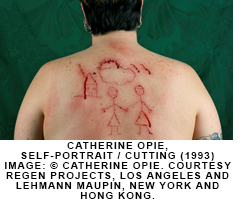
Those who know her work will recognize that not too much has changed in terms of Opie's desire to document her life and interests. Her early work consists of portraits of her friends from queer and BDSM communities, and some of her photographs, notably “Self Portrait/Cutting" (1993) and “Self Portrait/Pervert" (1994) garnered controversy for their graphic and sexual content.
She has since taken portraits of artists, designers, and writers in the style of Old Masters, surfers, high school football players, and more. She has also tackled inscrutable landscapes, and she recently shot the home and belongings of the late Elizabeth Taylor for her series 700 Nimes Road.
We spoke to the artist in advance of her 55th birthday to find out what she's learned about art, life, and radicalism.
On how her photographs have changed:
"I think that the work has become more sophisticated than when I was nine [laughs], but I would still say those early interests and ideas around wanting to make images are still very true to who I am as a person.""The way that I work with cameras is really different [now]. Not so much how I think about making images, nor am I constructing in Photoshop like a lot of contemporary photographers. But just the idea of large format cameras from shooting 8×10 and 4×5. Going into medium-format digital has really been able to change the way that I work." — Alyssa Buffenstein, Apr. 14

Read the full interview on the Artnet News website.