CARLA reviews the Fowler's 'The Map and the Territory'
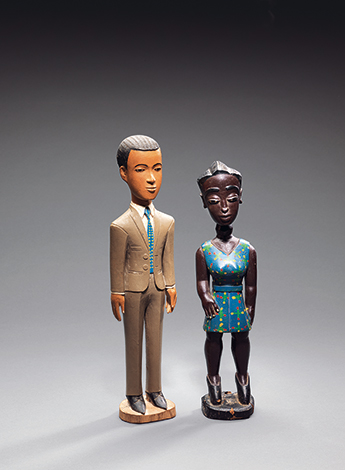
Artist unknown (Baule peoples, Côte d’Ivoire), Otherworld husband (blolo bian) and wife (blolo bla) (20th century). Wood and paint. Image courtesy of the Fowler Museum at UCLA. The Map and the Territory: 100 Years of Collecting at UCLA, at UCLA’s Fowler Museum, takes on the ambitious task of re-examining the institution’s vast archives, and strives to do so in a way that acknowledges the histories of imperial conquest that helped shape its holdings. Archival museums like the Fowler have forced the objects in their care to take on the burden of representing entire civilizations—their collections reflecting a desire to record and categorize the geographic and cultural contours of empire, an impulse that has characterized imperial expansion for centuries. And as the keeper of many of UCLA’s Indigenous cultural artifacts, the Fowler Museum cannot so easily divorce itself from that legacy. This show grapples with the question that remains: How can a museum built on these premises move forward, if it should at all?
Oftentimes, within the white walls of the museum, cultural artifacts appear devoid of their historical and social contexts. Such displays often not only implicitly, but inaccurately, suggest that the people who made these objects—along with their cultures—are long gone, and that the objects have ended up in museum collections as if by magic. The Map and the Territory begins to remedy this contextual vacuum by placing artifactual objects in conversation with their more contemporary relatives. Two pairs of wooden Baule statuettes from the Cote d’Ivoire make this clear. The first, from the 19th century, depicts a man and woman, featuring elaborate hairstyles, jewelry, accessories, and body scarification marks. The second pair, placed directly next to the first, is from the 20th century and also depicts a male and female figure. The former wears a business suit and the latter a colorful, polka dot dress. The newer statuettes enliven the older, opening up a dialogue between the works and disrupting the isolation and stasis of the museum archive.
The exhibition’s self-interrogation of display continues with a Plexiglas case of colorful, iridescent birds, tagged and organized by species. This type of animal collection, like butterfly pinning, has long followed imperial conquest, but within the context of this exhibition, it is not so much the fantastic birds that are on display as the display itself. No longer representatives of the “exotic” lands of South America and the Pacific, the birds instead become representations of the process by which they ended up in a museum to begin with. — Sampson Ohringer, Sept. 30, 2021

This post is an excerpt. Read the full article on the CARLA website.
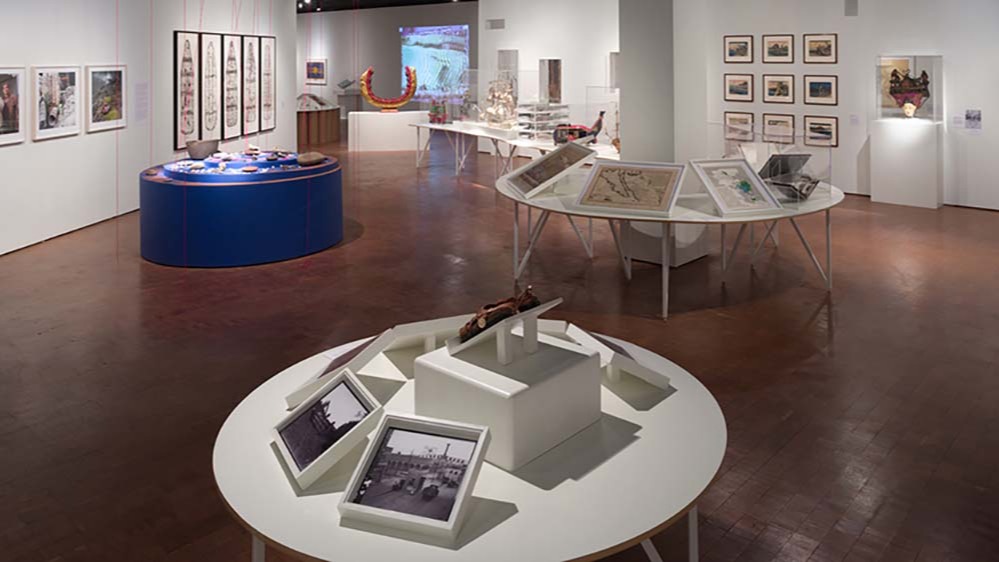
HEADER IMAGE: The Map and the Territory: 100 Years of Collecting at UCLA (installation view) (2021). Image courtesy of the artists and the Fowler Museum at UCLA. Photo: Fredrik Nilsen.
Stay engaged. Use #UCLAarts to stay connected.


