Candice Lin’s Material Metaphors Conjure Invisible Entanglements
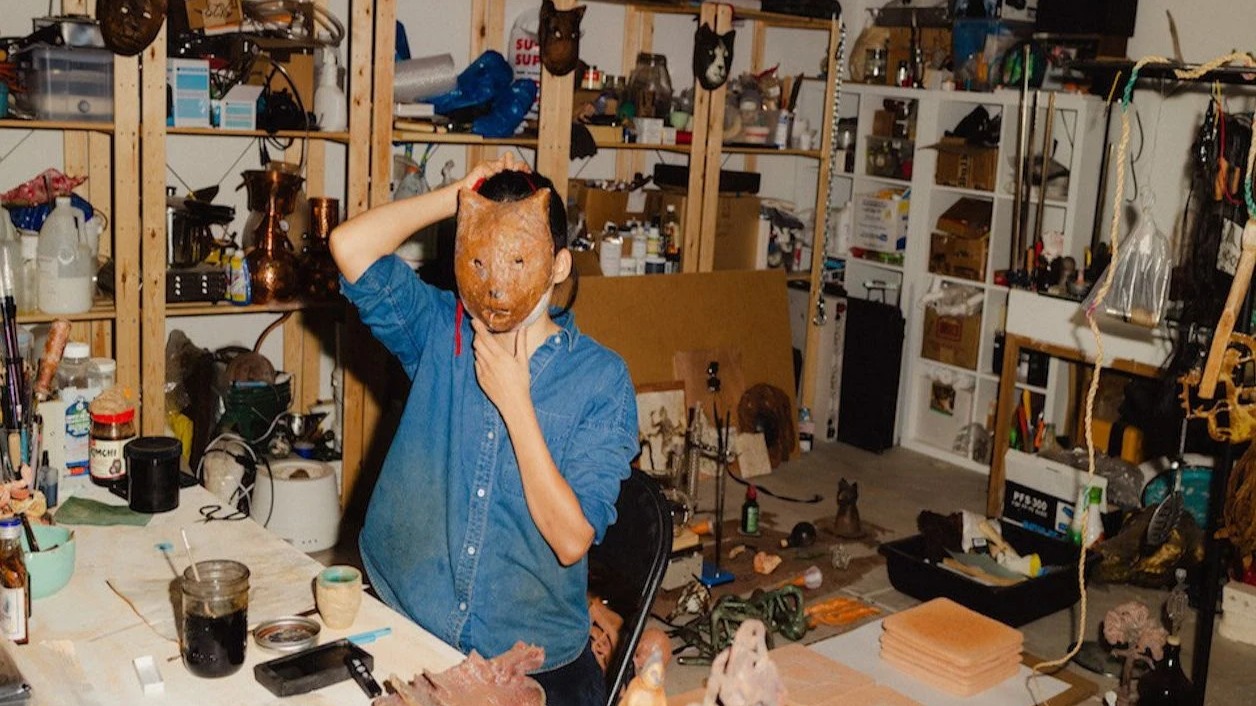
Candice Lin is an assistant professor in the UCLA Department of Art. Lin is an interdisciplinary artist who works with installation, drawing, video, and living materials and processes, such as mold, mushrooms, bacteria, fermentation, and stains.
Candice Lin, La Charada China (Tobacco Version) (2019). Cement with casein paint, welded steel table frame, tobacco, ceramics, distillation system (distilling a tincture of tobacco, sugar, tea, and poppy), poppy pod putty, sugarcane, white sugar, cacao, sage, ackee, oak gall, Anadenanthera, dong quai, California clay, Dominican Republic clay, metal parts, bucket, pumps, tubing, dried indigo, glass slides, bottles, drawings, tile, rubber, wood. Exhibition view: The Agnotology of Tigers, LSUMOA, Louisiana (20 October 2021–20 March 2022). Courtesy LSUMOA.
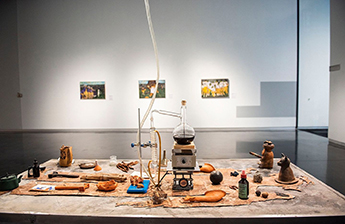

Candice Lin is kind of a historical alchemist, with installations arranging materials and substances into activated sequences that draw out intricate cartographies lurking behind macro-narratives. La Charada China (Tobacco Version) (2019), for instance, on view in the artist's solo show The Agnotology of Tigers at Louisiana State University Museum of Art (20 October 2021–20 March 2022), comprises a man's silhouette made from tobacco leaves pressed into a steel and cement table laden with raw materials—cacao seeds, indigo, sugarcane, and opium poppy pods.
A 2018 variation of La China Charada, first exhibited in Made in L.A. 2018, was configured for a group show at Lisbon's Galerias Municipais (6 November 2021–30 January 2022); this time with a man's imprint in a mound of red earth and guano from which sugarcane, opium poppies, and tropical poisonous plants were grown using growth lights.
Unearthing complex histories through matter is an ongoing theme in Lin's work. Swamp Fat (2021), shown in Prospect.5 in New Orleans (23 October 2021–23 January 2022), refers to late-19th century reports about the Mississippi River becoming gelatinous due to cattle river transportation and slaughterhouses throwing carcasses into the water, and the Slaughter-House cases triggered by white butchers complaining about sharing space with Black and non-white butchers.
Reflecting on these material intersections, Lin created swamp creatures and mounds from clay sourced from the former Louisiana fishing village Saint Malo, thought to be the first Asian-American settlement in the U.S. started by Filipino indentured labourers, and lard infused with the scent of rotting meat from Louisiana butchers.
'The history of Saint Malo as a multiracial fishing village and maroon settlement formed by a disparate group of people eking out a living on an unstable, marginal terrain interests me in ways that feel related to the intercultural mixing that is present in the indigo panels,' Lin told Catherine Damman for Bomb Magazine.
Pigs and Poison takes its title from a phrase used in 19th-century trade jargon. Chinese immigrant workers were referred to derogatorily as 'pigs' and the poison was the opium that the British and other imperial nations were pushing as their primary trade product to exchange for porcelain, tea, and other Chinese goods, despite the fact that trading opium or bringing it into the country was illegal. I was connecting but not equating the violent technologies that were developed to discipline enslaved people of African descent to the earlier restraint and torture devices used on enslaved Indigenous people in the Encomienda System from the 16th to the 18th centuries, or similar devices used on subversive people in medieval Europe, disproportionately female workhouse inmates, during a similar time period.
I think this kind of trans-historical desire to trace connections across time and space borrows from scholars like Silvia Federici's work in Caliban and the Witch (2004).
I feel like as an artist, I'm often in the act of bearing witness. I think it's something that James Baldwin talks about. I think he was saying that as a writer you bear witness to the particularities of who you are and you bear witness to the moral failures of the nation, and this makes history and culture.
For me, an artist—or really any layperson who acts as a witness—creates a record of what they have seen, and this can serve as an alternate history. — In Conversation with Stephanie Bailey

This post is an excerpt. Read the full article on the Ocula website.
Read more about Candice Lin.
Stay engaged. Use #UCLAarts to stay connected.


