Candice Lin turns survival, solitude, and loss into art
Candice Lin is an assistant professor in the UCLA Department of Art. Lin is an interdisciplinary artist who works with installation, drawing, video, and living materials and processes, such as mold, mushrooms, bacteria, fermentation, and stains.
Artist Candice Lin spent the COVID-19 lockdown seeping, rotting, resting, and weeping. But then, didn’t we all?
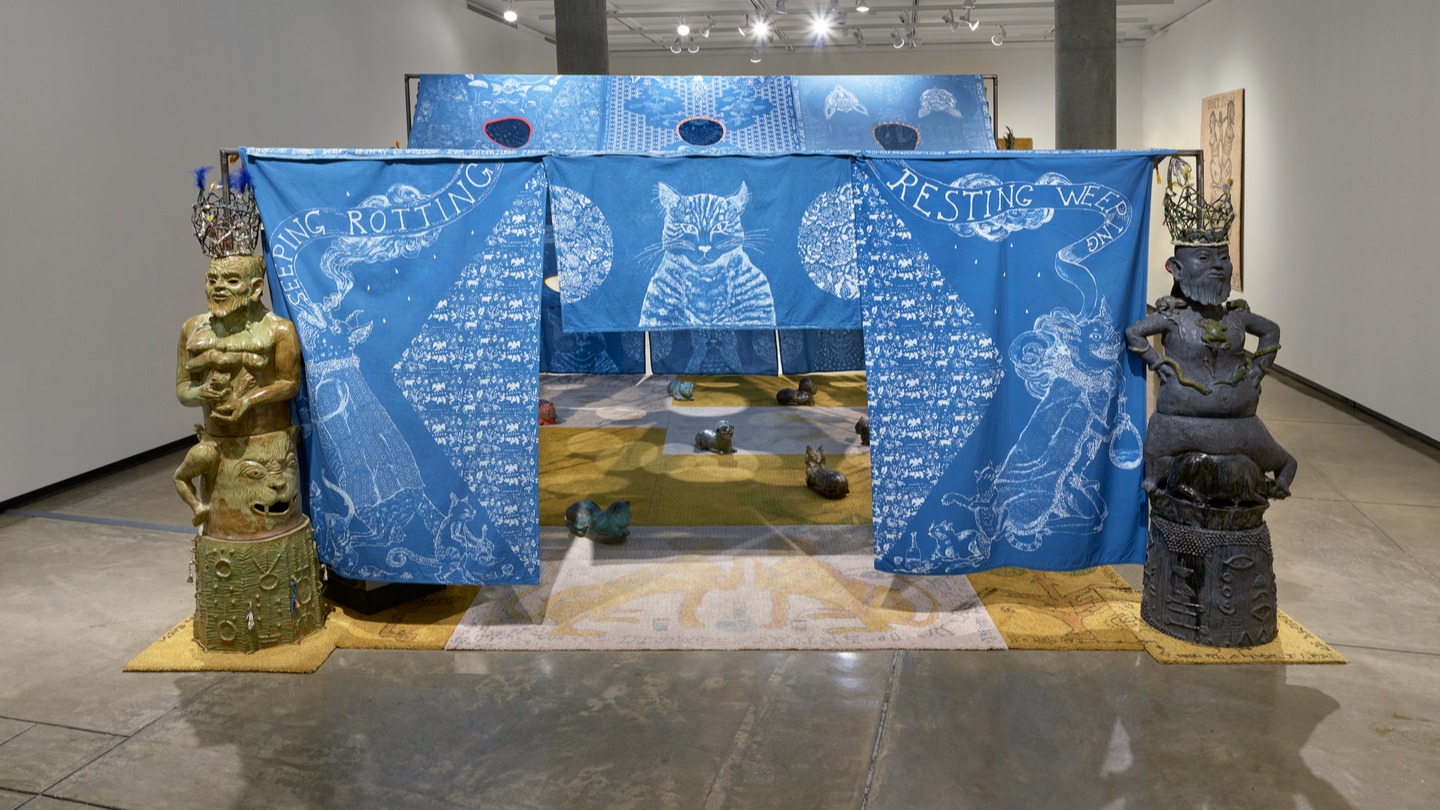
The Los Angeles-based artist grows indigo, and ferments it into a dye in a kiddie pool in her backyard. Seeping, rotting, resting, and weeping are part of that process. At home alone with her cat Roger in the early days of the pandemic, she dyed textiles, made ceramic cats, and let her imagination percolate in fearful and fruitful ways. “Candice Lin: Seeping, Rotting, Resting, Weeping” at Harvard University’s Carpenter Center for the Visual Arts springs from that time.
The central installation, an indigo-blue tent, invites viewers to crawl inside and lie down. Guarded by ceramic cat demons (or deities), the piece is at once cosmic, comforting, and unhinged. Summoning us back to the animal qualities of living in the body, Lin detaches from structures of knowing we humans have used to put ourselves at the top of the power ladder.
In a series of installations titled "A Hard White Body" she used unfired porcelain, which was unstable enough before she drowned it in a solution made partly from distilled urine. “I didn’t want it to feel authoritative,” she told writer Catherine Wagley in 2019 of texts about botany and colonization she’d immersed in another urine solution. “I wanted it to feel fragile and always changing.”
Then came that destabilizing year, 2020, and Lin was stuck alone at home with Roger. This show was already on the books, co-curated by Carpenter Center director Dan Byers and Victoria Sung, associate curator of visual arts at the Walker Art Center in Minneapolis, to be presented by both institutions. Byers flew to Los Angeles to visit Lin that February. His seatmate on the flight out, he writes in his catalogue essay, was already equipped with mask and hand sanitizer.
If Lin’s work up to this point has been about tearing down hoary structures that hold privilege in place, now it was also about survival, solitude, and loss. COVID tore down structures, too — about safety and a social life based on proximity to others.
“Lin’s alternate universe draws upon the emergent field of animal studies’ starting assumption that ‘the human is an animal,’” writes co-curator Sung in her catalogue essay.
Lying on the floor and resting one’s head on a ceramic cat in the social space of a gallery prods a viewer away from safe intellectual moorings, into a world animals know better than we do – one where knowing arises from touch, sensation, instinct, and a way of moving through the world untethered to rationalism. It is no less violent than the one humans have ruled, but safety, as we learn again and again, is in many ways an illusion. Loss and death are imminent in “Seeping, Rotting, Resting, Weeping,” but the life of the body Lin describes is also one of deep comfort and mystical possibility. — Cate McQuaid, Mar. 30, 2022
This post is an excerpt. Read the full article on the Boston Globe website.
Stay engaged. Use #UCLAarts to stay connected.


