Candice Lin on collective grief and the consolation of cats
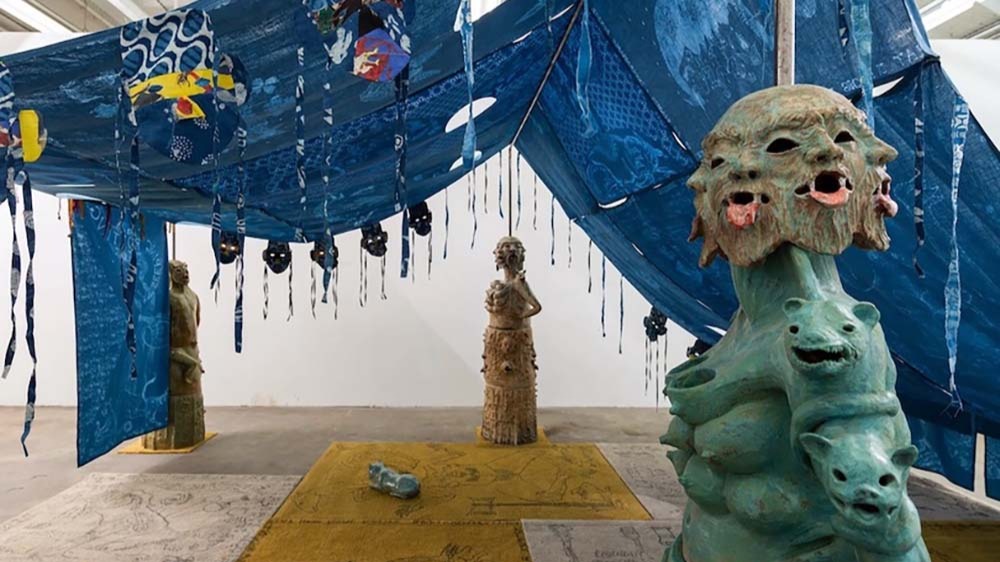
Candice Lin, Seeping, Rotting, Resting, Weeping, 2021, hand-printed (katazome) and hand-drawn (tsutsugaki) indigo panels, steel bar, dyed rugs, glazed ceramics, epoxy resin, feathers, block-printed and digitally printed fabric, bells, tassels, and miscellaneous small objects, dimensions variable. Installation view, Walker Art Center, Minneapolis, 2021–22. Photo: Ian Byers-Gamber. Candice Lin made Seeping, Rotting, Resting, Weeping, 2021, in the isolation and inertia of the coronavirus pandemic. The installation, which also marks her first solo museum show, strains against that sadness. Centered in and around a collapsible, movable, wearable tent, Lin’s latest work draws on the ways she found connection over the last eighteen months, and creates a setting where others might find the same. But connection is double-edged: The installation references the sometimes gradual, often violent ways cultures meet and intermingle, creating new hybrids and then moving on. The exhibition is mobile, too; on view at the Walker Art Center in Minneapolis from August 5 to January 1, 2022, it will move in February to the Harvard University’s Carpenter Center for Visual Arts.
WHEN I CONCEIVED THIS INSTALLATION, I imagined Covid-19 would be over and we would be so excited to be in a world of full sensations and touch. I didn’t foresee the pandemic still being ongoing and that the idea of handling objects and resting on surfaces other people have touched might be anything but inviting. But in Minneapolis, people have not been hesitant to interact with and touch the work.
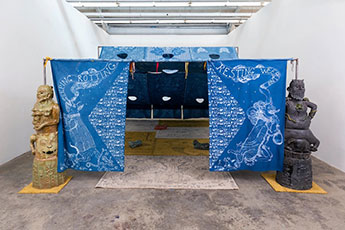
Seeping, Rotting, Resting, Weeping consists of an indigo-dyed tent flanked by ceramic figures that hold up the panels. There is a little bit of signage inviting people to enter, but the work’s material quality and sensuousness also compels them to go inside. There are soft, plush rugs that have been stippled with dye, and ceramic cats that can be rested on like Tang Dynasty ceramic pillows. There is an indigo-bound journal of drawings and personal notes recording the time from March 2020 until June 2021: roughly the start of the pandemic in the US to the time this show came together. There are also two pieces I call tactile theaters that have a seat on either side, and visitors are invited to sit across from one another and touch them like a surrogate body. One is made of concrete and the other is made of scagliola. They’re very smooth, sanded to 3000 grit, and are very sensuous to the skin.
The words in the show’s title—sleeping, rotting, resting, weeping—seemed to encapsulate much of my, and perhaps many other people’s, experience during the pandemic. The weeping refers to all the death and collective grieving of this year and a half. But I’m also thinking about the processes that are involved with some of the materials, about how death and decay are linked to fermentation and new life. For example, when indigo is fermented (or control rotted) it is sometimes referred to as an alive being, even a child, that needs to be put to bed or to rest under the “bedcovers.” The making of the indigo dye pot relies on feeding the bacteria which eat the oxygen and reduce the vat. They can only live by breaking down decaying organic matter like urine, broth, or old fruit. I did a lot of experimentation with different types of vats. (The urine one was stinky. The vat has to be hot, so I kept it outside in my yard in 90-degree weather.) When I was ready to dye all the panels, I made enough to fill a kiddie pool. — As told to Travis Diehl, Nov. 1, 2021


This post is an excerpt. Read the full article on the ArtForum website.
HEADER IMAGE: Candice Lin, Seeping, Rotting, Resting, Weeping, 2021, hand-printed (katazome) and hand-drawn (tsutsugaki) indigo panels, steel bar, dyed rugs, glazed ceramics, epoxy resin, feathers, block-printed and digitally printed fabric, bells, tassels, and miscellaneous small objects, dimensions variable. Installation view, Walker Art Center, Minneapolis, 2021–22. Photo: Ian Byers-Gamber.
Stay engaged. Use #UCLAarts to stay connected.


