Can a Building Dream, Learn, and Hallucinate? A Conversation with Refik Anadol
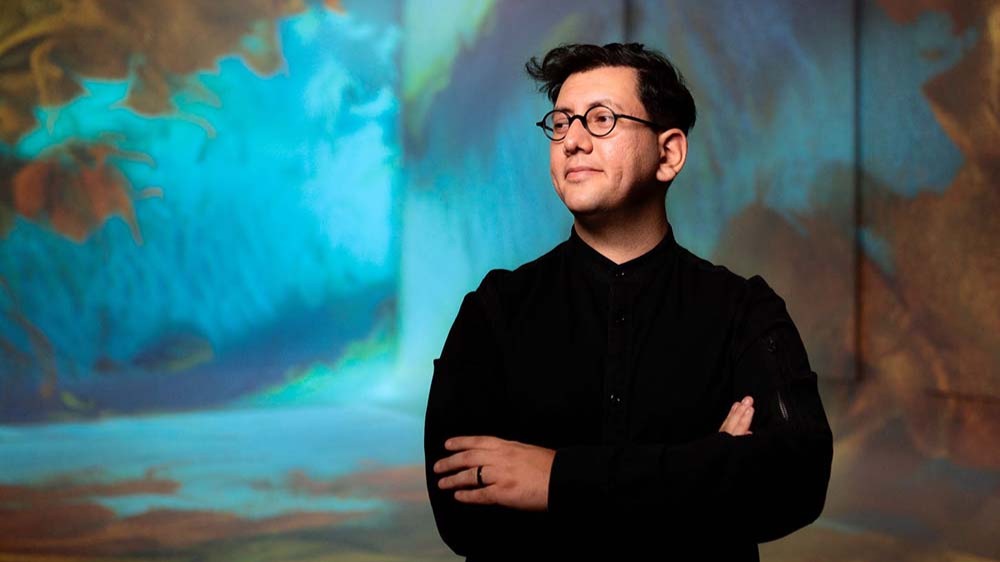
Alum and Visiting Assistant Researcher Refik Anadol (Design Media Arts, MFA '14), works in the fields of site-specific public art and live audio/visual performance with an immersive installation approach, particularly his works explore the space among digital and physical entities by creating a hybrid relationship between architecture and media arts.
Sense of Space at the 2021 Venice Biennale. Image Copyright: Refik Anadol Studio Refik Anadol has carved an eclectic career, rich with confluences. His work blurs the boundaries between art and science, the visible and invisible, the operational and emotional, the fleeting and permanent. The composition of this studio further demonstrates this confluence; housing artists, architects, data scientists, and researchers, drawn from 10 countries and fluent in 14 languages. Since establishing Refik Anadol Studio in 2014, the Istanbul-born artist has produced a litany of projects that celebrate, and define, the aesthetics of data and machine intelligence, from his installation at Frank Gehry’s Walt Disney Concert Hall in 2018 to his Sense of Space exhibition at the 2021 Venice Biennale.
Archinect’s Niall Patrick Walsh spoke with Anadol in September 2021 at an exciting time for the artist: not only during his ongoing project at the Venice Biennale, but also on the eve of his latest milestone: a first-of-its-kind NFT project to be auctioned by Sotheby’s Hong Kong. In the context of our conversation, the project seems almost inevitable for Anadol; taking a cutting-edge representation of art in the machine age, from infinitely generative data paintings to AI data sculptures, and blending it with the cutting-edge blockchain infrastructure set to host that age. Arguably, this is Anadol’s greatest asset, and his greatest contribution to the built environment: an ability to take an invisible, unattainable idea beyond our everyday reality, and make it not only visible in our present day , but somehow defining of it.
Niall Patrick Walsh: Your work forms a crossroad between art, science, and technology. Can you give us an insight into how you discovered this crossroad, and how your career grew from it?
Refik Anadol: I began dreaming about architecture when I was a child. I would complain to my family about my room, asking “why are my walls so boring?” and “why am I going to the same room every day?” and “why am I seeing the same ceiling every day?” As a young mind, I found myself becoming critical of my static built environment, particularly materials such as concrete, glass, and metal. Video games also piqued my interest. I began playing video games when I was eight years old. Games were not an escape from reality for me, but instead seemed to convey a reality beyond two-dimensional space. I began wondering where the games were coming from. I was inspired by the space that had been created within a machine back at an earlier time.
Over the following years, I began speculating about alternative materials such as light and data, asking what happens when they blend, and exploring their potential for enhancing our responsive built environments. These movements and blends are gradual; they grow together not just because of technology, but because of imagination.
If an architect and artist come together, they can make the invisible flow of data visible.
In 2008, when I was at a media architecture event in Berlin, I discovered that there was an entire community dedicated to urban media facades; an academic-like group of people imagining the future of urban space. They would always say that the future of media facades were not boring screens, or monotonous, predictable advertising, but could reach beyond that. 2008 was the true beginning of my connection with media architecture. I learned about the poetics of augmented space, an amazing paper by Lev Manovich, and was particularly inspired by his view that if an architect and artist came together, they could make the invisible flow of data visible. It was an important trigger point in my imagination.The question of “can a building dream, learn, or hallucinate” was a question I first asked in 2012, when I was studying at the UCLA Design Media Arts and while I learned about Greg Lynn’s perspectives on animate architecture. Then in 2017, my uncle was sadly diagnosed with Alzheimer’s, which propelled me into deep research about thoughts and memories; one which I continue today. — Niall Patrick Walsh, Sept. 24, 2021


This post is an excerpt. Read the full article on the Archinect website.
HEADER IMAGE: Refik Anadol. Photo by Efsun Erkilic.
Stay engaged. Use #UCLAarts to stay connected.


