But Is It Art?
In the Case of ‘Doggie Hamlet,’ Yes

With the National Endowment for the Arts under threat, it's more important now than ever to discuss the value of contemporary art. Ann Carlson, choreographer and performance artist, released an early video sketch of a work she plans to present at the Center for the Art of Performance at UCLA and now, we are forced to answer the questions, "Is it Art?" and "Is Art worth funding?"
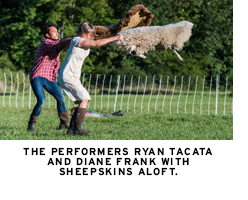
At first glance, it doesn’t seem like a performance. The stage is a meadow, and the score is a collection of sounds, including the commands of a dog handler and the pounding of hooves. A woman extends her arms while four sheep, trailed by a determined dog, trot in a circular formation. In quick cuts, we see bigger flocks — a blur of curly wool and strong snouts — race by. Moments later, a young man holds a sheepskin and spins, before collapsing onto the grass.
Is it silly? Is it pretentious? Is it art?
An early video sketch of “Doggie Hamlet,” a site-specific work by the choreographer and performance artist Ann Carlson, has recently become fodder for conservatives intent on eliminating federal funding of the National Endowment for the Arts. I can’t defend this strangely chopped together video, which undercuts the scope and mysterious splendor of Ms. Carlson’s vision. But as a dance critic, I will fight for Ms. Carlson, a multidisciplinary artist whose work poignantly explores social issues through the lens of performance.
Ms. Carlson is no joke. But under the headline “Taxpayers Foot Bill for ‘Doggie Hamlet’” in the conservative online magazine The Washington Free Beacon, Ms. Carlson and her production were mocked in a piece subtitled: “Actors in federally funded show yell and run at sheep in field for ‘postmodern dance.’”
For Kristy Edmunds, the executive and artistic director of the Center for the Art of Performance at the University of California, Los Angeles, which will present “Doggie Hamlet” at Will Rogers State Historic Park, Ms. Carlson gives “exquisite attention to things that we don’t see without her care.”
Speaking of what it costs to present “Doggie Hamlet,” Ms. Edmunds said: “The total estimate that I have right now, including her fee, is $76,000. That is the production costs, the permits, lights, hotels, where to house and board the sheepherding dogs, then how to find the flock of sheep, getting all of the animal protections in place, finding a site, getting permits in place, the marketing and food and per diem.”
Ms. Carlson pays her performers out of her fee. “How many times would the project have to be performed,” Ms. Edmunds said, “before the artist makes $5?”
In her recent “Symphonic Body: UCLA,” Ms. Carlson conducts 80 people from all walks of university life, including maintenance workers and personnel from the vice chancellor’s office, in a performance of gestures. She cast it by asking people to recommend five others they admired. They didn’t need to know them well. One, said Ms. Edmunds, who commissioned the work, was a beloved parking attendant. She called the piece “a symphony of silence.”
Ms. Carlson’s projects are not slapdash. (As Ms. Edmunds put it, “You can’t imagine how many flocks of sheep I’ve gone and seen.”) They’re considered, detailed and grand in their seeming simplicity. Few artists are so able and even willing to bridge the gap between art and the everyday at such a high level, but Ms. Carlson does so by documenting life’s beauty and absurdity. She unearths what’s wise in absurdity and shows how something that might appear banal can suddenly become luminous.
And though I have no problem with certain kinds of elitism, Ms. Carlson is hardly an elite artist: She not only makes art for the people, but she also makes it with and about them. And if you believe that taxpayer money should support the arts — and I do — this fits. Because in answer to that earlier question, yes, on too many levels to contemplate “Doggie Hamlet” is art. — Gia Kourlas, Apr. 7, 2017

Read the full article at the New York Times website.