Bridging the Gap Between Art and Code
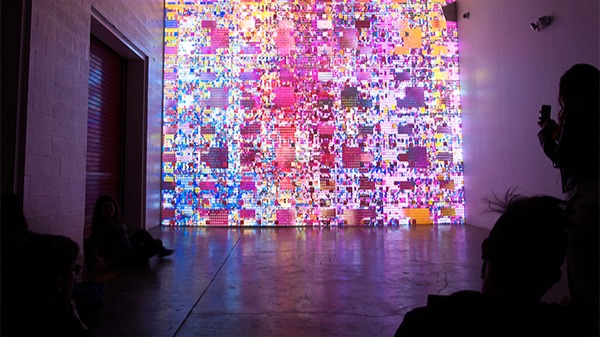
Design Media Arts Professor Casey Reas writes software to explore conditional systems as art. Through defining emergent networks and layered instructions, he has defined a unique area of visual experience that builds upon concrete art, conceptual art, experimental animation, and drawing. While dynamic, generative software remains his core medium, work in variable media including prints, objects, installations, and performances materialize from his visual systems.
Visual artist Casey Reas’ initial interest in computer programming grew out of an art project. Reas, a UCLA Design Media Arts professor, said that as an artist he has always been engaged in drawing, but found it difficult to represent his subjects through traditional artistic methods. To work around this, he learned to write software that drew thousands of lines simultaneously.
Despite his many artistic endeavors that integrate software and various technologies, Reas, who also serves on UCLA’s Institute for Digital Research and Education’s (IDRE) Humanities, Arts, Architecture, Social and Information Sciences Collaborative (HASIS), said that for him thinking of computers as a source of entertainment and artistic expression is a more recent development.
As computers were used initially as research machines in the sciences and then later as business machines, it was only when the web became a phenomenon in the 1990s that Reas took his professional design work and started to apply it to software.
“I don’t think about writing code and programming as a ‘tech’ thing,” Reas said. “I think about it as a ‘thinking’ thing. It’s a very interesting and powerful way of thinking that doesn’t have a specific domain,” Reas said. — , Apr. 22, 2016

Read the full article at the UCLA Institute for Digital Research and Education website.