BLAZING BEACON
Distinguished Professor Peter Sellars Returns to the Mogao Caves
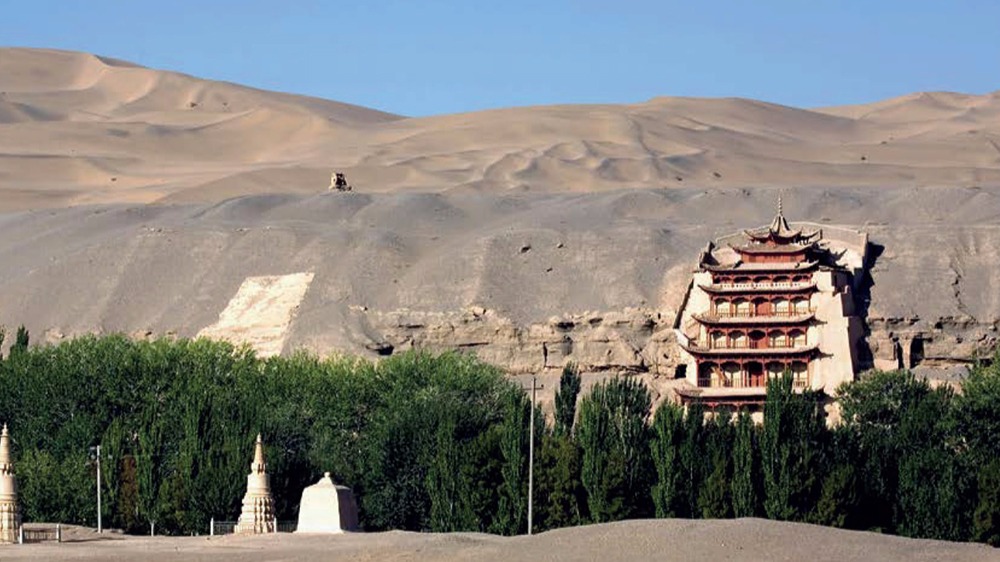
Distinguished Professor and renowned theater director Peter Selllars, joined by a group of fellow artists and historians, will return to Dunhuang later this year and report back from the field throughout his travels.
"The Mogao Caves, set near the ancient Silk Road city of Dunhuang, are an oasis of Buddhist art that evolved over many centuries. As professor and theater director Peter Sellars embarks on his most ambitious project to date—a ten-year study in and of Dunhuang—he returns to themes that have animated his long and storied career: that ideas and practices are shared across geographies and time, and that the art of performance can best reveal these living traditions. In the following text, Sellars tells Thomas Francis about his long-standing fascination with the Mogao Caves and his desire to bring the experience of the caves to a wider audience.
THOMAS FRANCIS How did you first learn about Dunhuang, and what was inspiring about it at the time?
PETER SELLARS Well, for twenty-five years I’ve been completely obsessed with one of the first Mahayana Buddhist texts, the Vimalak rti Sutra, which probably dates in its worldly form from the first century a.d. It’s the first of a new brand of sutras that was followed by the Lotus Sutra, the Flower Ornament Sutra, and the Amitabha Sutra, which are about getting Buddhism out of the monastery, out of the intellectual surround of pure mind theory, and moving it into a public space where a nonliterate audience can enter the highest levels of practice. The strategies are amazing, in the Lotus Sutra they almost read like supermarket giveaways—everything is like, “No matter who you are, no matter what you’ve done, you’re already a Buddha.” That’s extremely different from the long, complex, straight-and-narrow path of the earlier texts.
Anyway, the whole sutra has these amazing reversals, these miracles, this unexpected humor. The high goes low, the low goes high. I’ve always wanted to stage it. For twenty-five years I’ve been collecting books with images of the Vimalak rti Sutra, and most of them turn out to be, of course, in the Dunhuang caves. I was assembling an entire shelf of books without ever quite putting it together that all roads lead to Dunhuang [laughs]. The Getty Conservation Institute in Los Angeles has been working with the Dunhuang Academy on the protection and preservation of the caves for twenty-seven years. In the summer of 2016, the Institute and the Academy, together with the Getty Research Institute, mounted a stunning exhibition: Cave Temples of Dunhuang. As the exhibition was taking shape, I was able to be part of a series of encounters with the curators and was invited to imagine some of the ancillary programs. This was the first moment when it occurred to me that I could actually visit Dunhuang—that it was a real place, not just a shelf of books, and I began planning my own projects."— Gagosian Gallery, Nov. 3, 2017
The above text is excerpted from this full-length article.