Better Safe Than Sorry: American Museums Take Measures Mindful of Repatriation of African Art
The Fowler Museum at UCLA may offer an example of how such research could be conducted going forward
This past February, the Metropolitan Museum of Art ended an exhibition earlier than expected when the centerpiece of “Nedjemankh and His Gilded Coffin”—after seven months on view with robust attendance figures nearing 450,000—was found to have been looted from Egypt. In response to the finding, the Met agreed to turn the artifact over to the Egyptian government. But the question of how such a tainted treasure could work its way through the hallowed museum’s acquisition process remained. Hollein vowed that the Met would learn from the incident and that he would personally be “leading a review” of the acquisition program in order “to understand what more can be done to prevent such events in the future.” The Fowler Museum at the University of California, Los Angeles may offer a working example of how such research could be conducted going forward. Though the museum’s policy is to request all available provenance information, such information tends to be limited, vague, or difficult to verify. Acquisitions from decades past, the museum officials wrote, “may not have had very much collection information beyond the donors and the dealers they acquired them from, if that. Coupled with the fact that many dealers were and are reluctant to reveal their sources or asked too few questions themselves, the result is a trail that often goes completely cold in a search for an object’s provenance.” A partial solution presented itself to the Fowler earlier this year in the form of a $600,000 grant from the Andrew W. Mellon Foundation to study its Wellcome holdings from Africa. For a 40-month project initiated in February, the museum is dedicating two full-time fellows to work with curatorial staff to investigate the origin of 700 objects, with the intention, according to museum staff, to establish how much the “reconstruction of provenance can be enhanced by both comparative ethnographic research as well as scientific materials analysis.” Based on the success of their results, the Fowler will continue that approach while considering future steps such as “building connections to people in specific source communities to consider potential future actions around cultural patrimony and ownership, preservation and education, and possibilities for restitution.”
"This past February, the Metropolitan Museum of Art ended an exhibition earlier than expected when the centerpiece of “Nedjemankh and His Gilded Coffin”—after seven months on view with robust attendance figures nearing 450,000—was found to have been looted from Egypt. The museum had acquired the ornate golden coffin from the first century B.C. two years ago for €3.5 million (around $3.9 million) from Christophe Kunicki, a Parisian art dealer who supplied fake provenance records including a forged Egyptian export license dated 1971.
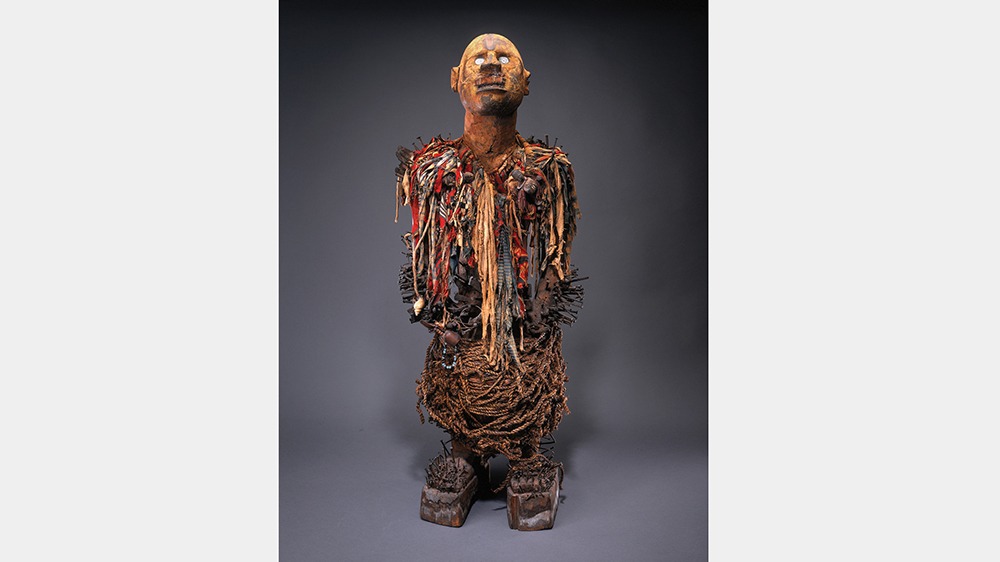
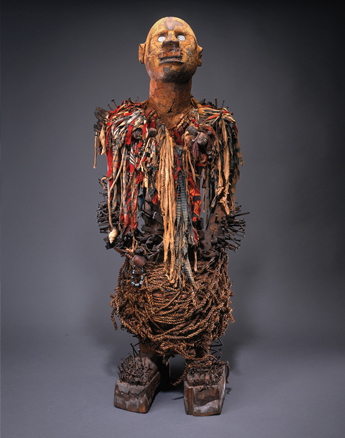
Artist unknown (Yome peoples, Democratic Republic of the Congo), Power Figure, 18–19th century, part of the Fowler Museum’s collection donated through the Wellcome Trust. According to an investigation by the Manhattan District Attorney’s Office, however, it appeared that the coffin had been stolen from its homeland in 2011. In response to the finding, the Met agreed to turn the artifact over to the Egyptian government. But the question of how such a tainted treasure could work its way through the hallowed museum’s acquisition process remained.
“Stewards of the world’s most important artifacts have a duty to hold their acquisitions to the highest level of scrutiny,” Manhattan District Attorney Cyrus Vance said in a statement at the time. Max Hollein, the Met director then just a few months on the job, said, “Our museum must be a leader among our peers in the respect for cultural property and in the rigor and transparency of the policy and practices that we follow.” Hollein vowed that the Met would learn from the incident and that he would personally be “leading a review” of the acquisition program in order “to understand what more can be done to prevent such events in the future.”
The turnabout at the Met was not the first of its kind in the United States, and it won’t be the last. In fact, calls for repatriation of holdings in American museums may be about to get much more heated, as attention to the matter migrates beyond Europe and demands for closer scrutiny intensify across the globe.
...
Reconciling the present with the past is difficult but necessary. Ogochukwu-Smooth C. Nzewi—a Nigerian-born curator joining the Museum of Modern Art’s department of painting and sculpture in July after working as a curator of African art at the Cleveland Museum of Art and the Hood Museum at Dartmouth College—said that relativism over past standards should not preclude museums from being “above reproach” with regard to their recent and historic holdings. “Given that the institutional history of the museum is fraught, a more ethical approach should stem from an acknowledgment that museums were part of the colonial ideology of conquest, domination, and attempts to hijack or re-write the narratives of so-called subject peoples to serve political, economic, and intellectual agendas,” Nzewi added. By recognizing realities of the past, museums will be better equipped to revisit and dissect their collections via “a well-thought-out and deliberate process of sifting through holdings and tracing the trajectories of individual objects.”
The Fowler Museum at the University of California, Los Angeles may offer a working example of how such research could be conducted going forward. UCLA purchased its first African art collection in 1961 and, after forming the Fowler Museum in 1963, acquired more. “We have received major donations from a number of important private collectors in Los Angeles, which was a strong locus of collecting African art from the 1960s to the 1980s,” Fowler Museum director Marla C. Berns, chief curator Matthew H. Robb, and associate curator of African arts Erica P. Jones wrote to ARTnews in an email.
The museum received a 30,000-object gift in 1965 from the Wellcome Trust in London, including 7,000 African artifacts collected by the English tycoon Sir Henry Wellcome. Though the museum’s policy is to request all available provenance information, such information tends to be limited, vague, or difficult to verify. Acquisitions from decades past, the museum officials wrote, “may not have had very much collection information beyond the donors and the dealers they acquired them from, if that. Coupled with the fact that many dealers were and are reluctant to reveal their sources or asked too few questions themselves, the result is a trail that often goes completely cold in a search for an object’s provenance.”
A partial solution presented itself to the Fowler earlier this year in the form of a $600,000 grant from the Andrew W. Mellon Foundation to study its Wellcome holdings from Africa. For a 40-month project initiated in February, the museum is dedicating two full-time fellows to work with curatorial staff to investigate the origin of 700 objects, with the intention, according to museum staff, to establish how much the “reconstruction of provenance can be enhanced by both comparative ethnographic research as well as scientific materials analysis.” Based on the success of their results, the Fowler will continue that approach while considering future steps such as “building connections to people in specific source communities to consider potential future actions around cultural patrimony and ownership, preservation and education, and possibilities for restitution."— Robin Scher, Jun. 11, 2019


This post is an excerpt. Read the full article on the ArtNews website.
Stay engaged. Use #UCLAarts to stay connected.


