Behind the Scenes
Field Notes of a Follower
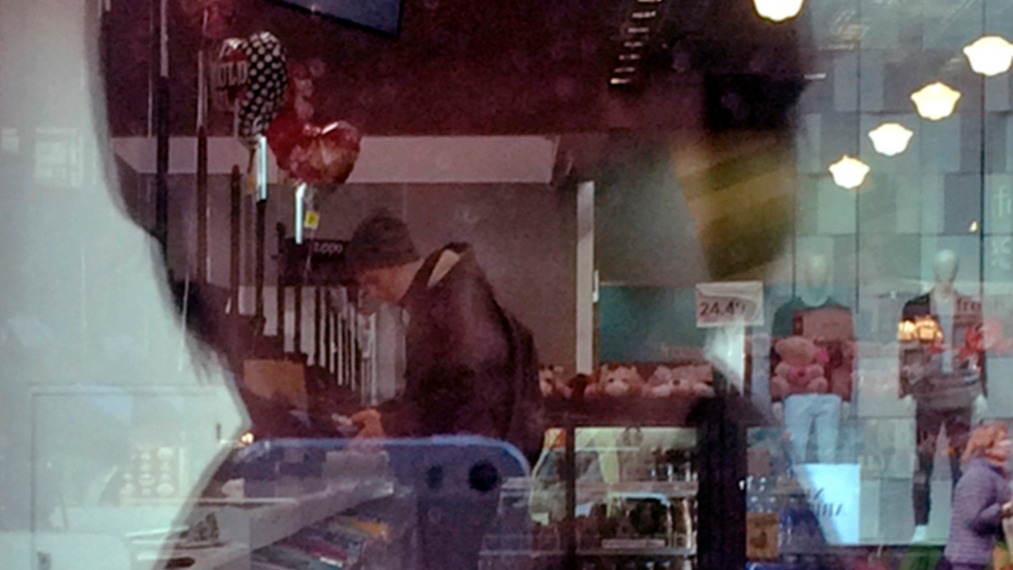
Introducing Department of Design Media Arts Assistant Professor, Lauren McCarthy, ’11 (M.F.A., Design Media Arts). In her own words, McCarthy provides a glimpse into her latest research and practice.

“There is this funny thing where every day I get up with the sunrise at 6 a.m. to prepare and get in place, but I have to wait until they wake up for their location to start broadcasting. In those minutes or hours, I get a coffee and feel a nervous anticipation. As the minutes pass, I worry that they didn’t get the notification, or that the app failed somehow. All this while imagining them in bed sleeping, not knowing this has even begun…”
I am fascinated by the systems and structures for being a person and interacting with other people in modern society. How do we build relationships and identity, and how does technology shape this process? I start with the social situations that feel most confusing or limiting to me, and I use technology to create disruptions meant to reveal underlying expectations and systems of control. This research takes the form of software applications, performances, videos, and interventions in everyday life. With my work I hope to create moments of improvisation, connection, and new ways of relating to each other.
“Camped outside her house, I’m surprised by how scared I feel. I’m looking suspiciously at each of her guests as they pull up to her house, worrying that they’ll notice me. I feel like I’m doing something wrong even though she has asked for this. I guess it is the act of hiding that induces guilt.”
For the past few weeks, I have been doing a performance called Follower. Follower is a service that provides interested individuals with a real life follower for a day. In order to be followed, you sign up on a website and are asked to answer two questions:
Why do you want to be followed?
Why should someone follow you?
If you are selected, you are given an app to download…and then you wait. You don't know when it will happen. One morning you are notified that it has begun. The following lasts one full day – it will begin promptly at sunrise and end sometime after sunset. At the end of the day, you are left with one photo of yourself, taken by your Follower. The Follower stays just out of sight, but within your consciousness. What you don’t know is that I, Lauren, am your Follower.
“I like the feeling of being completely at the whim of another. They control where I go and what I do. Each time he ventures in a new direction, I feel dizzy with excitement. Where is he going? Where will we end up? By the end of the day, I start to make guesses, feeling as though I have some unique insight and know him. I’m almost always wrong.”
What is the relationship between attention and surveillance? There are websites at which you can buy online followers: $10 can get you 1000 followers. We have this intense desire to be seen, to feel connected. But is that desire really fulfilled by watching your follower count tick upward? Could a real life follower provide something more meaningful or satisfying? How does this fit with our fear of surveillance? We imagine "the man" or Google or the government watching us, but does it feel different if we know that it’s a real live human?
“I end up really liking every person I follow. Are these people performing ‘nice people’ because they know I’m watching them? Or does imagining their thoughts and paying such intimate attention to them cause me to empathize and appreciate them more? Or are people just more attractive to me when I don’t have to interact with them?”
In a previous project, Social Turkers, I went on a series of dates with people I met online and live-streamed video of these encounters to the internet, where I enlisted hundreds of people—all of whom were paid—to watch me and to direct my actions: to tell me what to say and do. I used an online service called Amazon Mechanical Turk to facilitate this crowdsourced labor. I wanted to see if a crowd of impartial observers would be able to make better social decisions than I could for myself. If I removed my own head from the equation, would I find love?
“He’s not smiling and I worry that he’s not enjoying this. But I realize that most people probably don’t smile a lot when they’re alone.”
In another project, pplkpr, I collaborated with Kyle McDonald to create an app that would pair with a smartwatch that was measuring a person’s heart rate in order to algorithmically determine how the people they interacted with made them feel. The metric that pplkpr used to correlate heart rate with emotional state was called “heart rate variability.” The app would look at the variation in the time interval between heartbeats, with more regular intervals indicating more stressful or aroused emotions, and more irregular intervals indicating more calm or bored states. pplkpr would rank everyone in the user’s life accordingly, auto scheduling time with people that made them feel good and deleting the contacts of people that stressed them out.
“I’m sitting a few seats away from her, stealing glances while we both slurp noodles. I wonder if she is wondering if I’m her Follower? If she is thinking of me while I’m thinking of her? If this connection between us—that is completely guiding my day—is shaping hers as well?”
I embrace ambiguity, often positioning my work in the gray area between utopic and dystopic, pleasurable and uncomfortable. Amidst rapid technological development and social discourse, it is easy to dismiss something new with a knee-jerk reaction of like or dislike. However, the innovations and societal changes we are seeing aren’t black and white. To productively move forward, we need to engage with their inherent tensions and questions. Through my work, I hope to create spaces for people to engage, question, and realize the agency they have to decide how they want to live in the world.
“...I leave him at the end of the day. I felt so close to him all day, as if we were making little gestures toward each other that can’t ever be acknowledged or confirmed. And then after the entire day together, we leave each other, without ever saying a word or meeting eyes.”
To learn more, visit http://lauren-mccarthy.com
JOIN THE CONVERSATION
Stay engaged. Follow us on Facebook, Twitter and Instagram. Use #UCLAarts to stay connected.
Subscribe to our mailing list to receive this quarterly newsletter directly to your inbox!