Barbara Kruger Forever: The essential artist talks Ikea, Trump, hypebeasts, sex, and power.
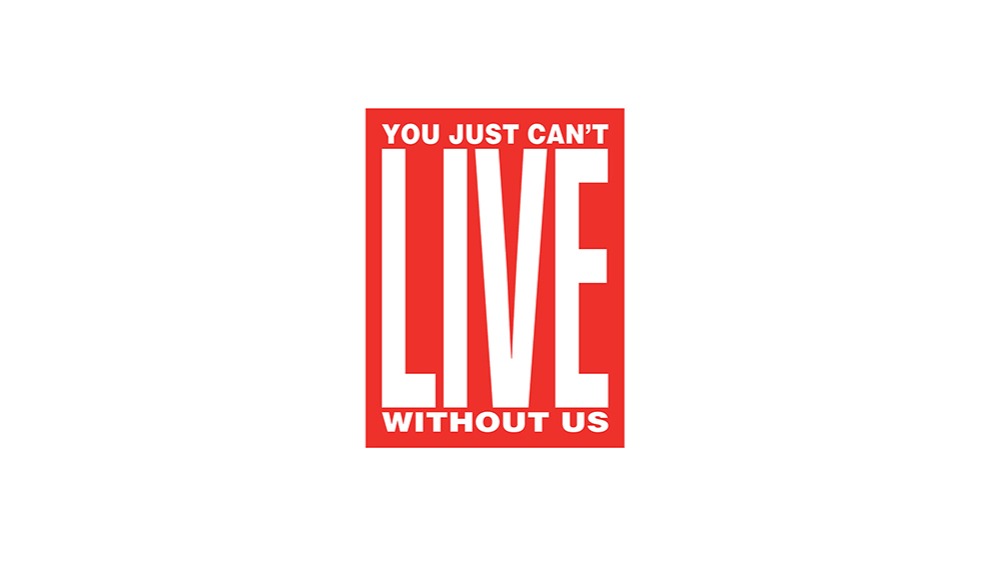
UCLA Department of Art Professor and American conceptual/pop artist Barbara Kruger is best known for laying aggressively directive slogans over black-and-white photographs that she finds in magazines and other ephemera or over fields of red. Her work largely addresses cultural constructions of power, identity, and sexuality.
"I met artist Barbara Kruger on the day after Christmas: the fourth-biggest shopping day of 2017 and one of the coldest. “They’re returning things already,” she said, gesturing toward the bundled figures hustling past an Upper West Side Le Pain Quotidien. Kruger would beat the worst of the cold snap, flying to Los Angeles, where she teaches at UCLA and lives half the year. Her Boxing Day errand was to mail some books to herself there.
Kruger is best known for text and image pieces that prompt you to assess your relationship to consumerism — “I shop therefore I am” and “You want it. You buy it. You forget it.” — although her nearly 50-year CV covers many isms across many media. Her background is in magazine design, and perhaps as a result, her work is eye-catching, easily transmitted, and frequently ripped off. It’s a phenomenon that both amuses and inspires her. In 2011, she made a wall piece collaging hundreds of Kruger look-alikes that she found on the internet, and in November, she staged her first-ever performance: a flash sale of Barbara Kruger merch modeled after a “drop” from Supreme, the skatewear brand whose logo mimics the white-Futura-on-red text treatment that she layers over black-and-white photographs.
Asked about Supreme, Kruger is blasé. “I don’t own a font,” she said. Partly, this is a function of her work, which gives an ambivalent voice to the lurking influences of money and power, butdoesn’t get in the weeds of small-time copyright battles. But, partly, it seems to be a reflection of Kruger’s disposition: an affably astute, inveterate city kid (Kruger grew up in Newark) who is too private to properly feud. Kruger dreads public events, marveling at her students’ passion for openings. “I love the moments between events,” she said. Even the holidays appeal primarily as “an empty square on the calendar.” “I don’t find it depressing,” she added. Kruger doesn’t have a social-media presence, and she dislikes being photographed. When gallerist Mary Boone arranged to have Kruger’s portrait taken by Annie Leibovitz, Kruger consented only to an image of her image, broadcast via closed-circuit television in an electronics-store display on 14th Street.
All of this makes Kruger logical catnip for hypebeasts. Who’s cooler than the person who doesn’t come to the party? But her critical distance also makes her a deeply satisfying observer of media and culture. A self-described news junkie, she isn’t on Twitter and Instagram, but she followsTwitter and Instagram, and she is quick to rattle off the brands that her students like (Stussy, Virgil Abloh, and, yes, Supreme). She’s thinking about how the reception of her work is changing, observing — “without judgment” — that it will be reproduced in miniature on phones. And, as uncomfortable as she seems with contemporary standards of personal exposure, she is at ease in the realm of the abstract. As in her work, she quickly distills dissertation-worthy topics into stuff you want to put on a sweatshirt. “History is a circle jerk of hurt and damage,” she told me at one point. Talking to Kruger makes you think that anecdotes are a crutch."— Kat Stoffel, Feb. 2, 2018
This post is an excerpt, read the full article on The Cut's website.
Read more about Barbara Kruger.
Read more about the UCLA School of the Arts and Architecture Art Department.
Stay engaged. Use #UCLAarts to stay connected.


