Artists Teaching Artists
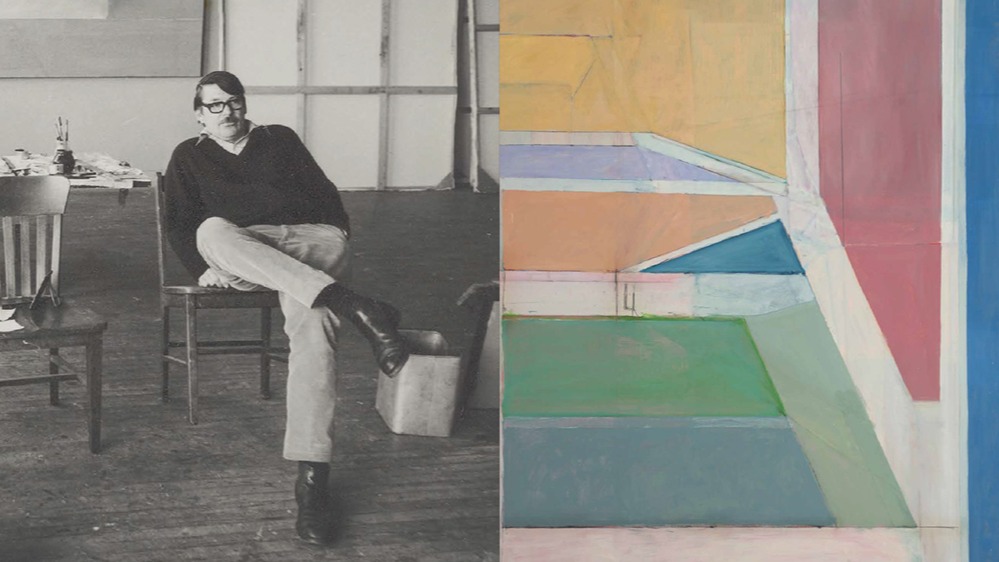
Since the 1960s, UCLA’s visual arts program has attracted premier working artists to nurture the next generation of talent.
"Tony Berlant, who grew up in Culver City in the 1950s, aspired to be an artist from an early age. “As soon as I had a car, I didn’t go to the beach, I went to the museums and around to every gallery — there weren’t that many — twice every month,” he says. In 1960, when Berlant entered UCLA as an undergraduate, renowned painter William Brice, who was on the faculty, must have recognized his talent right away. He placed him in an upper-division painting class taught by visiting artist Richard Diebenkorn.
Berlant was thrilled. “I had admired Diebenkorn’s work from the time I was in high school,” he remembers.
In fact, UCLA Chancellor Franklin D. Murphy had taken great pride in recruiting Diebenkorn, whom he later called “one of the half-dozen most distinguished practicing painters at the time.”
Diebenkorn, from San Francisco, was associated with the Bay Area Figurative Movement of the 1950s and 1960s. But his greatest acclaim was for his 135 Ocean Park paintings, inspired by the light and space of Southern California and created after he moved south to teach at UCLA. These abstract creations are counted among the defining bodies of work of the late 20th century."
“When I was a student of Diebenkorn’s,” Berlant remembers, “he was already very famous. What you get from people like that is their attitude, dedication to independence, curiosity and focused obsession.”
But, Berlant says, famous or not, many of his UCLA teachers were tremendously smart, influential and supportive. Painter Elliot Elgart, for example, encouraged Berlant to change his major from art history to studio art, pulling him aside occasionally to coyly ask, “You know you’re great?” After Berlant made the switch, Elgart laughingly whispered in his ear, “You’re not that great.”
The ’60s were a singular time for art in Los Angeles. With cheap rent, plentiful light, good art schools and typical California verve, visual artists were blossoming here. The Los Angeles County Museum of Art opened in 1965. The nearby Ferus Gallery was a center of the nascent contemporary art scene. And midway through the decade, English painter David Hockney arrived to teach a summer class at UCLA, fell in love with the city and decided to call it home.
Changes were under way at UCLA, too. Murphy didn’t want students to “dabble in the arts” but to be “professionally trained.” So, in 1961, he formed the College of Fine Arts, helmed by an eclectic mix of exceptional working artists, including Laura Andresen (ceramics), Diebenkorn (painting), Brice (painting), Robert Heinecken ’59, M.A. ’60 (photography), Bernard Kester ’50, M.A. ’54 (weaving) and Lee Mullican (painting).
This stellar faculty nurtured a dynamic generation of students that included Neda Al Hilali ’65, M.A. ’68; Peter Alexander ’65, M.F.A. ’68; James Bassler ’62, M.A. ’68; Berlant ’62, M.A. ’63, M.F.A. ’64; Judy Chicago ’62, M.A. ’64; Vija Celmins M.A. ’65; Charles Garabedian M.A. ’61; Lance Richbourg ’60, M.A. ’62, M.F.A. ’67; and Don Suggs ’69, M.A. ’71.
“The main thing that made UCLA unusual,” Berlant notes, “was the particular set of students who were there at the time. That was easily as important as the teachers, who were excellent."— Stacey Abarbanel, Dec. 13, 2017

This post is an excerpt, read the full article at the UCLA Magazine website.