Artists on the front lines: how designers are fighting COVID-19
"This is our moment,” artist Victoria Vesna declares. “This is what we were preparing for.”
Vesna has long worked at the intersection of art, science and technology, and she is now witnessing innovative collaborations between artists and medical researchers to slow the spread of the novel coronavirus.
Vesna is a professor at the UCLA Department of Design Media Arts, and she directs the Art|Sci Center, a joint effort of the School of the Arts and Architecture and California NanoSystems Institute. She spoke to UCLA Arts about the “teachable moment” we’re in, and how those lessons are making their way into her remote classroom lessons.
Vesna: The community has just been, from day one, so incredibly active online, on social networks, in the trenches with hospitals. And also thinking of ways to expand the communication about it, offer alternative views. It's really fantastic actually, because artists and in particular media artists who are really well versed in technologies, hacking things and moving quickly to develop programs and softwares and interface design, this is a place where it's a natural intersection. Because we all use the same tools. If a media artist enters a science lab, it's familiar territory. It's similar types of technologies.
And now scientists are incredibly busy, obviously, and they have to be absolutely full-on focused. And, so it's really up to us to be helping put things out as far as communication goes and ways that are not just throwing more panic into the air, but really thinking about what are we doing at this intersection and how can we shift after the virus slows down. This is really a big discussion now. But yeah, I think that artists, especially working with technologies have a big role to play. And I include this in my classes. I've shifted everything to be enshrined in our current situation and to call on the students to use their skills and use their knowledge to figure out ways where they can help.
UCLA Arts: You are teaching a class right now on biotech, nanotech and design, and you are recording Zoom interviews with designers who are directly responding to COVID-19, including a former student of yours who is creating a ventilator prototype. Can you tell me about some of the projects that these designers are doing?
Victoria Vesna: One of the first interviews I did was with Aisen Caro Chacin, who I met initially at the Parsons New School in New York when I was a visiting professor there to introduce art and science in 2013. Her PhD was all about echolocation and visuospatial assistive devices that were meant for people who have visual problems, blindness, etc.
After she finished her PhD, she got work at a hospital in Texas. That was one of the first places that actually had a prototyping lab, which for her was a dream job. And she got hands on in there with Dr. Chris Zahner, a medical doctor. They really got along well and when he found out about what was going on with the pandemic, he immediately thought they should do something.
Their emergency ventilator is such a smart design that's open source and meant not only for that hospital and preparing for the wave coming to Texas, but also for quick prototyping and putting together these devices for third world countries and countries where they just cannot afford to have these devices. And to me, this is such a perfect example of how these two worlds come together in a way that can be so beneficial.
So I'm hoping to encourage other scientists to invite media artists who are eager to do something, by seeing this, and especially with UCLA and the medical school, we should have more people who are creative, those who know technology, programming, software, robotics, and who can really get in there hands on. We're also used to working really quickly and developing things quickly.
UCLA Arts: And you had another example of an artist who's making origami masks.
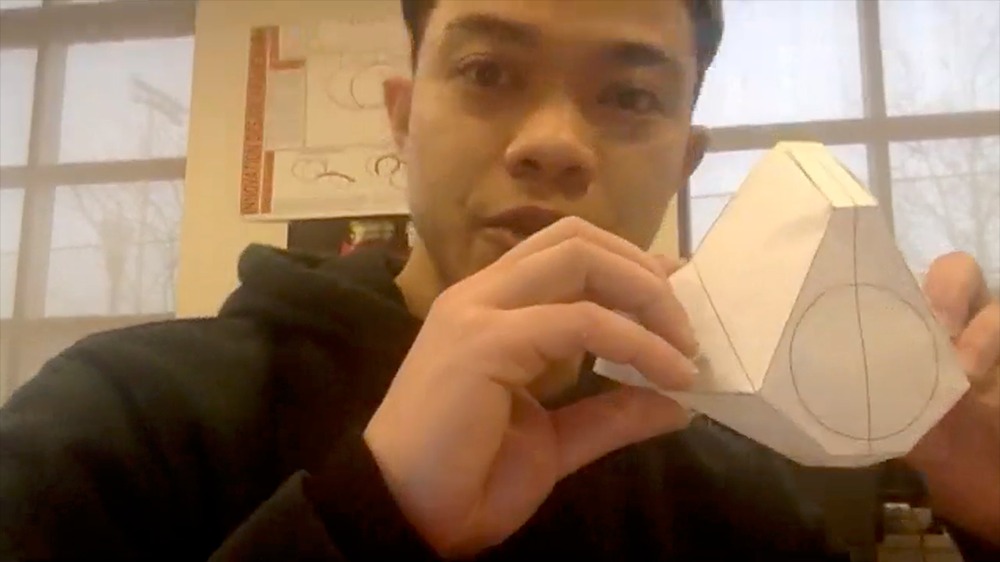
Victoria Vesna: A young student, Alex McDonald, is developing this wonderful device that actually is trying to solve the problem of having to replace these masks all the time. So he created a 3D print that then is covered with these origami masks, which you can use and reuse. And now both of these examples are in discussion and are on fast track with hospitals and the FDA to see how they can make this happen. Additionally, they're gathering people to collect and donate masks and it's been amazing.

Alex McDonald shows Victoria Vesna the origami mask that he 3D printed. Screenshot via Zoom conversation on Vimeo.
What I liked about him in particular is that he's 24. He's in this lab. He got access through his professor, and he's really using the skills of 3D printing and media arts and design and the professor’s remotely and occasionally meeting with him and talking to him and mentoring him. So it's another way of education where it's on the ground, all hands on deck and we're doing remote, but some people can meet and actually do this on site. It's quite exciting.
UCLA Arts: Shifting gears to your own work, you just opened a show called Alien Star Dust that looks at micrometeorites and among other things, issues like borders, pollution, and how dust carries bacteria and viruses. It seems very timely to what we're going through right now. Can you talk a little bit about that project and how you see connections between it and this global pandemic?
Victoria Vesna: It's been quite a journey with that project, I have to say. I was invited to do an installation at the meteorite gallery at the Natural History Museum by the director a few years ago, and I was stalling and I wasn't quite sure what to do.
I worked on another project with plankton in Vienna. Long story short, I found out about micrometeorites, which a hundred tons of day fall on earth, and I thought, this is really interesting. And eventually I figured out how to create this project where you enter into a space where it all kind of looks beautiful and this dust is falling on you.
And it's these animations and 3D prints of micrometeorites that I was working with Alex McDonald and the team on, and you realize that yes, we looking up to Mars and we're looking up to meterorites and thinking about space, but really we're part of this larger cosmology. So I just was thinking it's really time to start thinking of ourselves as planetary citizens because this dust travels and is causing a lot of pollution. But there's no place on earth that's separate, really. You're seeing this dust and you suddenly see the coronavirus and it's moving around and it keeps going like that to every part of the planet.
And you should be also aware that viruses can hitch rides on dust. So it's quite possible that these respiratory diseases actually travel with the various dust, and it's such a complex system between aerosols and dust. So I tried to teach this in my classes in addition to doing it through my work.
Stay engaged. Use #UCLAarts to stay connected.


