ARTISTS AT WORK: MELEKO MOKGOSI
Meleko Mokgosi M.F.A. '11 featured in Interview Magazine
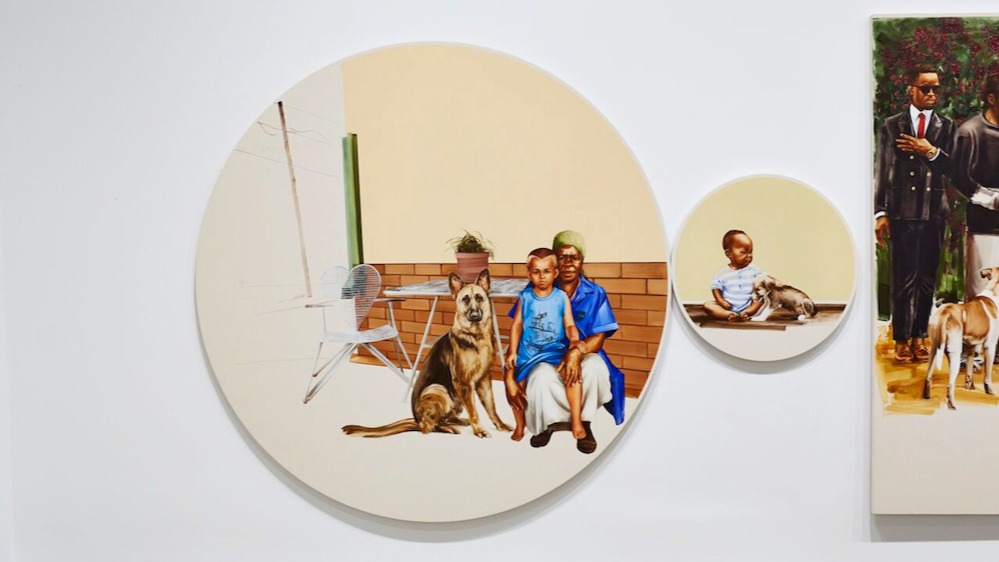
Alumnus Meleko Mokgosi (born in Francistown, Botswana), M.F.A. '11, is an artist who works within an interdisciplinary framework to create large-scale project-based installations. Mokgosi works across history painting, cinematic tropes, psychoanalysis, and post-colonial theory. His studio program interrogates narrative tropes and the fundamental models for the inscription and transmission of history along side established European notions of representation in order to address questions of nationhood, anti-colonial sentiments, and the perception of historicized events. His series, Democratic Intuition (2014-Present) aims to ask questions about how one can approach ideas of the democratic in relation to the daily-lived experiences of the subjects that occupy southern Africa.
"This summer, during group shows and ahead of fall exhibition openings, we’re visiting New York-based artists in their studios.
Meleko Mokgosi paints his subjects at just above life size. It’s an artistic sleight of hand that makes the figures seem poised to step off the canvas and into the room—or, rather, float off into space. His paintings take on a dream-like quality: they are meticulously rendered, fragmentary (some appear unfinished), imbued with magic and portent, and full of symbols, animals, faces obscured by darkness.
Mokgosi is less interested in dreams, though, than he is in looking to the past. He was born in Botswana in 1981 and moved to the United States to study art at Williams College. He received an MFA from UCLA in the Interdisciplinary Studio program, and now teaches full-time at New York University. Though he claims that he is “no academic, just a painter,” he combs through the past like a historian, looking to form a clearer picture of the present. A voracious collector and reader (of topics like postcolonial and gender theory), it is only after months of research that his brush touches the canvas. And when it does, everything is brought into dazzlingly high relief.
In September, Jack Shainman Gallery will present Mokgosi’s first solo show in New York at both of its Chelsea locations. The show focuses on two chapters of an ongoing project that Mokgosi calls “Democratic Intuition.” Its first iteration was shown in 2015 at the Institute of Contemporary Art in Boston.
MATT MULLEN: It’s less than a month until your show. How have you been feeling?
MELEKO MOKGOSI: It’s really terrifying. I’ve been living here for five years, but this is my first New York solo exhibition.
MULLEN: That’s a big deal!
MOKGOSI: Some would say so. You know, New York bills itself as the cultural capital. Obviously we know that’s not true, but we still feel it. So I’m nervous. I’ve been here for a while. It’s where my institution [NYU] is. It’s like sharing your backyard. I think the most important thing for me is if one or two people can see what I’m trying to do and find the ideas interesting, then I’ll be happy.
MULLEN: Can you tell me about those ideas?
MOKGOSI: This project began in 2014. It’s called “Democratic Intuition.” My previous project was about the idea of nationalism; it was basically trying to understand things like xenophobia. Things like why people, at a certain time or period, become so nationalistic. I tried to really pose these questions but not come up with any big theory or answers. It just came from this place of, “What is going on? I can’t understand this.” And after that project I was stuck. I thought, “What the hell am I going to do?” Slowly I started thinking about democracy. How can we—without majorly philosophizing it and making it an academic thing—how do ordinary people understand this thing of democracy? How do we have access to it? Who has access to it and who doesn’t? That also came through [Indian scholar] Gayatri Chakravorty Spivak’s work and how she’s trying to understand democracy. She’s a superstar intellectual and the first person to translate Derrida into English, actually. So she’s kind of a big theory person—a theorist, a feminist. And at the same time, Axel Honneth, who’s a German theorist, he also wrote a book on the idea of democracy. I’m always looking at theory and history.
At its most basic, the project is about how do normal people understand, reciprocate, have access to, and not have access to the ideas of democracy and the democratic … I’m thinking about things like education, things like gender, sexuality, ethnicity, nationality. And even just the nation state—who has access to the nation state and who doesn’t? If you’re an illegal immigrant and you live in New York, you don’t have access to the state. You don’t know how to use the state. You can’t vote. And that means already that you’re outside of understanding of the democratic, right? That’s long-winded, but that’s basically it."— Matt Mullen, Aug. 11, 2016

This post is an excerpt, read the full interview on the Interview Magazine website.