Artists at Work: Candice Lin
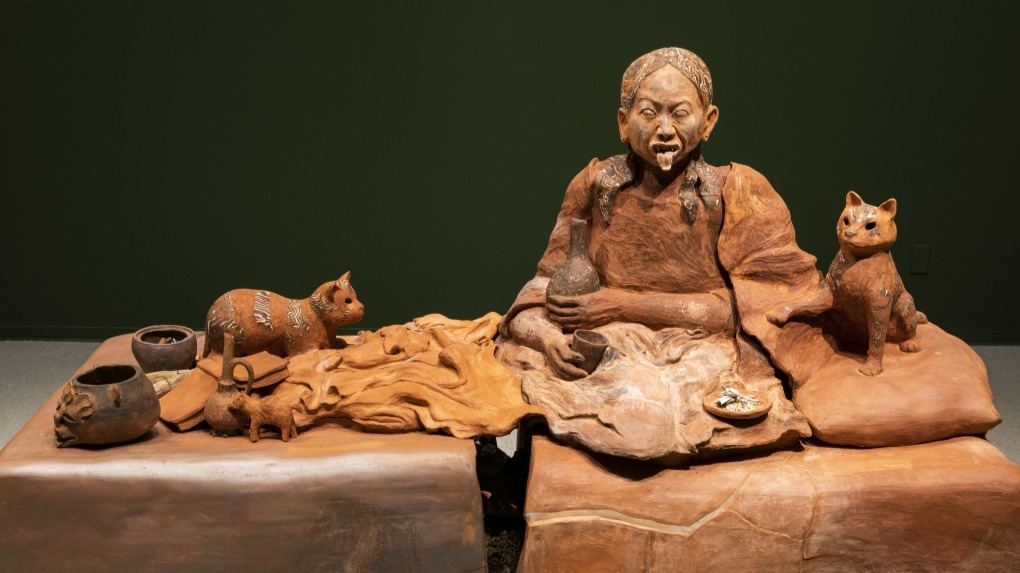
Candice Lin is an assistant professor in the UCLA Department of Art. Lin is an interdisciplinary artist who works with installation, drawing, video, and living materials and processes, such as mold, mushrooms, bacteria, fermentation, and stains.
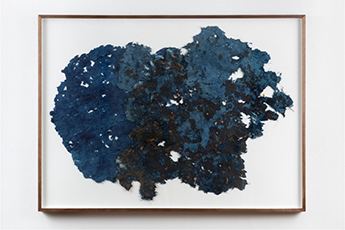
Map to an Unknown Sea, Candice Lin, 2018. Indigo, sugarcane fibers, opium poppy stems, yucca, cotton rag pulp; 58.5 x 42.75 x 2 inches. Installation view from “Pigs and Poison” at Govett-Brewster Art Gallery, New Zealand. Courtesy of the artist. Candice Lin is an interdisciplinary artist whose research-based practice lends itself to sculpture, drawing, video, ceramics, and installation. In her work she offers a number of windows through which to encounter the colonial histories deeply embedded within her materials. A multi-sensorial endeavor that allows for animate and (in)animate bodies to co-exist, living beside and within one another, Lin’s work further expands the idea of panpsychism. In the following interview, we discuss her past and current projects as well as her upcoming exhibitions.
Silvi Naçi: Ever since I heard you speak at the Hammer in early 2019, I’ve been thinking a lot about redistribution of power in the material world, and reimagined futures, intertwined with the effects of decolonization and the internal colonizer that’s left behind, which Frantz Fanon speaks so beautifully to. What possible futures do you imagine for land and people had we done things right and respected the earth and indigenous life? Can you talk about these reimagined worlds and the interactions happening through the cultures and colonial histories of your materials?
Candice Lin: I don’t know if I’m optimistic enough to imagine a space uncontaminated by colonization. I feel like the fabric of my being and existence is so interwoven with the violences of colonialism and imperialism that it’s not just that I’m making work from a position of internalized colonization, but that there is no way I could ever stand outside of or have an exterior separate from colonization. My interest in indigo began from a tactile response to its color, both in the dye pot and in the fabric. And this interest deepened as I learned about how this material, this plant, traveled across so many different global trade routes.
I was interested in how many cultures had their own regional and specific imagery using indigo that transformed through colonization and cross-cultural influences of the global trade. For example, 19th century Nigerian Adire prints meld British colonial imagery of the crown, the king and queen, and the Union Jack with traditional geometric motifs representing philosophical ideas or local flora and fauna. Even the methods of how the designs were applied changed — from being drawn from cassava paste with a chicken feather to being stamped through a stencil that used a flattened metal tea tin (an off-product of global trade during British colonization between all of its colonies). This changed the crispness and gestural qualities of the line drawing designs. The same kinds of hybridization of techniques and imagery can be seen in Japanese katazome (rice paste resist-dyed indigo) textiles as well, which reflect cross-cultural influences from China, Portugal, and other countries despite stringent restrictions on foreign access from the 17th-19th centuries. "— Silvi Naçi, Dec. 1, 2020


This post is an excerpt. Read the full article on the East of Borneo website.
Read more about Candice Lin.
Stay engaged. Use #UCLAarts to stay connected.


