Artist Barbara Kruger is still right about everything. Let’s listen up.

UCLA Department of Art Professor Emerita and American conceptual/pop artist Barbara Kruger is best known for laying aggressively directive slogans over black-and-white photographs that she finds in magazines and other ephemera or over fields of red. Her work largely addresses cultural constructions of power, identity, and sexuality.
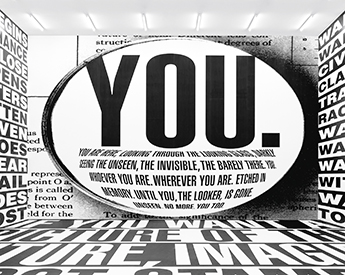
Barbara Kruger’s “Untitled (Forever),” 2017. Installation view, Sprüth Magers, Berlin, 2017–18. (Amorepacific Museum of Art (APMA), Seoul. Photo by Timo Ohler/courtesy of Sprüth Magers.) No self-respecting lefty college kid in the 1980s and ’90s was without a reproduction of something by Barbara Kruger. Perhaps it was her black-and-white image of a hand holding a message in bold, white-on-red type: “I shop therefore I am.” Or the iconic distillation of how the oppression of women has played out for centuries, printed over a woman’s face: “Your body is a battleground.”
They circulated as postcards, magazine clippings and unauthorized photocopies, stuck to the refrigerator with magnets, tacked to your dorm-room corkboard or taped to the composition books in which you recorded lecture notes. Some people wore them on their bodies, emblazoned on T-shirts at anti-apartheid protests and ACT UP marches for AIDS awareness.
“Thinking of You. I Mean Me. I Mean You.,” an extensive and engaging Kruger exhibition that opened at the Art Institute of Chicago last month, is her first major solo show in two decades. In the four decades since Kruger emerged as one of this country’s most uncompromising conceptual artists, the media landscape has changed almost beyond comprehension. But Kruger has kept up with it, turning to different modes of presentation and media, refining her messages, sharpening her wit. As new generations encounter her work for the first time, they will find it as bracingly smart as when their parents discovered it.
Kruger’s text-based art emerged from her experience as an artist and a magazine designer and from her wide reading in feminism, critical theory and other disciplines. Early works from the 1980s and ’90s, known as paste-ups because they were made with the same cut-and-paste design method common to magazine and print layout, combined trenchant and ironic distillations of social theory with found images. Kruger, 75, now works in both New York and Los Angeles, where she is on the faculty at UCLA’s School of the Arts and Architecture.
Pithiness was part of her work’s appeal. But also, truth. Kruger was a natural at literary and philosophical condensation, and presented her insights with a visual sophistication born of close study of advertising and propaganda. For students drowning in recondite texts about feminism, media and Marxism, Kruger’s work cut through the theoretical verbiage with razor-sharp epigrams.
Several of those early works are on view in Chicago, along with more recent installation pieces, sound works, video and wall-size text pieces that recast earlier motifs and ideas. An untitled 1988 work combines the words “we don’t need another hero” with a campy image of a girl admiring a boy flexing his nonexistent biceps. The image underscores the innocence that precedes masculine bravado, and then deflates the very idea of heroism itself, a daring idea in a society that uses the word reflexively and often indiscriminately to valorize state power. — Philip Kennicott, Oct. 4, 2021


This post is an excerpt. Read the full article on the Washington Post website.
HEADER IMAGE: A still from Barbara Kruger’s 2020 video “Untitled (No Comment),” which uses cats and other memes to deflate the power of online media. An exhibition of her work in Chicago shows Kruger keeping pace with changes in media culture since her early work of the 1980s and ’90s. (Courtesy of the artist/Sprüth Magers and David Zwirner, New York)
Stay engaged. Use #UCLAarts to stay connected.


