Art Review: Catherine Opie

Catherine Opie joined the UCLA Department of Art faculty in 2001. One of the preeminent artists of her generation working with photography, Opie is known for her evocative images of contemporary America that have been featured in major museum exhibitions around the world. Opie has chosen a myriad of subjects throughout her career, including the S/M community, city buildings, domestic life, high school football players, surfers, and President Barack Obama’s first inauguration. At UCLA, Opie teaches graduate and undergraduate students in photography.
"I believe in bearing witness in the simplest way
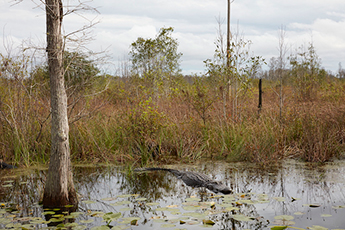
Untitled #2 (Swamps), 2019, pigment print, 102 × 152 cm. © the artist. Courtesy Regen Projects, Los Angeles American photographer and artist Catherine Opie has spent more than three decades exploring identity – what it means, how it’s represented – across numerous bodies of work and subjects that range from queer identity (the 1991 series Being and Having, for which Opie photographed herself and her queer female friends performing masculinity, launched her career) to urban and natural landscapes, to temporary communities, politics and iconographic critique.
Opie’s start as a photographer came at the age of nine, when she picked up her first camera (a Kodak Instamatic) and, having completed a book report on child labour for which she took inspiration from Lewis Hine’s early-twentieth-century series on child factory workers (he was made the official photographer for the National Child Labor Committee in 1908), promptly told her parents that she wanted to become a documentary photographer. “I realised that a photograph could literally have this power to, not necessarily create social change (because I’m not that idealistic), but I think it’s important to create social change if even one’s own community can recognise themselves within the work later on,” Opie tells me, when we meet in London on the morning of the Barbican’s Masculinities opening, in which her series Being and Having and High School Football (2007–09) are included. She goes on to cite Robert Frank, Karlheinz Weinberger, Wilhelm von Gloeden and Julia Margaret Cameron as influences. “I was able to grow up with the great kind of pictorial magazines like Life and National Geographic,” she continues. “So as a kid, for me that was always the way a story began to be told.”
In her most recent series, on show (although affected by closures related to the current COVID-19 pandemic) at Regen Projects in LA, Opie returns to that early inspiration of mid-century print culture. Rhetorical Landscapes comprises nine largescale landscape photographs of the Okefenokee Swamp in Georgia and eight stop-motion animations (all untitled, 2019) shown on giant kiosk screens, styled like smartphones. These last feature a compilation of images cut and collected from magazines and newspapers since the 2016 US presidential election campaign that build up into a collage. “In this day and age where we’re on an iPhone, scrolling through the news, the very validity of photography is called into question,” the artist says. “Everyone’s asking, ‘Aren’t there too many images now, Cathy?’ Well, there’s too much of everything, but it’s about how you decide to disseminate that information. That’s what’s interesting to me – this idea of criticality.” The resulting conflation of cuttings from print media made into political collages, with technology that allows us to access a constant stream of news, brings into focus the highly edited nature of the information we receive.
She goes on to describe how the contemporary political climate, the post-truth era and the way in which society is fed information has led her to make the connection between print culture and the US’s wetlands, both of which are ecosystems vital to preserving, say, independent thought, or keystone species of a particular environment, but which are nevertheless under threat. That Opie includes wetlands in the series is no coincidence given that in American political discourse swamps have represented bureaucratic quagmire, a sentiment popularised during the 1980s and one often referenced by Trump’s borrowed line ‘to drain the swamp’ of federal government (not forgetting his attacks against news outlets that don’t conform to the current government’s ideology by calling them ‘fake news media’).
Despite the fact that Okefenokee Swamp is a protected area, conservationist groups are currently fighting off proposals by heavy mineral mining company Twin Pines, whose project along the eastern border of the wildlife refuge threatens to literally drain the swamp. Opie’s inclusion of the wetlands points to the idea that although they are an icon of that region, they are omitted from the stereotypical visual rhetoric of well-known national sites like Yosemite National Park (the first site to be officially recognised, in 1872, a decision influenced by the photos of Carleton Watkins, later extensively photographed by National Park advocate Ansel Adams and which were also a subject of Opie’s 2018 Hong Kong exhibition, So long as they are wild) that picture the US landscape as a symbol of Manifest Destiny. Most of the 62 listed parks are located in the Western US, and just two are swamps. Opie presents the swamps as quiet, lush and verdant. They are photographed from the wetland’s waterways: natural paths that allow visitors to pass through the ecosystem but also reinforce its impenetrability, reflected here in the opaque, glassy black water."— Fi Churchman, Apr. 1, 2020


This post is an excerpt. Read the full article on the Art Review website.
Read more about Catherine Opie.
Header image: Catherine Opie, Untitled #3 (Political Collages) 2019 digital video on monitor trt: 2:16, looped
Stay engaged. Use #UCLAarts to stay connected.


