Art Lurks in an Unlikely Place for Mary Kelly: the Dryer
Professor Emerita Mary Kelly is known for her project-based work, addressing questions of sexuality, identity and historical memory in the form of large-scale narrative installations. From 1996 until she retired in 2017, Kelly was a professor of Art and Critical Theory in the Art Department where she established an Interdisciplinary Studio area for graduate students engaged in site-specific, collective, and project-based practices.
"LOS ANGELES — There is a peculiar, almost shameful, pleasure in visiting Mary Kelly’s laundry room. A pioneer of conceptual art, she is a model of precision in many ways. Her thinking is rigorous, her speech is eloquent, and her small home and studio up in the hills are sparsely and beautifully furnished with choice midcentury pieces.
Her laundry room, in the corner of a garage overloaded with boxes, seems the opposite: dark, dingy and even a touch ugly, with beige, 30-year-old Maytag appliances and the cheap plastic laundry bins designed to contain a family’s daily spills and stains. With a nod to psychoanalytic theorists such as Julia Kristeva, she calls it “the abject room.”
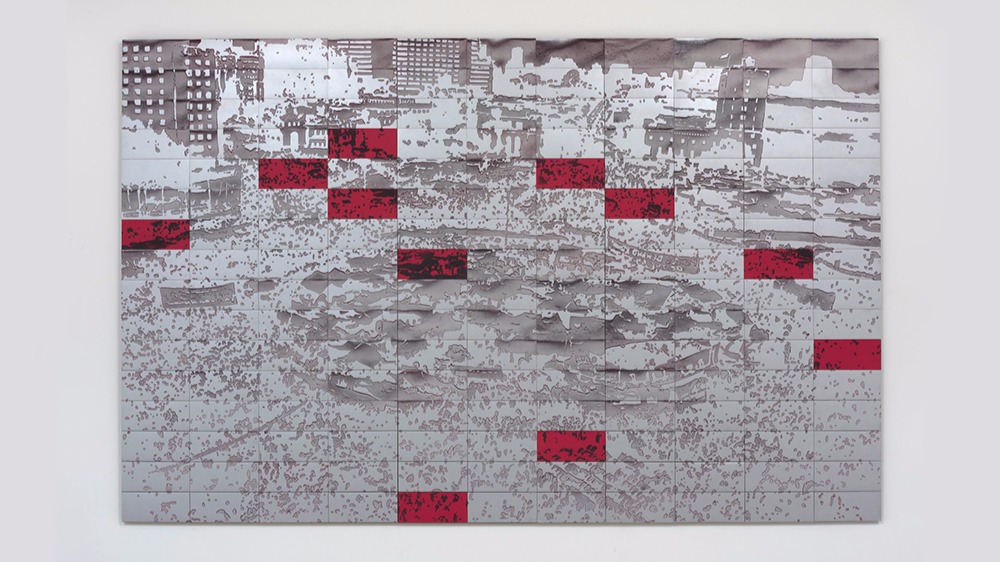
It’s the space unworthy of art in other words, and yet it’s the matrix for so much of her artwork. She first began making images out of compressed lint in 1999, carefully culling the material from a standard lint screen covered with a vinyl sheet that has been laser cut, in what amounts to an intaglio printing process, to create desired forms.
The lint works as pigment and as an ephemeral reminder of daily life or, more specifically, of the never-ending rhythms of women’s domestic labor.
Now, it has become such an integral part of her work that she does thousands of extra loads just to create enough lint, in the right colors, for her artwork: what her husband, Ray Barrie, a sculptor who helped her devise the lint-printing system, calls “fictional washing.” Every piece in her new show at Mitchell-Innes & Nash, through Nov. 22, was made from compressed lint."— Jori Finkel, Oct. 21, 2017

Read the full article at the New York Times website.
Read more about Professor Emerita Mary Kelly here.