Art exhibit review: ‘There’s No Place Like No Place’ encodes language in colorful symbols
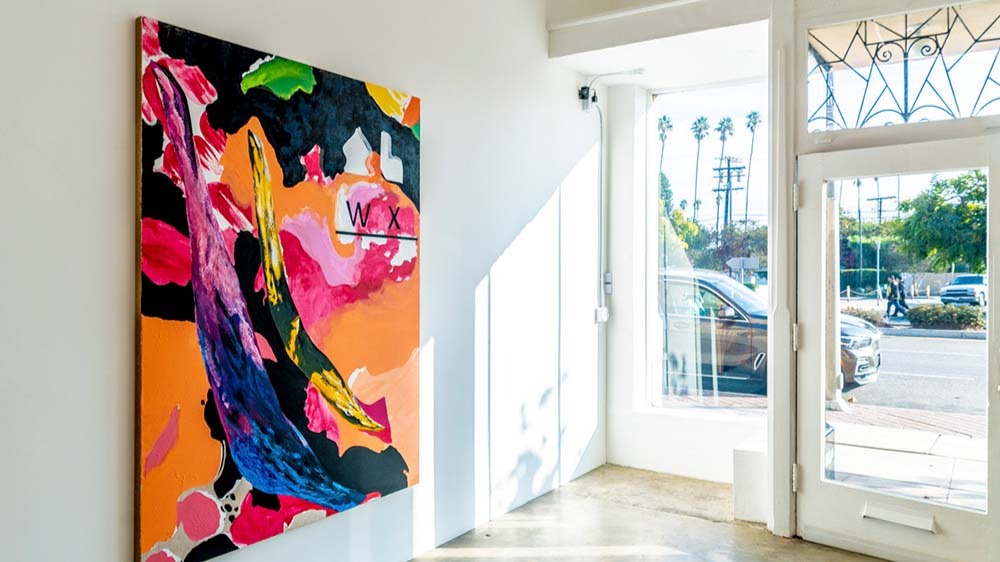
With a background as a hip-hop dancer, August-Salazar explores communication through symbols, categorized as “Abstract Character Copy.” (Lauren Man/Daily Bruin senior staff) No color is left unused in alumnus Lindsay August-Salazar’s latest paintings.
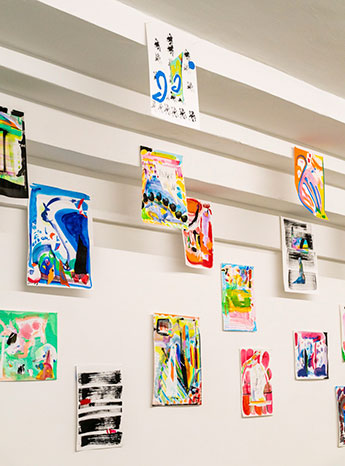
Shown in the exhibit “There’s No Place Like No Place” at Lowell Ryan Projects in Mid-City, six large abstract paintings hang in the sunlight-drenched downstairs gallery. Another painting with blue LEDs is tucked in the back beside a small bar and the entrance to the gallery’s garden. Upstairs, 47 abstract works on paper span the room. The show turns out to be more conceptually difficult and intriguing than one might expect from the bright, pleasant paintings.
August-Salazar’s use of symbols from a language she created is both overwhelming and enthralling. Though the abstract art can be frustrating in its formlessness, August-Salazar’s zeal in her aesthetic and conceptual goals – along with her struggle to create original, meaningful paintings – is as inspiring as the work is visually stimulating.
Walking into the gallery, viewers first see six 78-by-60-inch canvases saturated with color. Bright yellow, blue and orange paint is applied thick alongside darker shades of gray and black. The works that feature blank space and two or three subdued hues exhibit more finesse and consideration from August-Salazar and even painful restraint, as if she wanted to continue the spontaneous free application of paint but held back. The monochromatic black paper works and the painting “Mimicry Illusion Progression” exemplify how August-Salazar’s subtler pieces allow for more contemplation. Still, their power likely comes from contrast with the spontaneous multicolored brushstrokes.
But the paintings are not just swaths of color, as August-Salazar includes symbols from the language she calls “Abstract Character Copy.” With background as a hip-hop dancer, she developed this language from bodily movements and employs it in these pieces – first on paper and then on large canvas. Viewers are only exposed to the language through the symbols – figures vaguely indicative of crowns, shoes, etc. – scattered through the works. Each big painting downstairs uses one symbol as its subject, such as the penguinlike figure in “Tangled Narrative Overlays” or a bananalike form in “(Fleeting Contact) Overhead.”
It can be frustrating knowing the symbols are part of August-Salazar’s linguistic system while not knowing that system or what the symbols mean. Abstract art is typically open to interpretation because the works are emotionally expressive, but interpretations of “There’s No Place Like No Place” will always be partial because only August-Salazar knows the language. This is less a flaw than it is a challenge for viewers – less negative critique than a forewarning of the paintings’ evasive subjects. “What is that?” asked one toddler at the opening Saturday, pointing at the abstract works. “It is art,” his mother responded. This may be the best and only answer one can muster.
The barriers between viewer and art are not from any lack of rigor. There is a palpable intensity in August-Salazar’s methods as well as the works’ conceptual underpinnings and arrangement in the gallery. While a handful of works on paper are striking on their own, the strength of the upstairs gallery is the collection seen altogether as a whole. Any piece alone might seem gleefully whipped together, but the sum of 47 is a startlingly dedicated artistic pursuit. — David Egan, Nov. 1, 2021


This post is an excerpt. Read the full article on the Daily Bruin website.
HEADER IMAGE: Alumnus and artist Lindsay August-Salazar’s exhibit “There’s No Place Like No Place” opened at Lowell Ryan Projects on Oct. 30. (Lauren Man/Daily Bruin senior staff)
Stay engaged. Use #UCLAarts to stay connected.


