Andrea Fraser Interviews
Excerpts from Prof. Andrea Fraser's new book on the occasion of her Hammer exhibition
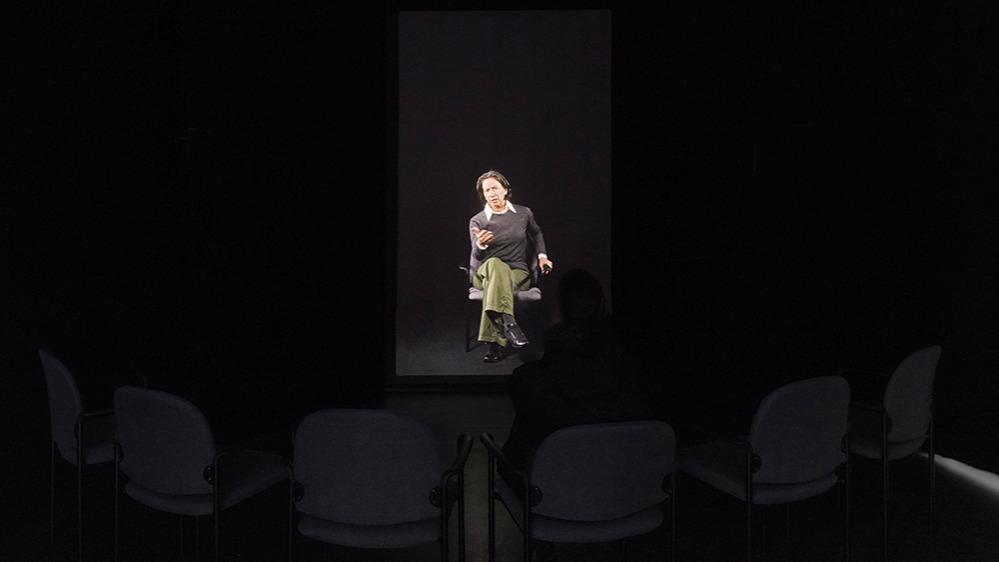
This month, Hammer Projects: Andrea Fraser opened at the Hammer Museum featuring Men on the Line: Men Committed to Feminism, KPFK, 1972 (2012), a video installation by Department of Art Professor and Chair Andrea Fraser. Since the 1980s, Fraser has achieved renown for performances and other works that interrogate social structures with humor and pathos, aligning herself with feminism and institutional critique.
Coinciding with the exhibition is the release of Andrea Fraser: Collected Interviews, 1990–2018, a publication coedited by the art historian Rhea Anastas and artists Alejandro Cesarco and Andrea Fraser, and published by A.R.T. Press and Koenig Books, London. The publication presents the artist’s voice in dialogue with interlocutors ranging from professional peers to journalists from the popular media and contextualizes Fraser’s practice in the artistic, institutional, and discursive fields in which she intervenes.
Fraser is also presenting work in MOCA's just-opened exhibition, The Foundation of the Museum: MOCA's Collection, and will be featured in the Hammer's upcoming group exhibition, Celebration of Our Enemies: Selections from the Hammer Contemporary Collection.
Below are excerpts from this publication on topics ranging from the work featured in Hammer Projects, to her beginnings, to teaching, to the role of art.
| On Men on the Line | On the economics of art |
| On beginnings | On research |
| On site specificity | On performance |
| On institutions | On teaching |
| On the role of art | On critique |
On Men on the Line:
“Emi Fontana invited me to participate in a series of performances inspired by the Woman’s Building, a center for feminist art and culture in Los Angeles. I wanted to do something about the group process that was central to the feminist movement. That interest led me to the archives of the Pacifica Radio station KPFK, which broadcast a lot of programs about feminism in the 1970s. The idea of performing this discussion by ‘men committed to feminism’ resonated with debates about gender identity that have become central to contemporary feminism. It also represents a lost history of the men’s movement that developed alongside the women’s movement. These men reflect not only on feminism but also on masculinity with a vulnerability that remains very rare today. In my capacity as a professor of art at UCLA, I find that young women have tools for addressing gender and sexuality in their art and lives that most young men don’t have.”
FIRST PUBLISHED ONLINE BY THE CORCORAN SCHOOL OF THE ARTS & DESIGN 2013
"The familiar process of group critiques, that are still so much a part of art education today, were transformed by feminist techniques of consciousness-raising groups, where art making was being very directly linked to social and psychological experience—to the personal and the political…
That really transformed art..."
“One of the most radical aspects of the feminist art movement in Southern California, in my opinion, was the shift from individual practice to collective practice on the level of artworks as well as on the level of a movement and on the level of organizational structures. The Woman’s Building was not just a place where a lot of amazing artists did amazing works as individuals: the core of it was the Feminist Studio Workshop, which developed the approaches of the feminist art programs created by Judy Chicago at Cal State Fresno in 1970 and, with Miriam Schapiro and Sheila de Bretteville and others, at CalArts in the early seventies. Women from all over the country, and all over the world, came to participate in workshops in painting and sculpture, performance, filmmaking, writing, printmaking, not only to explore art and develop art practices but to explore themselves and their experiences as women. The familiar process of group critiques, that are still so much a part of art education today, were transformed by feminist techniques of consciousness-raising groups, where art making was being very directly linked to social and psychological experience—to the personal and the political…That really transformed art, to an extent that I may not have realized until I started doing the research that I did for Men on the Line…. It was the feminist art movement above all that opened art to an engagement with the whole range of psychological, and social, and political structures and experiences that defines art today.”
ON THE LINE: ANDREA FRASER DISCUSSES THE PERSONAL AND THE POLITICAL BY STEPHANIE CARDON 2013
On beginnings:
“My earliest memories are of anti-war demonstrations and 'happenings' and watching my mother paint. She stopped painting in ‘69 to do film, photography, performance and to write. Then she got involved in the women’s movement, came out as a lesbian and became a psychologist (my parents divorced). I went from anti-war demonstrations to gay pride demonstrations. My older brothers and sisters went from drugs to eastern spiritualism. I missed most of the drugs, but started in on the spiritualism when I was about nine. It wasn’t an unusual childhood for Berkeley, but unfortunately we had moved to the suburbs.
I only did two years of high school. I dropped out when I was 15. I always made things, but never assumed that I would be an artist. In high school I did theater as well as crafts (they’re big in California). I applied to art school because I thought it was the only kind of college that would accept a high school dropout like myself. So a couple of months later, when I turned 16 in the fall of 1981, I moved to New York and started at the School of Visual Arts. I was still 17 when I began my third year of courses at SVA. I had produced an enormous number of paintings and drawings in less than two years, and they were already being looked at for shows, but I was lost. I was thinking about dropping out again. I was thinking about suicide. I felt crazy and alone. Yoga and meditation were not keeping me together. Then I accidentally ended up in Craig Owens’s class and he saved me! He provided me with a set of reference points and they were Marxism, feminism, psychoanalysis and post-structuralism.
I had an incredibly rich childhood – culturally, intellectually and politically. My family was constantly reinventing itself. There was no particular boundary between the avant-garde traditions in my mother’s artistic background, the counter-culture we were in the midst of and the socially transformative politics and self-transformative practices we were engaged with. But it was all a big mish-mash in my head. And by 1983, it was already history – a history I didn’t really share with anyone around me. The critical, theoretical frameworks Craig introduced me to gave me a way of translating the values and experiences of my childhood into a shared public discourse. In his class I also began to find people I could share it with: Gregg Bordowitz, Mark Dion, Tom Burr. I did drop out of SVA, but with Craig’s help I was accepted at the Whitney Independent Study Program at the end of that year. I started there in January 1984.”
INTERVIEW WITH ANDREA FRASER YILMAZ DZIEWIOR 2003
"I had an incredibly rich childhood – culturally, intellectually and politically. My family was constantly reinventing itself. There was no particular boundary between the avant-garde traditions in my mother’s artistic background, the counter-culture we were in the midst of and the socially transformative politics and self-transformative practices we were engaged with."
“In 1979, when I was in the eighth grade, I cut school with one of my classmates and took the bus from Berkeley to San Francisco for the pre-opening of Judy Chicago’s The Dinner Party at the San Francisco Museum of Modern Art. My classmate’s mother had worked on it so she had an invitation. I remember sitting with my mother and her friends and looking through the book of The Dinner Party. So both the political and the artistic sides of the women’s movement in California were part of my childhood.”
ON THE LINE: ANDREA FRASER DISCUSSES THE PERSONAL AND THE POLITICAL BY STEPHANIE CARDON 2013
“Even before I ‘found theory’ my paintings and drawings were all about contradiction, juxtaposing perspectives and modes of representation that cancelled each other out. The superimposed images in my 1984 book Woman 1/ Madonna and Child 1506–1967 were a direct extension of that very early work. It was actually Barbara Kruger who gave me the last little push. When I started at the Whitney program I was working on a huge drawing, reproducing de Kooning’s Door to the River in monumental scale, superimposed on an equally monumentalized drawing of a nude by Prud’hon. Barbara took one look at it and said, ‘Oh, this is like find the face in the flower!’ Barbara doesn’t mince words, as we know from her work. Luckily for my fragile young ego she found the superimposed slides I was producing as studies much more interesting.”
INTERVIEW WITH ANDREA FRASER YILMAZ DZIEWIOR 2003
On site specificity:
“Whether that’s art practice or another kind of practice, [site specificity is] the idea that one should essentially start where one is standing.”
THE DESIRE OF MUSEUMS; INTERVIEW FOR UNIVERSITY OF CALIFORNIA, BERKELEY STUDENT PUBLICATION START 1992
“…if you want to transform relations, including relations of power or domination, the only chance you have is to intervene in those relations in their enactment, as they are produced and reproduced. The tricky part is that this almost always also means that you yourself participate in them, however ambivalently or self-consciously.”
IS THIS A SITE SPECIFIC INTERVIEW? ANDREA FRASER INTERVIEWED BY ANDREW HUNT 2004
"If you want to transform relations, including relations of power or domination, the only chance you have is to intervene in those relations in their enactment, as they are produced and reproduced. The tricky part is that this almost always also means that you yourself participate in them..."
“For the most part…I have understood ‘site’ not as physical, geographical, or architectural spaces and places, but as relational, discursive, and also temporal. Site specificity can also be understood as a kind of boundary of critical intervention: the limit of its possible efficacy. Site specificity in this sense implies that a critical intervention is only going to function as such, at best, within the very specific conditions of the historical moment, physical place, and social relationships for which it was conceived.”
WHAT DO I, AS AN ARTIST, PROVIDE?: A CONVERSATION 2002
“What defines my practice is less [the art] field as an object than the practice of examining and intervening on the relations that are dominant in the field of my activity, which happens to be art. I would hopefully do the same thing if it were another field... The reason that my critical practice is about the art world or about museums is because that’s where I function and where that practice is situated. From very early on, my model—which I haven’t really been able to keep up—was that the site of my practice should be every context in which I work, whether it’s a museum or a gallery or a classroom, whether it’s a performance or a lecture, et cetera.”
INÈS CHAMPEY AND ANDREA FRASER 1997
“For me, institutional critique is defined not by its object (art, art institutions) but by a procedure of critical and site-specific reflexivity. I often say that if I’ve made work about museums, it’s not because I find museums particularly interesting—I don’t—but because that’s where I end up.”
“WHAT DO WE WANT FROM ART, ANYWAY? A CONVERSATION” GREGG BORDOWITZ AND ANDREA FRASER 2004
On institutions:
“I don’t think of myself as outside these institutions. I’m working in this field and want to understand its complexity and dynamics. I don’t want to produce interventions that involve disidentifying or misconstructing an insider position as oppositional and as working against the people you’re working with, who are sponsoring you. That’s a kind of bad faith.”
ANDREA FRASER, REESA GREENBERG, AND SANDY NAIRNE 1993
“I began to recognize [a] kind of splitting in artistic anti-institutionalism, in the splitting off of what’s bad in art and ourselves and our practices and using the ‘institution’ as a container for all the shit we want to disown, for our bad conscience, for the failures of our art practices, for the failures of our politics, for our guilty complicity, for our shameful whatever. We put all of that into the ‘institution’ and attack it as something separable from ourselves, denying our investment in it, our connection to it, and what is productive about it…But I realized that institutional critique, with its self-reflexivity and site-specificity, is also an enactment of a profoundly ambivalent relationship to the field of art [and its] institutions. And I came to understand ambivalence, not as a problem for radical critique but as precisely what is productive about institutional critique. But I always have to stress that ambivalence in psychoanalysis is not, ‘I don’t know what I want.’ No! Ambivalence is a painful confrontation between conflicting impulses and affects directed at a single object. It’s when we repress such conflict that we get that kind of wishy-washy vagueness, cynicism, willful naïveté, happy-go-lucky complicity, and a lot of very bad art.”
ANDREA FRASER WITH THYRZA NICHOLS GOODEVE 2016
“I don’t think of myself as outside these institutions. I’m working in this field and want to understand its complexity and dynamics."
“Whether artists and art professionals pursue larger or smaller audiences, the more important question is: Which of our own interests are served by those audiences? Do they represent a progressive, corporate or demagogic populism? An elitism rooted in wealth and social exclusivity? Or the autonomy of a specialized field engaged in the development of its own practices, discourses and values? And what social distributions of resources are reproduced or transformed as we pursue those audiences?”
A TALK WITH ANDREA FRASER BY ANNE DORAN 2016
On the role of art:
“I believe it’s important to create an intellectual space in which social conditions and social relationships can be interpreted and understood and possibly even changed. That’s what I expect from contemporary art. However, I only find it very rarely.”
“I PROVIDE SERVICES” A CONVERSATION WITH ANDREA FRASER BY HANNE WESKOTT ON THE OCCASION OF AN EXHIBITION AT THE KUNSTVEREIN MÜNCHEN 1993
“I still think that the role of art is like that of psychoanalysis: it’s about bringing us to the question of what we want. And one of the ways it does that is through the release of affect that’s gotten displaced, misplaced, alienated and bound up with things it doesn’t really have anything to do with. I mean, what do we want from art, anyway?”
“WHAT DO WE WANT FROM ART, ANYWAY? A CONVERSATION” GREGG BORDOWITZ AND ANDREA FRASER 2004
“I wanted smoke to be coming out of people’s ears. I wanted to short-circuit people’s brains in a way that was about the breakdown of identity or a kind of liberation from signification, and that might provoke laughter or also tears or just a kind of open blankness.”
HIGH TIME FOR HUMOR ANDREA FRASER (IN CONVERSATION WITH JUDY BATALION) 2008
"My goal as an artist these days is to be honest about how impossibly compromised I am..."
“If an artist’s aim is to make beautiful, desirable, seductive things, or to engage formal or aesthetic concerns with no social content, and there are people who want to buy what they produce, there’s no contradiction. But as soon as social and political claims are made for the work – and this is usually a condition of any artistic legitimation – then those claims should be evaluated not only on the level of the content of the work but also on the level of how that work exists in the world. This cannot and should not just be a matter of a few artists taking a stand: the field as a whole, and especially art discourse, must make that a basic criterion. I’ve been struggling with these things for almost thirty years and have not managed to resolve these contradictions in my own practice. I don’t believe there is a pure position. But we can at least strive for honesty about our failure to live up to our ideals and about the conflicts we struggle with and to keep trying to resolve those conflicts, as difficult as it may be, rather than patting ourselves on the back for supposedly having escaped them with some new critical strategy or participatory practice.”
“My goal as an artist these days is to be honest about how impossibly compromised I am, even as I am unable to completely withdraw from an art world I see as deeply corrupt and dishonest and driven by bad faith. But since the art world is no more corrupt or dishonest than the worlds around it, escaping it isn’t really an option, except into utopian fantasies. The self-critical traditions of art at least offer an opportunity to be honest about dishonesty, not to celebrate a triumph over ethics, but to recover what’s at stake for us in what we do.”
ÁNGELA MOLINA, “THE BODY IS ALWAYS AT STAKE,” EL PAÍS 2010
“Artists reserve for themselves the right to rediscover the world, including the world of thought, and to see that world as their own creation. Sometimes we actually do manage to create something new.”
“WHAT DO WE WANT FROM ART, ANYWAY? A CONVERSATION” GREGG BORDOWITZ AND ANDREA FRASER 2004
On the economics of art:
“I’ve been trying to set up a meeting with other artists to get something together—not a union or even a professional association, but to work out the set of guidelines for working with institutions that would cover fees, conditions, the recognition that this kind of work is labor that needs to be compensated, particularly when the production is not, or only partly, transferable. It would also cover issues relating to the integrity of the work. Does work produced in these relations have a different status?”
ANDREA FRASER, REESA GREENBERG, AND SANDY NAIRNE, NEW YORK CITY, NOVEMBER 1993
“What makes it exploitative, however, is not the idea that there might be a ‘fairer’ price for my labor or my artwork. What makes it exploitative is the fact that others have the potential to profit more from my labor than I do myself and that this potential derives from their capacity for capital investment. I don’t believe that there is any such thing as a ‘fair’ price. As soon as one begins to think about compensation in relative, comparative, competitive terms—'fair’ or ‘unfair,’ ‘a lot’ versus ‘not enough’—one accepts a market logic. In accepting a market logic, one also accepts the reduction of one’s labor and its products to commodity status within that market. And one also accepts the legitimacy of that market to determine their value. But markets are never ‘fair’: someone always gains and someone always loses.”
“WHAT DO WE WANT FROM ART, ANYWAY? A CONVERSATION” GREGG BORDOWITZ AND ANDREA FRASER 2004
“…if you look at the documents around the unionization of MoMA [in the 1960s], one of the demands the staff made to the museum was to seek more public funding. Did that have anything to do with their material or practical interests? It had to do with insisting the museum recognized itself as a public institution. Was there an assumption that that was in the interests of art professionals? Would that provide more of a basis for professional autonomy, or for artistic autonomy or intellectual autonomy, than a relationship with an institution that considers itself a private institution and is dominated by private interests? At the same time in the United States, the Art Workers’ Coalition and other groups were making demands on the museums that they recognize their public obligations, their responsibilities to audiences and urban communities. Many of those demands had to do with diversity and came out of the black power and civil rights movements; they also came out of the women’s movement. They had to do not only with redefining audiences but also with redefining art and culture, whom and what the museum should represent in its exhibitions… The unionization drive at MoMA might not have been a consequence of Art Workers’ Coalition activity, but it was surely encouraged and supported by a lot of artists. The NEA and NYSCA and other public agencies emerged at that time as a source of funding for museums. But these funders developed their own guidelines, and these guidelines introduced a new set of values into institutions and forced them to recognize constituencies other than educated, white, middle-class urbanites. Public funders also began to support artists’ organizations and alternative spaces.”
SERVICIO PÚBLICO: CONVERSACIONES SOBRE FINANCIACIÓN PÚBLICA Y ARTE CONTEMPORÁNEO (PUBLIC SERVICE: CONVERSATIONS ABOUT PUBLIC FINANCING AND CONTEMPORARY ART) 1998
“Artists often paint themselves as innocent victims – or innocent beneficiaries – of economic forces beyond their control. Of course, most economic forces are beyond our individual control. But ‘the market’ does not commodify artworks: artists do."
“…art is the site of a specific kind of social power, which is associated with artistic prestige and artistic competence: with cultural capital. So it exists within what Bourdieu calls the ‘field of power’. But in our market-driven society, cultural capital is in a dominated position relative to economic capital and economic power. For me, that account has gone a very long way in explaining some of the profound contradictions in the field of art. I mean, here we are, in the art world, the site of enormous wealth and social power, which is often based in very conservative forces. Museums are among the wealthiest institutions and collectors are among the wealthiest people in our society. And at the same time, artists and critics and curators and many other participants in the art world nevertheless take it to be the site of critique and subversion and transgression and contestation of those forms of power. Of course, there are segments of the art world that luxuriate in that power, prestige, and privilege, and have no ambivalence about it. And then there are sectors of the art world that just don’t want to have anything to do with it, and reject it entirely. But most of us are in between, often a pretty painful place to be, struggling to live with those contradictions.”
ON AND OFF THE PAGE: ANDREA FRASER IN CONVERSATION JUDITH BATALION 2008
“Artists often paint themselves as innocent victims – or innocent beneficiaries – of economic forces beyond their control. Of course, most economic forces are beyond our individual control. But ‘the market’ does not commodify artworks: artists do. We can choose not to sell our work. We can choose not to sell it to some people…It is our responsibility and not only for political reasons but for artistic reasons as well. I very much believe that an artwork can mean completely different things depending on how it is valued, who owns it, and where it is shown. We often pretend that artistic meaning exists in a completely different universe than economic value. That simply is not true.”
HOW THE ART MARKET BECAME A LUXURY GOODS BUSINESS 2012
On research:
“I think of myself as an artist engaged in a critical activity, which sometimes takes the form of performance, sometimes essays, sometimes installations and video, among other forms. I never thought of myself as an art critic or as an “artist and writer,” but just as an artist. For me, being an artist includes writing.”
ON AND OFF THE PAGE: ANDREA FRASER IN CONVERSATION JUDITH BATALION 2008
“I think of writing and research as part of artistic work. Unfortunately, I think the growing professionalization of both the artist and the intellectual (which has become almost synonymous with ‘academic’) have created a division between ‘writing’ or ‘thinking’ and ‘making’ that may be quite new. It’s led to a situation in which artists who think and write and do research are considered ‘academic’ even when, like me, they have no academic affiliations or credentials.”
INTERVIEW WITH ANDREA FRASER YILMAZ DZIEWIOR 2003
"Teaching has become one of my primary forms of research about art."
“I just heard a funny definition of artistic research: you make a bow and arrow, you shoot the arrow in the air, you go find where it lands, and then you draw a target around it. I identify with research-based art as a specific artistic method going back to Hans Haacke, Mary Kelley, Martha Rosler, and a few others. I don’t identify with the claim that all art is research and (somehow) produces knowledge, which one hears in academia sometimes. I think most artists aim to produce value, whether financial or artistic; some, to produce experience; some, to produce social change; some, to produce community—although most aren’t very clear on what they want to produce, really.”
A TALK WITH ANDREA FRASER BY ANNE DORAN 2016
“Teaching has become one of my primary forms of research about art. Before I started teaching, I did archival research, I interviewed people, I did introspective research—which I understand as a central methodology of feminism, and also of psychoanalysis. When I started teaching full-time, it became a central arena of research. It’s part of what has led me toward a more psychological approach, engaging with group relations and trying to understand what happens in our encounter with art, both individually and collectively.”
A TALK WITH ANDREA FRASER BY ANNE DORAN 2016
On performance:
“My process of writing performances has been that I do a lot of research…They’re very labour intensive for me. I collect a huge amount of material and then start pulling quotes. I then begin to work out the structure; I re-write and add material. There is an associative aspect. Usually by the time I finish a script, I have it mostly memorised, because part of the process of writing is going through it again and again. Usually the performance is pretty formed by the time I finish writing as well; part of the meaning that the language is acquiring for me is associated with how I imagine performing it. Then there’s the final memorization and rehearsing. I hate rehearsing [laughs]. But then, once I have the piece in my memory, it’s like my imaginary friend. I get very attached. I loved to memorise things when I was very young. It’s a kind of incorporation, taking words into my body, like things. I love Lacan’s description of words as an object in the throat. Words become physical and almost material for me at a certain point. And at that point it becomes very difficult for me to revise.”
ON AND OFF THE PAGE: ANDREA FRASER IN CONVERSATION JUDITH BATALION 2008
“I’ve always tried to avoid the notion of characters, even with Jane Castelton, a name I used in three of my early museum-tour performances. I think I described her as ‘a position determined by a function’. Character always seems to imply fiction. All my performance work is research-based. I’m not interested in fiction. I can’t make that stuff up! I’ve always thought, rather, in terms of performing positions: institutional positions, psychological or sexual or gender positions, social positions.”
ON AND OFF THE PAGE: ANDREA FRASER IN CONVERSATION JUDITH BATALION 2008
"...what defines ‘performance’ for me is not just the live aspect performed in front of an audience, but that whole process of researching, of transcribing, of editing, of memorizing, of internalizing, and of embodying."
“But what defines ‘performance’ for me is not just the live aspect performed in front of an audience, but that whole process of researching, of transcribing, of editing, of memorizing, of internalizing, and of embodying. It also includes all of the psychological and social relations that artists, and in fact everyone, ‘perform’ in doing whatever it is that we do, including performing and preparing performances… More broadly, my conception of performance is that I’m not ever really performing other people; rather, I’m performing relations to other people, relations that must exist inside of me already, in relationships that I have already internalized.”
ON THE LINE: ANDREA FRASER DISCUSSES THE PERSONAL AND THE POLITICAL BY STEPHANIE CARDON 2013
“I’m still a high school dropout. I still have no degrees…I’m almost a cliché of the artist as autodidact, spontaneous intellectual and institutional misfit. I think my reputation as a ‘theory head’ has less to do with scholarship than being an obsessive researcher and a compulsive rhetorical mimic. That mimicry does have roots in a desire to achieve competence, but it also developed as self-conscious performance. Being able to ‘pass’ as an academic in a lecture hall is not so different for me than being able to ‘pass’ as a samba dancer in Rio. In both cases, it’s about performance.”
INTERVIEW WITH ANDREA FRASER YILMAZ DZIEWIOR 2003
On teaching:
“I felt I had lost control over my life and my practice by doing site-specific work in which I could only produce in response to invitations…Getting more involved in academic contexts gave me some outlet—teaching at UCLA and Bard College, participating in cultural policy studies debates—but it also made me realize that I really did want to continue to be an artist; there’s more to be done.”
WHAT DO I, AS AN ARTIST, PROVIDE?: A CONVERSATION 2002
“I used to teach a survey about the art field but it left most of the students totally depressed. Sometimes they stopped making art for months. Now I encourage them to figure out what they want. I don’t want to be naive, but being cynical or self-defeating is worse.”
A TALK WITH ANDREA FRASER BY ANNE DORAN 2016
“…while I rarely teach performance art specifically, I only teach performance: I am only concerned with what art works perform, regardless of medium, and what art works activate for others to perform. This approach to teaching also becomes a form of research that I find very engaging and enriching. We are all together discovering, in our study of our own interaction with art works, what they are doing in a very immediate way, which is not only directly felt and relevant to experience, but also capable of generating transposable understandings – that is to say, theories, to be tested in other encounters. Looking at art in galleries and museums really feels dead to me now by comparison to this form of engagement.”
THE PERSONAL AND POLITICAL REVISITED ANDREA FRASER 2015
“I kind of forbid my students from using the word interested. ‘You’re not interested. You’re spending an enormous amount of time, effort, energy in something, you’re more than interested in it. There’s something at stake for you that matters to you. Let’s try to get beyond this polite, well-contained, intellectual language and talk about what’s at stake.’”
ON THE LINE: ANDREA FRASER DISCUSSES THE PERSONAL AND THE POLITICAL BY STEPHANIE CARDON 2013
"I kind of forbid my students from using the word interested. You’re not interested. You’re spending an enormous amount of time, effort, energy in something, you’re more than interested in it."
“My goal as a teacher is to help students to understand their own primary values, aspirations, and investments and to develop practices that can lead to further development—for themselves, art, society. My aim is not to produce institutional critics but to spare them practices rooted in conflicted investments that can lead to naive, idealizing, or cynical denial and self-defeating struggle. Such practices can never lead to transformation and development but only to the reproduction of those conflicts.”
ANDREA FRASER IN CONVERSATION WITH SABINE BREITWIESER 2016
“I wanted to get at what the artwork was doing—as opposed to what it is, materially, or what it is ‘about.’ My premise is that what artworks do, fundamentally, is activate structures and relations and dynamics, through mechanisms including projective identification. Those structures and relations may be formal or semiotic or social or psychological, et cetera, but are registered, first of all, intersubjectively and experientially in individuals and groups. In particular, I wanted to get at what artworks do that remains unconscious, in the psychoanalytic sense of repressed, or that remains unthought because it is assumed or excluded by the norms of the field. I started working from psychoanalytic thinking about countertransference that was first developed by Paula Heimann and which is related to what is sometimes called the “consultative stance” in Group Relations (GR). It involves understanding phenomena, especially unconscious phenomena, intersubjectively by registering what they activate in oneself. I started instructing students in group critiques to reflect on and try to articulate what the work was activating in them. Eventually, I became clearer about my own role. I don’t talk about the work directly at all. I only reflect on what the group is doing and how the group may be enacting the work—that is, enacting what the work activates in the group.”
ANDREA FRASER AND JAMIE STEVENS, SAN FRANCISCO, JULY 2018
“In 2016, I gave a presentation called ‘Authority and Authorship’… In the process of developing that paper...I realized how central authority is to the process of engaging with artworks and to what I was trying to do in my group critiques. In these GR group critiques, the presenting artist does not speak, unless it’s a performance, and only observes the discussion. That, combined with the fact that I don’t speak about the work, represents a significant withdrawal of the usual forms of authority we rely on when engaging with works of art: the authority of authors and of institutionally authorized experts. On the one hand, this challenges students to authorize themselves in their experience of the work. On the other hand, it activates a bit of the regression and anxiety that is one of the hallmarks of GR conferences, which creates an opening for projections and fantasies to emerge and become available for reflection. My premise is that all the thoughts and associations about the work and its author that emerge in this process—in fact, everything that happens in the room for the ninety minutes we engage with the artwork—are activated by that artwork, in more or less specific ways. Sometimes they are not very specific at all, but that is also an important thing to recognize and understand. In other contexts, people tend to resist acknowledging that they are projecting. In this context, I find that students are often eager to discount their responses as projections, or random associations, and resist seeing the link to the work. It often seems to be a fear of hurting the work, or the artist, with projections, or of impinging on authorial authority, which reveals a fundamental fantasy about that authority.”
ANDREA FRASER AND JAMIE STEVENS, SAN FRANCISCO, JULY 2018
“Teaching has definitely played a role in my increasingly explicit focus on art discourse and also in my shift from a more sociological perspective to a more intersubjective one. Since I started teaching full time at UCLA eight years ago, encountering the work of young artists in classrooms and graduate studios, in individual meetings or group critiques, has been my primary mode and context of engaging with art works. This really is radically different from engaging with art works as an individual and relatively anonymous spectator in museums, galleries, and performance spaces. When one is engaging not only the work but also, invariably, the artist standing there and presenting the work – and usually together with a group of people who are also trying to engage the work – the interpersonal and group dynamics become much more prominent. Of course, one can continue to filter them out, just as we generally filter out most aspects of the context and relations in which art exists when we speak about art and our experience of it. Instead, I have made those intersubjective aspects of the encounter central to my approach to teaching, and they have also become central to my understanding of what art is and does.”
THE PERSONAL AND POLITICAL REVISITED ANDREA FRASER 2015
On critique:
“I always point out that Institutional Critique was never only a critique of institutions like museums, but also a critique of (the institution of) artistic practice itself.”
INTERVIEW WITH ANDREA FRASER YILMAZ DZIEWIOR 2003
“‘Critical’ may be one of the most often used and least defined words in contemporary art discourse. Despite remaining deeply committed to institutional critique, I try to avoid using the term ‘critique’ and always challenge my students when they describe a work as ‘critical’ What do we mean by that? What is it about the work, or our experience of it, that evokes that term? Critical of what, exactly? To what end? Answers to these questions are often sought in content—what an artwork means or what it says—which reduces critique to a statement or a stance. I would rather understand critique as what art does. I believe that what all art does is activate structures and relations… For me, a work is critical only when it activates and enables a reflection on immediate experience in a way that allows unthought structures in that experience to be recognized—hopefully with some complexity.”
CONVERSATION WITH ANDREA FRASER HIUWAI CHU 2016
“For me, critique is a verb above all. It is an active process that takes place in an encounter and that involves investigation, analysis, negation, and also recognition and reintegration.”
ANDREA FRASER IN CONVERSATION WITH SABINE BREITWIESER 2016
“I’m not sure that we can know when and if critique is actually functioning critically anyway. Rather, it’s about pursuing the possible conditions of critique, of intervention, of transformation.”
WHAT DO I, AS AN ARTIST, PROVIDE?: A CONVERSATION 2002
“Institutional critique is sometimes criticized for only criticizing, and contrasted with cultural activism or social practices…For me, the important point is that if one proposes to develop new structures without a rigorous and reflexive critique of existing structures, one runs an even greater risk of simply reproducing those structures. But in fact, even if one does manage to change some structures, one is always reproducing others…. But one must always keep one’s eyes open to a whole range of consequences, and keep trying. It should never be about congratulating ourselves on the work we do, but rather about interrogating that work to find a better way forward.”
ANDREA FRASER IN CONVERSATION WITH SABINE BREITWIESER 2016
"...critique is, after all, is a test of love.”
“In many ways, my own work has been thirty years of grappling with the conflicted investments I brought to the field of art and internalized from it. I became an artist for a range of reasons, many of them in conflict, but I also discovered that art was an arena in which those conflicts could be explored, and potentially transformed…Critique and critical art practice are hypotheses to be tested. On most levels they fail. However, they also serve to expand and maintain a field of practice that is also a field of possibility. As such, they can challenge the field of art as a whole. Ultimately, the transformation of a field can only happen through a transformation of dispositions and practices on a broad basis, and that can only happen by transforming the institutionalized values and aspirations that drive participants to invest their energies in that field.”
ANDREA FRASER IN CONVERSATION WITH SABINE BREITWIESER 2016
“One always has to ask, critique of what? We’ve rejected aestheticism, art for art’s sake, but now we have resistance for the sake of resistance. I do believe in reflection for the sake of reflection, understood as critical reflexivity or self-analysis. But when it comes to imagining political action, one has to be very specific about which relations of domination and about one’s position in those relations. For the most part, of course, artists are on the side of the dominant, and resistance may be no more than a denial of that social and economic fact—which conservatives have exploited brilliantly in culture wars by identifying progressive politics with elitism.”
ÁNGELA MOLINA, “THE BODY IS ALWAYS AT STAKE,” EL PAÍS 2010
“A critical project…is bigger than an individual work, bigger than a career. Even though I’m not always clear on what that project is, and it can change…it’s something that’s shared and needs to be tested constantly. It’s not something you succeed at entirely, but something you test and build on and work towards. Whatever that is, you’re raising the bar in some way, not gratuitously, but because you want to be more effective. But I also realize that this kind of critical practice is an unfinished and perpetually failing project. It may even be a bit utopian.”
WHAT DO I, AS AN ARTIST, PROVIDE?: A CONVERSATION 2002
“I understand institutional critique as an enactment of a highly conflicted, ambivalent, love-hate relationship to art and its institutions. I sometimes wish I could just love, or just hate, art and its institutions, and be relieved of this conflicted relationship with them. If I just loved them, I would be a totally different kind of artist and there would be no critique, and probably no dynamic, no tension—which for me, in fact, wouldn’t even be art, just product or entertainment. If I just hated them, I would leave the art field and do something else. But I doubt I would ever find a field that I only loved. In fact, what I value most about art and art institutions is their capacity to tolerate and hold complexity, conflict and ambivalence.”
A TALK WITH ANDREA FRASER BY ANNE DORAN 2016
“One of the things that critique is, after all, is a test of love.”
INTERVIEW WITH ANDREA FRASER YILMAZ DZIEWIOR 2003
Stay engaged. Use #UCLAarts to stay connected.


