An Artist’s Piercing Yet Playful Look at Race
Rodney McMillian, associate professor of sculpture in the UCLA Department of Art, employsa wide range of media and techniques in his artistic practice. An overarching concern in his work is the relationship between language, aesthetics and content.
A charismatic video performer and creator of metaphorically loaded paintings and sculptures, Rodney McMillian addresses the experiences of African-Americans with an imaginative, angry yet often playful spirit. Based in Los Angeles, where he teaches at U.C.L.A., he’s now having a well-deserved East Coast moment, with exhibitions running concurrently in New York at MoMA PS1 in Long Island City, Queens, and at the Studio Museum in Harlem; and in Philadelphia at the Institute of Contemporary Art.
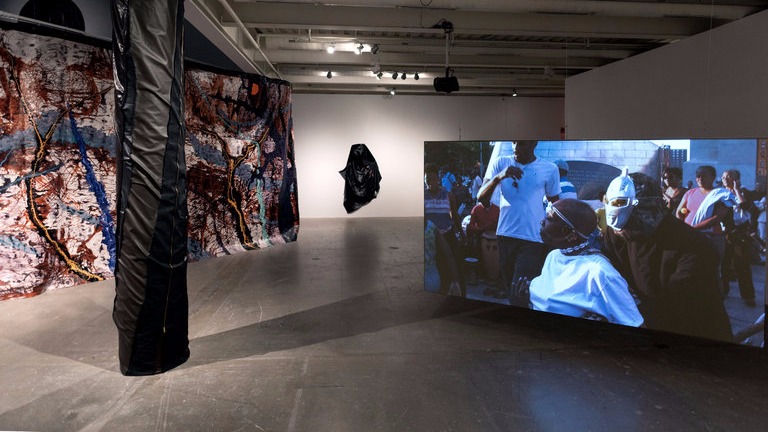
“Landscape Paintings,” at PS1, is a small but beautiful show of 12 paintings made by pouring industrial paints onto bedsheets bought from thrift stores. Marbleized, striated, puddled, encrusted and spattered paint adorns differently colored and patterned fabric rectangles, which are pinned to the walls unstretched and unframed. These evoke the idea of the artist as alchemist, transforming the dregs and dreck of human existence into the spiritual gold of high art.
“Views of Main Street,” at the Studio Museum, offers a more comprehensive overview, in the form of a 15-year survey of Mr. McMillian’s art. (It was organized by the guest curator Naima J. Keith.) Here, it’s video that determines the overall understanding of his various works. In “Untitled (the Great Society) I” (2006), Mr. McMillian steps up to a microphone before a gathering at an art museum and recites the words of President Lyndon B. Johnson’s “Great Society” speech of 1964.
While Mr. McMillian’s exhibitions in New York give the impression of a scattershot career thus far, “The Black Show,” at the Institute of Contemporary Art in Philadelphia, finds him coming fully into his own with a finely orchestrated installation. In the darkened gallery, a giant abstract landscape painting, “Many moons” (2015), hangs like a theatrical curtain from a serpentine ceiling track, while videos play on flatscreens or are projected on screens suspended in midair. Big, predominantly black paintings in various shapes are on the walls and, in one case, wrapped around a gallery column and fixed by a long black zipper. — Ken Johnson, Apr. 14, 2016

Read the full article at the New York Times website.