Alumnus Vinny Roca’s Video Games Explore Labor and Systems of Meaning
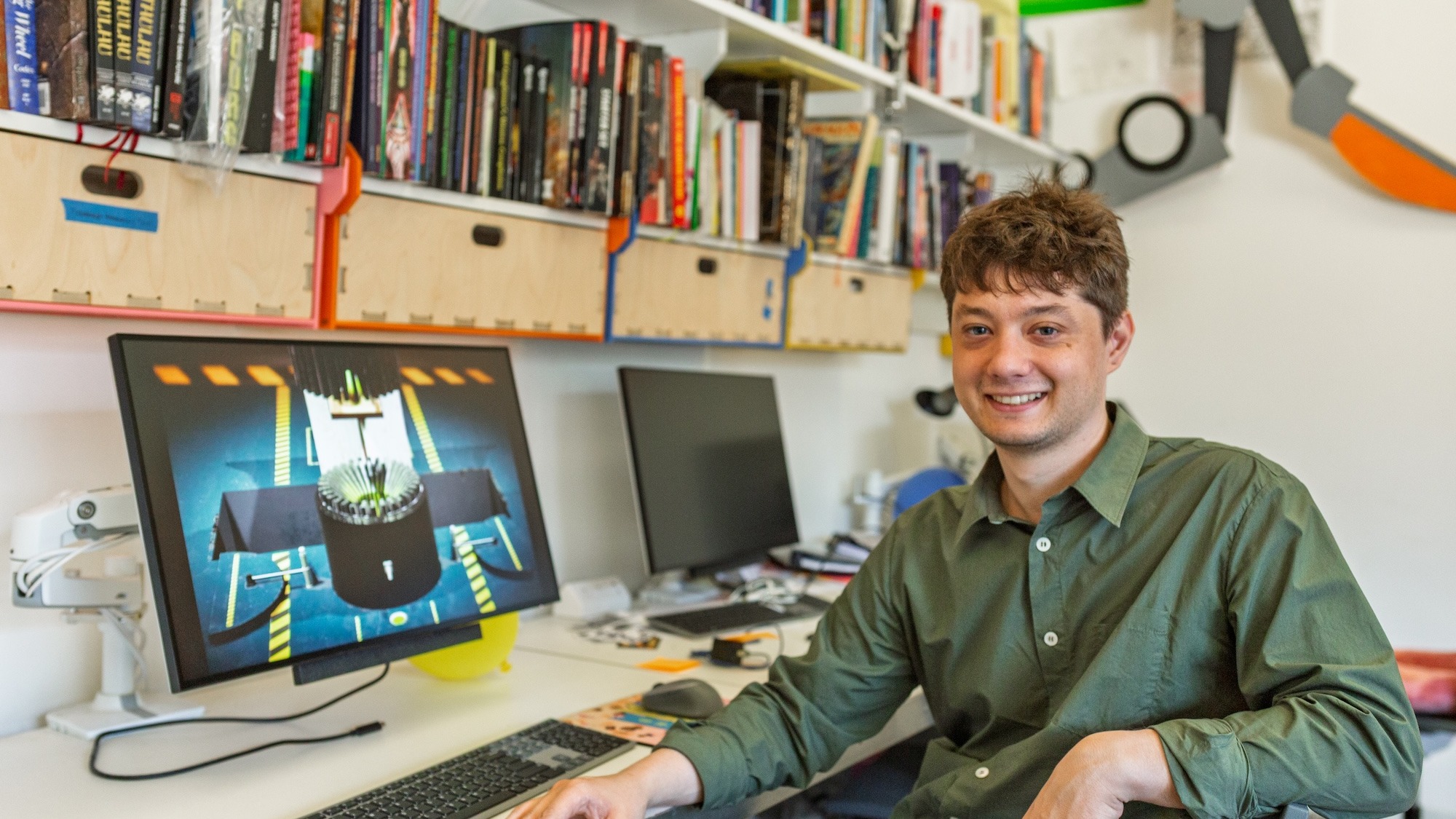
Vinny Roca is an artist, game designer, and alumnus of the UCLA Department of Design Media Arts (DMA). Roca’s practice explores strange encounters with labor through digital games, drawing on technical practice in programming, 3D modeling, animation, fabrication, and game design. His award-winning game works have been exhibited nationally and internationally.
In 2024, Roca released the experimental video game installation Slot Waste. It explores a lengthy, absurdist Rube Goldberg-like production process. The fantastically grotesque creatures that populate the game are both autonomous and alive, yet their existences remain inextricably tied to the process of production. When playing Slot Waste, the ambiguity between life and death, waste and product, and repulsion and desire compels the player to interact with the machine to become part of the elliptical production process itself.
Slot Waste was recognized at the 2025 Independent Games Festival with the Best Student Game Award.
Roca is assistant professor of media studies at Scripps College. He teaches courses on games, 3D computer graphics, artistic programming, and animation within the context of media art.

Vinny Roca, left, receiving the Best Student Game Award for Slot Waste at the 2025 Independent Games Festival. (Game Developers Conference)
What initially drew you to the UCLA School of the Arts and Architecture, and what were you hoping to find here?
What initially drew me to the school was the UCLA Game Lab. I was looking for a particular conversation around games, one that had to do more with art than perhaps mechanics or engineering. Looking at the work coming out of the Game Lab, I was hoping to enter into the discourse around games that is particular to game makers working within a media arts context.
What experiences at UCLA Arts most shaped your work?
Although much of my work was shaped by in-class experiences, such as developing new technical skills, the most influential impact on my practice came from the community of faculty, graduate students, and undergraduate students beyond the classroom. Looking back, this was a direct result of the many DMA student spaces, such as the Print Lab, Fab Lab, or Game Lab, where we were able to work together on everything from classwork to independent projects. The out-of-class learning that happens in these spaces was fundamental to developing my practice and a key part of the program.
Which skills or lessons from UCLA Arts have proven most valuable in your professional life?
Since I am currently continuing to make games as well as teach a variety of classes in media arts, the most valuable skills I’ve gained has been an understanding of art and media arts as a wide ranging practice that cannot be defined by media specific boundaries. What this means for my practice and my teaching is that, just like my game works, my classes look to break down media and disciplinary boundaries, blending various approaches to making, theory and history—an approach to media arts I gained directly from UCLA Arts. Not only does this keep my teaching and artistic practice new and exciting, but it also allows me to think more fully about how media operates beyond the specificity of a medium specific practice.
How did your interest in video games first develop, and when did it shift from playing to making?
During my undergraduate studies, I spent much of my time training to be a painter. It was only later during those studies and after college I became interested in conceptual and instruction-based artistic practices. Looking back on this time now, I can clearly see I was interested in both the play and performance that emerges when engaging with instruction art, but also the generative and algorithmic process of following rules and procedures. In somewhat of a happy accident, I was supporting this rules-based practice working as a 3D artist and animator and eventually decided to see if I could combine this technical work I was doing in 3D graphics with the artistic instructions I was developing. Eventually, I came to think of this work as video games. From there it was a quite arduous process of figuring out how to develop games, learning how to program, level design within game engines, and design interactions; however technically difficult, the transition felt incredibly natural as part of my practice and was only further supported by my time at UCLA Arts.
What inspired Slot Waste?
Many of the inspirations for Slot Waste are art historical, such as the work of Peter Fischli and David Weiss or the animation practice of the Quay Brothers. However, the work actually came out of thinking about games and interaction that I’ve been engaging with for a number of years. Beginning with a work from 2020, My Easy Shaker Yoke Face, I was trying to think through how games, as systems we interact with, can hold a variety of types of meaning simultaneously. By this, I mean something like a Rube Golberg machine: a system that is both the accumulation of interesting parts as well as what the overall system does. I’ve been looking to make games that attempt to pack and process so much competitive, contradictory, and absurd meaning to see what games might be able to hold. It was through this gesture that I wanted to more directly think about absurdist meaning that is generated through industrial production. Does it mean anything when one object is transformed into another object? Does the process through which an object is produced change its meaning, and what happens when those processes become stacked on top of each other?
How does your design process typically unfold?
In many ways, I have come to feel that my design process and games are very well suited for each other. Often when designing, the first step I need to undertake is to loosely design some type of machine or system. In other words, thinking of a work like Slot Waste, I began with the idea of a system of production but had little to no idea what would populate each step of the process. By starting with the system, I give myself constrained and segmented pockets in which I can work more intuitively. As I develop the work, I can be both surprised and inspired by the ways in which the different sections relate to each other as part of the larger system. I often am not thinking about mechanics or many other elements of formal game design, but rather how each interaction relates to one another as well as the individual and cumulative effect each action will have on the player.
What kinds of games most excite you, both as a gamer and designer?
As a gamer versus a designer, I find myself inspired by often opposing works. As a gamer, I often find myself excited by games that require large amounts of optimization, such as Factorio and its conveyor belt optimization mechanics, or Elden Ring and the self-optimization required to beat many parts of the game. As a designer, I’m more excited by atmospheric or boundary pushing games, works like Promesa and its meaningful wandering or Cruelty Squad with its dystopian world building. However, the games that have the most impact on me are the ones that oscillate between these poles of optimization and atmospheric, games like Universal Paper Clips, Death Stranding, My Summer Car, or Disco Elysium.
As a game designer, what’s next?
I am currently working on a new game project that is building on many of the ideas developed within Slot Waste.
What advice would you give current UCLA Arts students who are preparing to launch their careers?
My advice would be to both get your work out in the world as soon as you can and to try to look for the community of people that are interested in your work. This might mean having your work circulate through online communities or be installed in a physical location like a gallery; either way, I strongly believe sharing your work intentionally and widely can directly lead to a variety of unexpected opportunities.
Why is an education in the arts and architecture so important today, perhaps more than ever?
In many ways, making art is one of the most difficult things one can do—to create something new and decide for yourself if that thing has any value or merit. To do so, you must come face to face with everything you imagine about the world: what you hold dear, value, and want. In this sense, an education in the arts is about learning how you move within the world, how it currently operates, as well as how to design and remake the world around you. While it is difficult to generally say what makes an arts education so important today, I can say that, having gone through it, the most important outcomes for me are an awareness of the world and yourself as well as the idea that the world is not finished.
Header image: Vinny Roca photographed in the UCLA Game Lab, a research center at the UCLA School of the Arts and Architecture. (Nicholas Ismael Martinez)
Stay engaged. Use #UCLAarts to stay connected.


