Alumnus Dumëne Comploi Is Reimagining Jewelry Design with AI
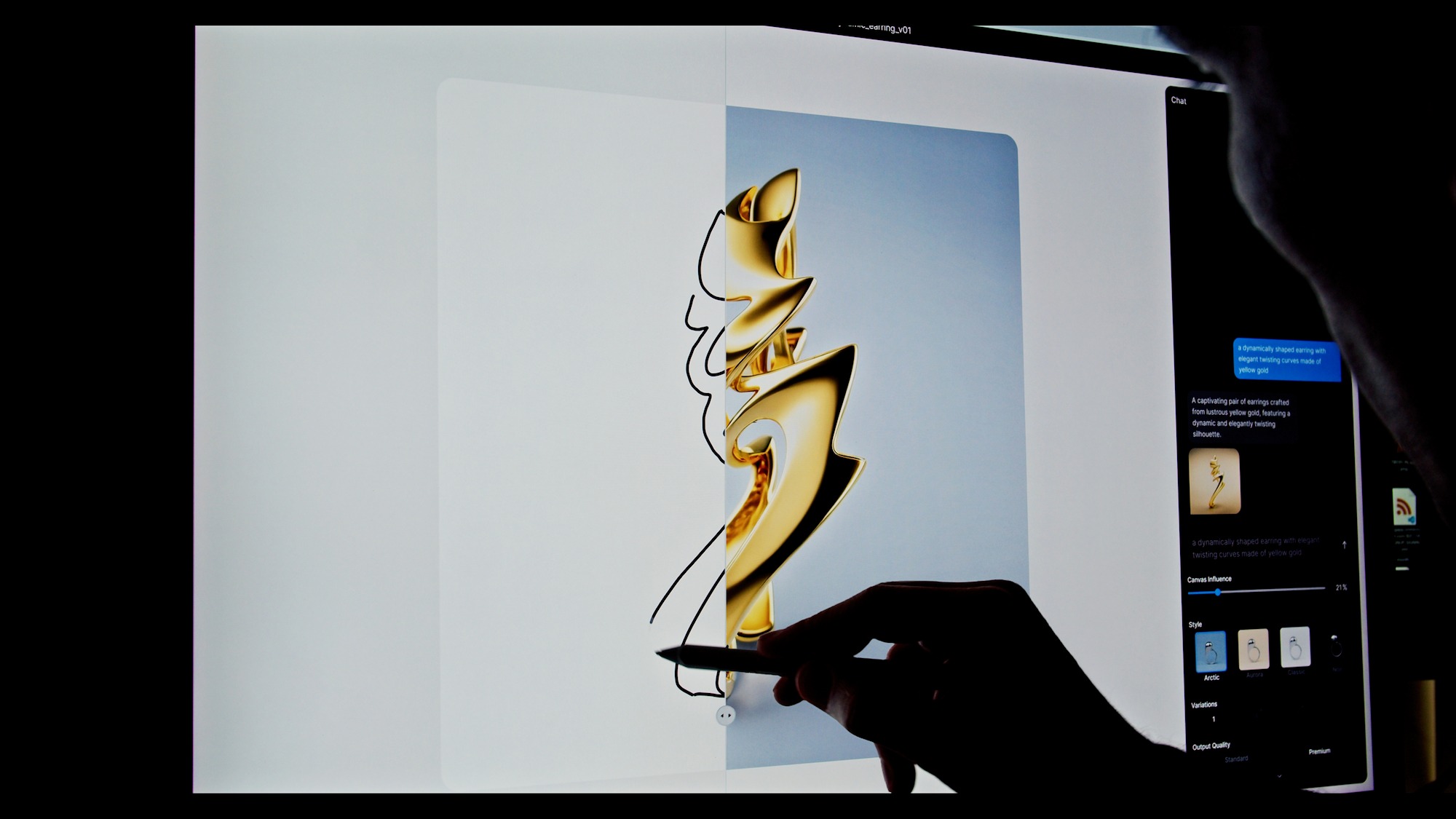
In 2023, Dumëne Comploi, an alumnus of the department of architecture and urban design (UCLA AUD), co-founded BLNG AI, an innovative app that uses artificial intelligence to transform jewelry sketches into polished renderings in a matter of seconds.
Comploi founded the company alongside his partner, Valérie Leblond, who was previously program director of IDEAS—a cross-discipline research initiative at UCLA AUD. For Comploi, the venture marked a significant career pivot after more than a decade at one of the world’s largest entertainment companies: Disney. There, Comploi served in various roles including senior manager of creative development for Disney Streaming and creative technology designer for Walt Disney Imagineering.
Since its founding, the Los Angeles–based startup has grown to a team of more than 20 employees and secured over $5 million in investment funding. In 2024, at Viva Technology in France—the country’s premier technology summit—BLNG AI won the LVMH Innovation Award.
Comploi and Leblond have no plans to slow down. They’re currently working on refining BLNG AI, aiming to deliver manufacturing-ready designs for independent designers and larger companies.

Since its founding, BLING AI has grown to a team of more than 20 employees and secured over $5 million in investment funding. (Courtesy of Dumëne Comploi)
What initially drew you to the UCLA School of the Arts and Architecture, and what were you hoping to find here?
After completing my Master of Architecture at the University of Applied Arts in Vienna, I imagined an academic path ahead. I was drawn to experimentation at the intersection of art, design, and technology, and I had begun considering a Ph.D. I spoke with Greg Lynn, who had been my professor in Vienna for five years and is also a professor at AUD. He suggested I look at his Suprastudio, a relatively new format within the M.Arch. II program. He was right about the fit. Suprastudio wasn't a post-professional program centered on theory; it was built around collaboration with industry partners and preparation for practice in the real world. That was exactly what I needed—a place to refine my professional instincts, not just my academic ones.
Looking back, what experiences at UCLA Arts most shaped your work?
The program itself was singular. I didn't know that our industry partner would be Disney, and the depth of their involvement was remarkable. They gave us genuinely difficult design challenges, toured us through Disneyland and Walt Disney World, and showed us how the many disciplines behind a large-scale immersive project actually fit together. We had room to dive in, to learn, and to develop the language of design thinking and presentation in a professional setting. I also took independent classes at the UCLA Department of Design Media Arts, which sharpened my interdisciplinary range. These two threads, practicing inside a real creative organization and exploring across departments, shaped how I work to this day.
Which skills or lessons from UCLA Arts have proven most valuable in your professional life?
The combination of architectural history, critical thinking, and the discipline of designing for the real world. UCLA invests in intellectual rigor, but it also insists one develops a design sensibility that can be tested against real cultural and intercultural context.
How did your interest in architecture first develop?
Honestly, somewhat by accident. I had a strong pull toward the arts. However, my parents, both educators—my mother especially—believed art school would lead to what she called "the unemployed artist." Architecture felt like a defensible adjacent path, and it had the appeal of letting me engage with the sciences as well. I grew up on a farm in the mountains, so architecture-with-a-capital-A wasn't part of my world. It was only when I moved to the city and began experiencing urban environments firsthand that architecture truly came alive for me. That love grew quickly from there.

BLNG AI generates a jewelry design using a reference image. (Courtesy of Dumëne Comploi)
How did you arrive at Disney, and what was it like to design for one of the largest entertainment companies in the world?
The path opened through UCLA’s Suprastudio. I was genuinely enjoying the program, and I think, or I hope, that came through in the work. The first time we toured Walt Disney Imagineering Research & Development (R&D), my eventual workplace, it struck me that this was a place where I could do creative, ambitious work that wasn't only fun, but also created real value for people. This is it, I thought. What's interesting is that I wasn't a Disney superfan growing up (again, the farm), and I had always gravitated more toward art museums than theme parks. Everyone is impressed by Disney, of course, but it wasn't a personal pilgrimage for me. Once I joined, though, I understood the appeal completely. Working alongside world-class talent across many disciplines, solving genuinely hard problems, and crafting beautiful experiences that made people happy, what’s not to love? I had thought I'd stay one or two years, until I'd absorbed what I could. But the learning never slowed. Twelve years later, every day was different, and there was still more to do.
What inspired the founding of BLNG AI, and what are the company’s objectives?
After 12 years at Walt Disney Imagineering R&D and Disney Streaming Advanced Research, it was time to do some R&D on myself. Right after graduating from UCLA, I had the opportunity to be the 3D modeler for Frank Gehry as he designed jewelry for Tiffany & Co., and through that project, I met the manufacturer who later produced Valérie's engagement ring and our wedding bands. That window into the jewelry world stayed with us. Valérie and I began to see real opportunities to bring value to an industry that hadn't yet been touched by the kind of technology we knew. I was skeptical at first; I had always thought of myself as an entertainment person. Then COVID arrived, and instead of baking bread, we started prototyping. I had already spent five years working with AI at Disney, so applying that strategic lens to a new industry felt natural. About two years later, we found an investor who believed in the vision, and the timing aligned to jump in fully. BLNG was born from that moment.
How does your background in architecture inform your work at BLNG AI?
Architecture training teaches you to think critically, work methodically, see the whole system, and then descend into the smallest detail without losing the thread. That movement between scales is essentially my daily practice. I'm fortunate to design products for designers: building roadmaps, solving technical problems, shaping the user experience, and defining methodology. It's all architecture, just at a different scale.
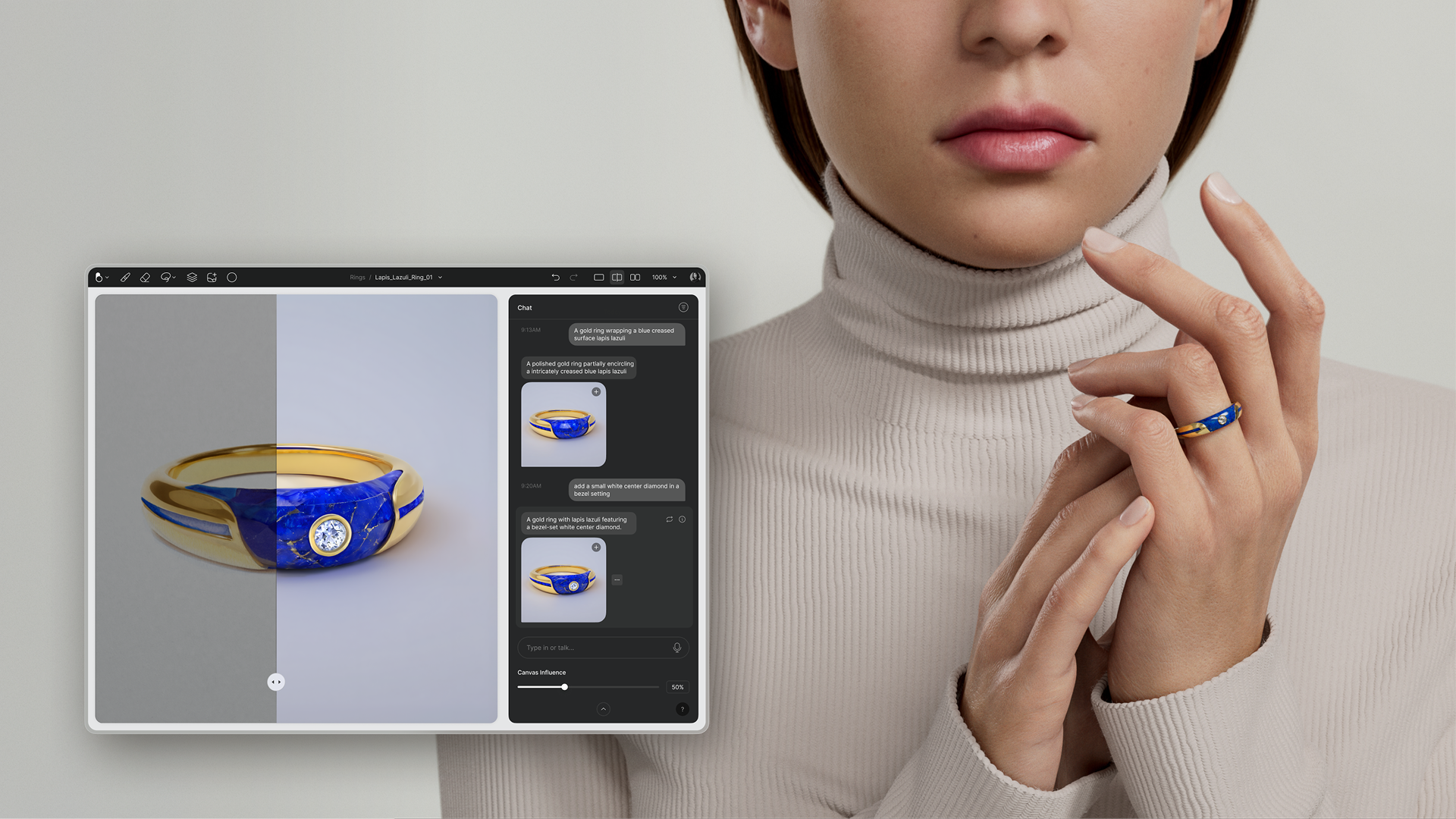
BLNG AI in use, iterating on a jewelry design. (Courtesy of Dumëne Comploi)
What is the future for BLNG AI?
Bright, I hope. We're focused on continuing to build a platform that makes designing, making, visualizing, and selling jewelry and luxury accessories a genuinely great experience. We'll keep working with both independent designers and larger houses to solve their real problems. Our north star is delivering manufacturing-ready designs, and there's still a steep road ahead.
What advice would you give current UCLA Arts students who are preparing to launch their careers?
Don't assume that learning ends when school does. School is a remarkable environment because it lets you prepare for a world where you'll have to create and deliver real value, while also giving you the space to fail along the way. But the work doesn't stop at graduation. Be brave, follow your passion, and work hard. Keep putting in the effort. If you do, the mistakes you make tomorrow will be better than the ones you make today, and that's how you grow.
Why is an education in the arts and architecture so important today, perhaps more than ever?
I often think about the role education plays in contemporary life. It's a place that teaches you to be a sponge: to absorb the world and then to ask the harder questions about what to do with what you've absorbed. In an era defined by overwhelming access to information, learning how to think about that information matters more than ever. Education as a physical space, where you sit beside other students, where you're guided by teachers further along the road, is irreplaceable in that respect.
Arts and architecture have always mirrored the cultural and societal zeitgeist. As a student, you don't just learn design sensibility or how to make beautiful, functional products, experiences, and spaces. You also confront the political, social, and critical dimensions of design, and the way those forces become embedded in what you build. Architecture and design are about building for humans, about how they coexist with a world that also includes machines, but in which they should still play the central role. Every small design decision can ripple outward for decades. Think of The Guggenheim Museum Bilbao, New York City’s grid system, a front-facing camera, the “like” button, an endless scroll, or a conversational design companion. None of these things are neutral. Someone designed each of them. That responsibility is exactly why this education still matters.
Header image: A person uses BLNG AI to design jewelry, transforming sketches into polished renderings in seconds. (Courtesy of Dumëne Comploi)
Stay engaged. Use #UCLAarts to stay connected.


