Alumni Spotlight: Sebastian Clough-Grahame
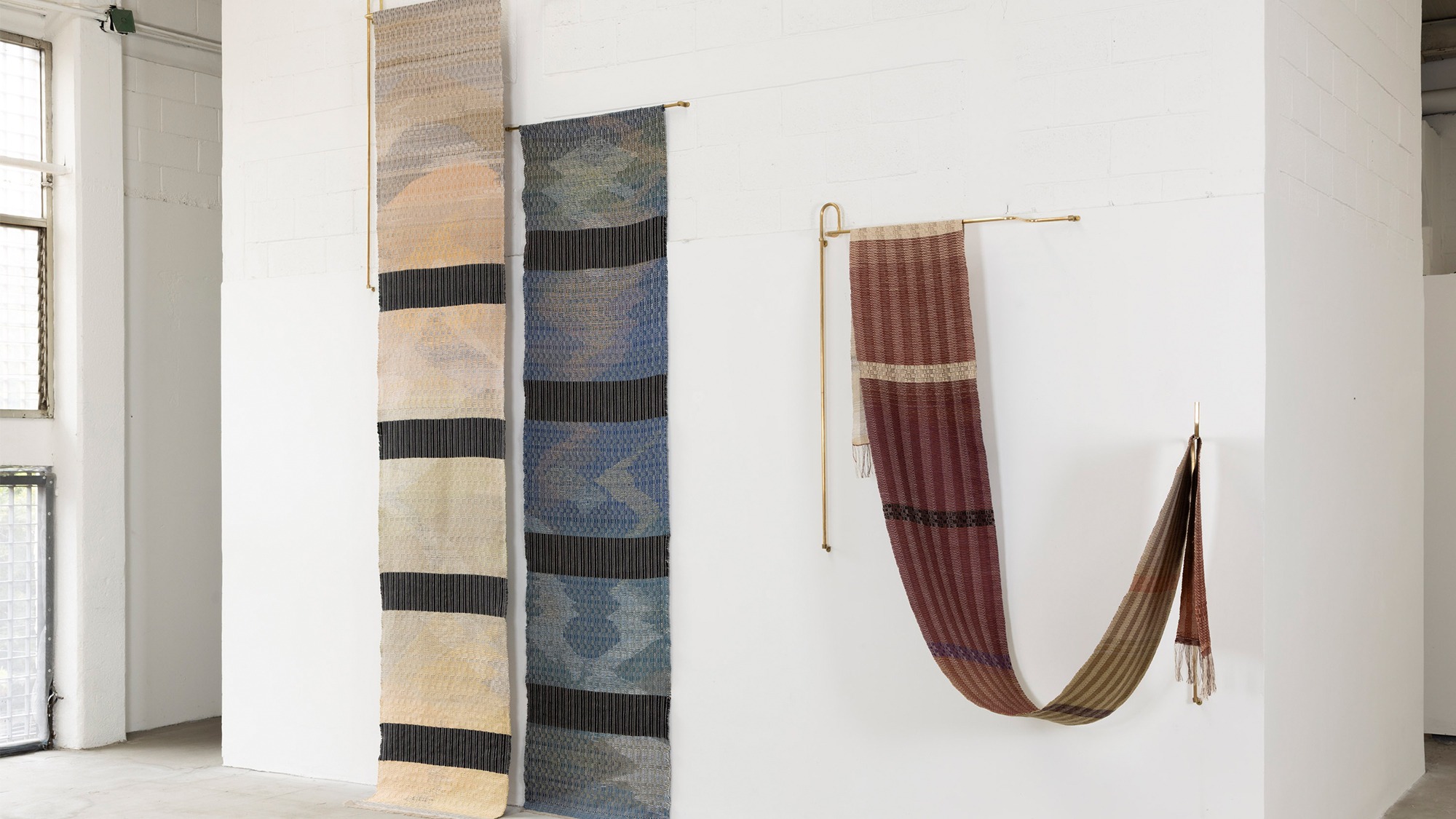
Born in Los Angeles and now living in Mexico City (CDMX), Sebastian Clough-Grahame is a department of art alumnus, artist, and curator with deep ties to code systems, museography, and textile history. He designs and produces handmade patterned textiles in a code-weaving tradition, as well as drawings about the underlying process. His work focuses on systems of ethical representation through language and pattern codes that identify the polemics and slippages between language, textile tradition, and contemporary art.
His most recent exhibitions, all in 2026, include Algoritmo at Solar Tacubaya, a collaboration with Madeline Jimenez Santil called Let Me Insist at Arróniz Gallery in CDMX, and a group exhibition titled About at Fundación M.
Sebastian was previously the director of exhibitions at the Fowler Museum at UCLA and has taught classes on the history of exhibition design and the architecture of exhibitions. He has produced numerous exhibitions on the history of world textile traditions.
He produced the seminal exhibition Radical Women: Latin American Art, 1960–1985 at the Hammer Museum at UCLA and curated the exhibitions South of No North: Gato Negro Ediciones and Rigo 23: From the Heart of Santa Madera, both at the Fowler Museum. He curated the exhibition Abismo Adentro, which is currently open at the MUDAS Contemporary Art Museum in Madeira, Portugal, with an upcoming exhibition catalogue.
Sebastian is also the founder of Taller Motet, an art and design platform focused on hand-woven textile projects, furniture design, exhibition design development, and the production of public sculptures.
Photo of Sebastian Clough-Grahame. (Courtesy of the artist)
What initially drew you to the UCLA School of the Arts and Architecture?
As a native Californian growing up in the ’70s and ’80s, tuition was affordable, and there was guaranteed admission if you put in two years at a local community college, which I did at Pasadena City College (PCC). The opportunity to study fields outside of fine art, like linguistics, sociology, and cultural history, greatly interested me and has had a lasting impact on my development. As an undergrad, I took Chris Donnan’s Peruvian ceramics course, little knowing that 25 years later I would be the director of exhibitions at the Fowler Museum, in charge of displaying the exact material I studied.
Looking back, what experiences at UCLA Arts most shaped your creative and professional practice?
I was among the first generation of New Genres students in the ’90s. My main professors were Paul McCarthy, Chris Burden, Richard Jackson, and Liz Larner. I have had meaningful and long-term relationships with all of them as I have grown into my own career. My relationship with Jason Rhoades, Rachel and Toba Khedoori, and the many artists I got to know through them has been very influential. Many of my lifelong friends were made there. Most of all, I would cite the prescient and probing questions asked by McCarthy as the most influential guidance. He is a great teacher.
Which skills or lessons from UCLA Arts have proven most valuable in your professional life?
My main experience was having my mind blown and then spending the rest of my life sorting it out.
What advice would you give current UCLA Arts students who are preparing to launch their careers?
Be humble, really look at things, and persevere.
I’m interested in learning more about your work at the Fowler Museum and the Museum of Contemporary Art (MOCA), designing and producing exhibitions. How did you arrive at that kind of work, and how would you describe this process.
There are many modalities to exhibition design, from barely noticeable to completely in-your-face. Some of the best-designed shows move you through the exhibition in a graceful way, revealing the ideas involved at a measured pace that keeps the visitor engaged and shows them something new, sometimes even revealing parts of the story in advance and then looping back to tell the whole story. It is also a very collaborative process, often involving large teams of people and years of planning.
I got into it when I was young because I was fabricating large works for a number of well-known artists and supervising the installations in museums. Since I also had a background in architecture and was already using 3D modeling software, it was a pretty easy fit to plan exhibitions.
The history of exhibition design as a practice is fascinating because it is really not that old—we go from the Paris Salons, where small paintings were hung twenty feet up in large grids, to the white cube pretty fast. Now we have all forms of new media, and what is possible to produce has expanded incredibly. Yet, with all this, it is still down to the most subtle decisions about relationships and space that have the biggest impact.
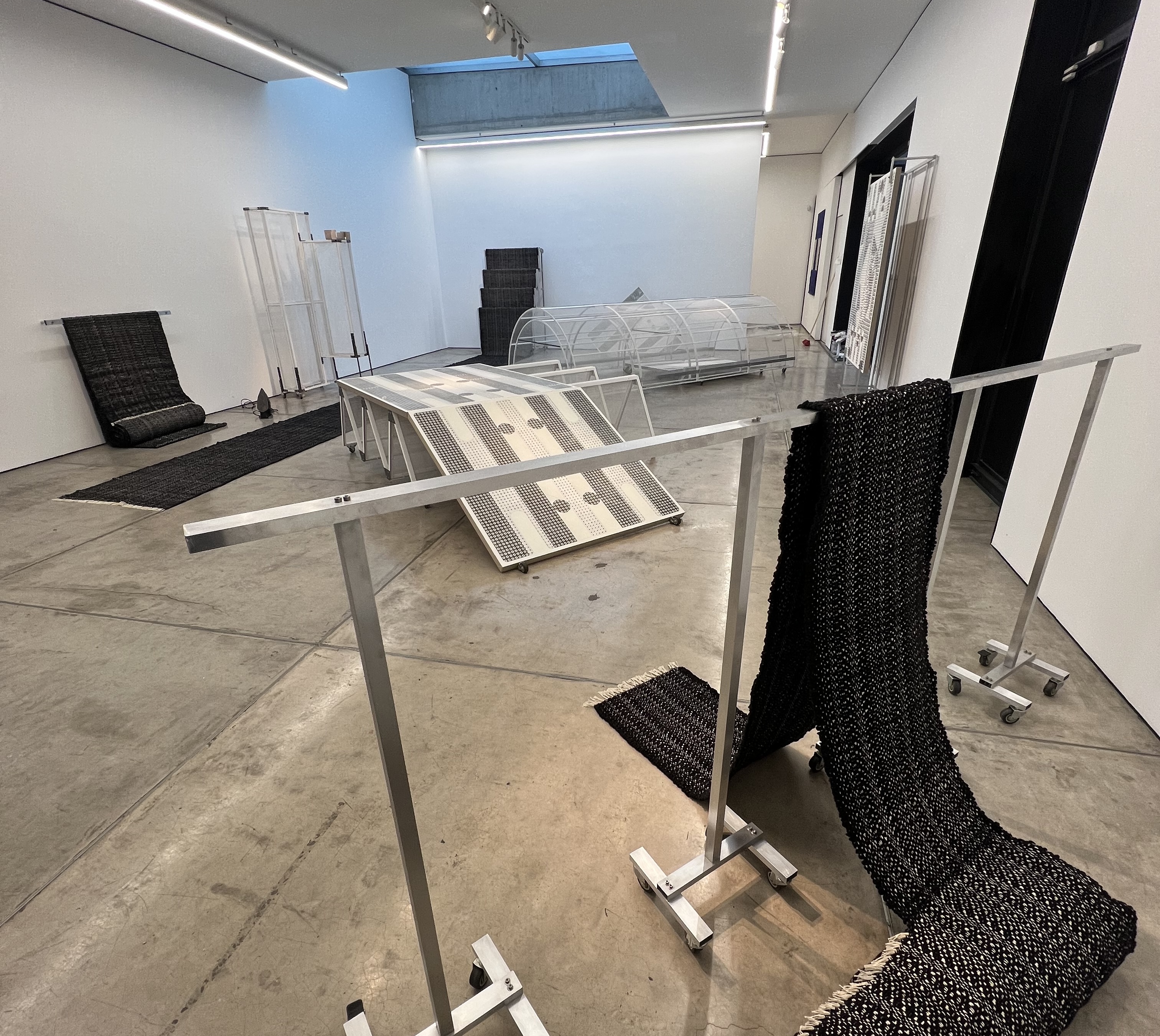
Installation view of Let Me Insist at Arróniz Gallery in Mexico City. (Courtesy of the artist)
Is there an exhibition or exhibitions you’re particularly proud of?
This year, I did an exhibition in Mexico City with Madeline Jimenez called Let Me Insist, wherein I wove elements of the gallery architecture, like the 30-meter-long terrace. This was really fun but also took over four months to weave! I also curated an exhibition at a museum called MUDAS in Portugal with the artist Rigo 23 called Abismo Adentro, which was a many-years-long labor of love, but came out beautifully.
How did you develop an interest in and experience with weaving?
Andrea Zittel taught me how to plain weave about 20 years ago, and I slowly got into more complicated techniques, bought bigger looms, started really putting in the hours, and figured out what I was really interested in, which is the underlying code structures of pattern weaving. I was lucky at UCLA because I worked at a museum that holds one of the best textile collections in the world, so I was able to see what is possible firsthand and learn from historians like Elena Phipps, who have made their careers studying cultural and technical textile traditions. I am also quite lucky here in Mexico because I work with a multigenerational textile factory near Toluca that spins and dyes its own yarn and then weaves fabric on large industrial looms. I do sample designs on floor looms for them, and then they select certain patterns to produce in limited runs on the big looms. Right now, I am planning a very, very large code weaving that I am going to produce with them.
Why is an education in the arts and architecture—and the pursuit of creative practice—so important today, perhaps more than ever?
It is a bit different here in Mexico because, in general, art, music, cinema, and literature of both high and low stripes are widely respected and considered an essential part of the culture as a whole. I don’t think this is a permanent thing, but in the United States, there has been a troublesome shift away from radical creativity and inclusive dialogue in favor of propagandistic and tribal posturing—the less Socratic, the better.
I have a story I like to tell about running into my dad one night at PCC with a portfolio under his arm. Now, my dad was an aerospace engineer who worked on deep-space explorers, not really an art guy. I was like, “Dad, what are you doing here?” And he said, “I’m taking a life drawing course. I just wanted to understand why you are so interested in art.” We need more of that.
Header image: Installation view of Clough-Grahame's code weaving. (Courtesy of the artist)
Stay engaged. Use #UCLAarts to stay connected.


