Alumni Spotlight: Brian Linder

Brian Linder, AIA (M.Arch. ’93) is an “Architecture Broker”—architect and real estate broker—whose practice is focused on the buying, selling, and advocacy of architecturally significant homes. With more than 25 years of experience in residential design, construction, and real estate, he brings an informed perspective to properties where authorship and architectural history matter.
As the founder of Los Angeles-based The Value Of Architecture, a real estate and media platform devoted to “Properties With Design Integrity,” his work is grounded in the belief that meaningful architecture creates value beyond square footage or finishes—through site, structure, light, material, proportion, landscape, and the quality of everyday experience.
Over the course of his career, he has represented and marketed important works by many of Southern California’s most influential architects, including Rudolf Schindler, Richard Neutra, Gregory Ain, Pierre Koenig, Craig Ellwood, A. Quincy Jones, Rodney Walker, and others. His architectural training allows him to recognize the qualities that distinguish a significant house, communicate those qualities to the market, and position architect-designed properties for an audience that understands their cultural and architectural value.
Beyond brokerage, Brian has become an active advocate for Southern California architecture. Through The Value Of Architecture, he produces architectural tours, films, interviews, and editorial content documenting significant houses and the architects who created them. The platform brings architecture to a broad international audience while promoting informed stewardship of important residential design.
Brian has lectured on The Value Of Architecture for the American Institute of Architects, the Society of Architectural Historians, UCLA Extension, and other professional and public audiences. He previously taught the UCLA Extension course of the same name and continues to speak and write about the relationship between architecture, cultural significance, and real estate value.
He holds a Bachelor of Science in Industrial Management from Carnegie Mellon University and a Master of Architecture from what was then the Graduate School of Architecture and Urban Planning, now the UCLA Department of Architecture and Urban Design within the UCLA School of the Arts and Architecture. He is a licensed architect, general contractor, and real estate broker, a member of the American Institute of Architects, and an active participant in the Los Angeles architecture and design community.

A photo of UCLA Arts alumnus and The Value of Architecture founder Brian Linder.
How did you develop your interest in architecture?
I really attribute it to early childhood experiences, like playing with wooden building blocks, Lincoln Logs, and Legos, and making little cityscapes in the dirt in the front yard. In fact, when I applied to graduate architecture school, I included images of myself as a five-year-old doing exactly that.
When I got to college at Carnegie Mellon, many of my friends were studying architecture, which influenced my way of looking at the built environment. In addition, the architecture of Pittsburgh was also quite influential, including the grand estates of the late 1800s, the downtown cityscape, and the industrial infrastructure of steel mills and factories. During a gap year, I worked as a construction superintendent renovating a historic hotel.
Moving to Los Angeles after graduation in the mid-1980s was also a game changer for me, opening my eyes to the world of contemporary art and modern architecture. In addition, I have enjoyed self-guided tours of architectural monuments, construction sites, and abandoned buildings for many years, exploring architecture avocationally. All of these experiences built on my earliest experiences, as my love of architecture continued to grow.
After working in management consulting and marketing for several years, I decided to pursue a career in architecture and began looking at first professional degree graduate programs in architecture.
What initially drew you to the UCLA School of the Arts and Architecture, and what were you hoping to find here?
I knew I wanted to study architecture in Los Angeles, which I consider to be the mecca for modern and contemporary architecture in the United States. I wanted to be part of a world-class academic institution. It was important to me to study in a department with pedagogy that led with design, supplemented by technical training, rather than the other way around. And I was looking for faculty that included practicing architects who were being recognized internationally for the exciting work they were producing. UCLA provided all of those things.
Looking back, what experiences at UCLA Arts most shaped your work?
Really, it was a combination of things: being taught how to see and identify the elements of good design; receiving instruction on how to reconcile design intent with functional sensibility (“Where does the sh*t go?” in Julie Eizenberg’s inimitable phraseology); learning to describe and defend my own design work (“talkitecture,” the word I coined for the process); serving as a teaching assistant in Dick Schoen’s Building Construction course for two years (believe it or not); the hands-on making of things in the wood shop; and studying the history of modern architecture and learning the relevance of context from Charles Jencks’ wonderful firsthand accounts. All of these elements shaped and enhanced my understanding and appreciation of architecture and the built environment.
A certain way of looking at the world; an understanding of architecture and construction; the ability to see and describe the elements of good design; creative problem-solving skills, particularly in situations with imperfect information and limited time; talking about architecture, both experientially and contextually—all of these skills I developed at UCLA and continue to use in my work as an "Architecture Broker" on a daily basis.
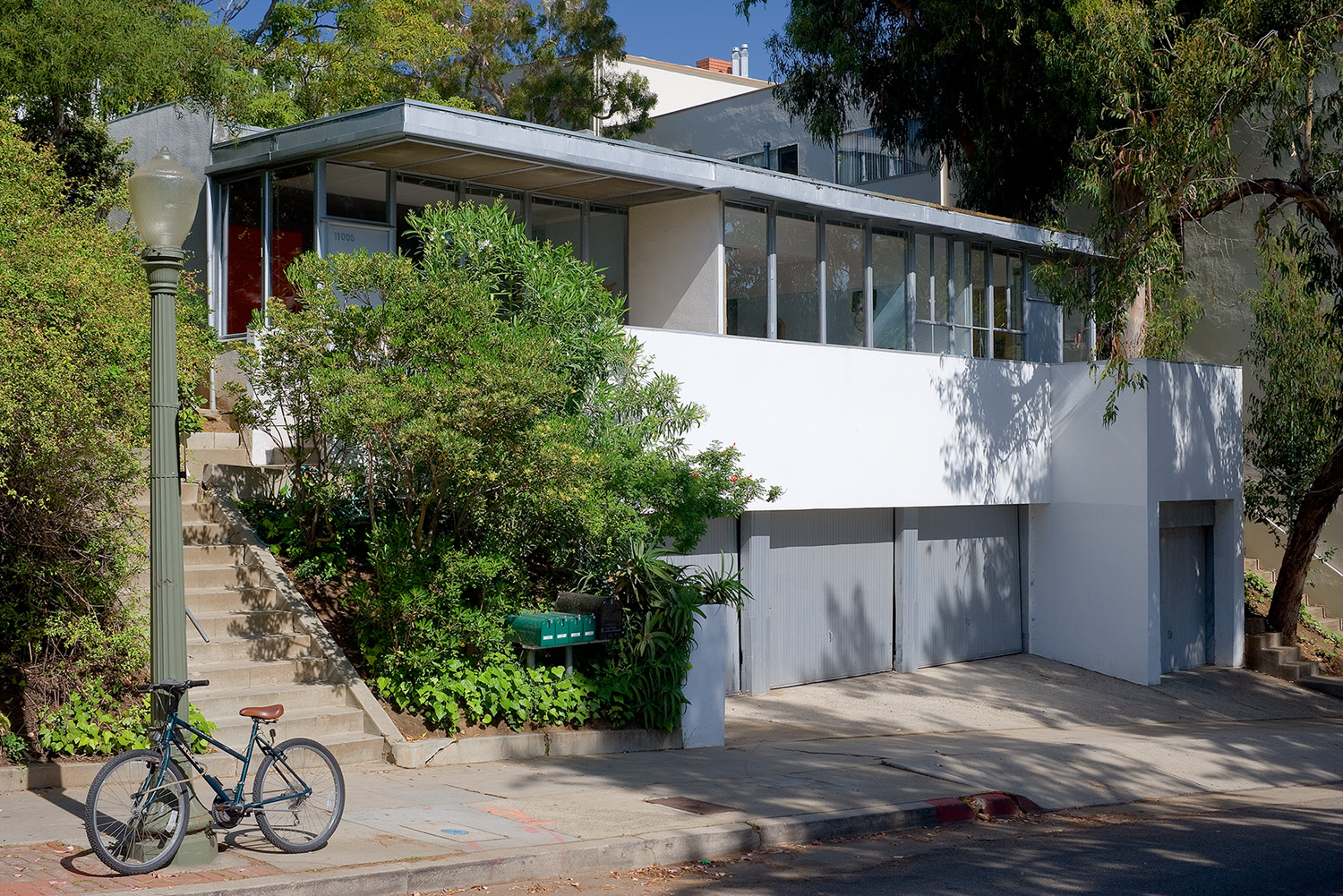
Brian Linder is responsible for many notable sales, including this intimate enclave of four flats designed and previously owned by Richard Neutra. In 1988, it was designated a Los Angeles Historic-Cultural Monument. (Photo by Brian Thomas Jones)
How did you arrive at the concept of “The Value Of Architecture,” and how has it evolved over time?
My first business partner, Erik Lerner, a fellow UCLA School of the Arts and Architecture alumnus, actually coined the phrase “The Value of Architecture.” He and I were both working at Mossler Deasy & Doe, the original realtors known for marketing good design (“Architecture for Sale”), and we recognized that we were both licensed architects and real estate brokers, so we decided to start working together. Later, when we went out on our own, Erik took one of our registered trade names, and I took the other. I built The Value of Architecture into the recognized brand that it is today.
For me, the phrase “The Value of Architecture” has always encapsulated the notion that good design adds value to the built environment, in both tangible and intangible ways. Properties that are well designed always command higher prices in the real estate market and are more resilient to market fluctuations. But well-designed buildings also enhance people’s lives, from a psychological and even spiritual perspective. In addition, when the marriage of form and function is successful, the physical architecture that results can be perceptibly more useful. The benefits of well-thought-out construction (architecture) are virtually innumerable. The phrase “The Value of Architecture” captures this notion quite elegantly.
What inspired the transition from architect to broker? What has been most rewarding about this shift?
Transitioning from architect to broker was a logical progression in my professional trajectory, rather than a radical departure or career change. I’ve always had a romantic notion of the architect as the master builder, which is why I got my general contractor’s license shortly after finishing at UCLA, before I became a licensed architect. The 10 years I spent as a construction superintendent/project manager are consistent with this perspective and inform my understanding of the physical aspects of architecture.
I have long been interested in the financial aspects and business side of the profession, including marketing and new business development. In addition, I find the human and psychological elements of the negotiation process to be challenging and captivating. As an “Architecture Broker,” I incorporate all of these elements into my day-to-day practice. I still consider myself a practicing architect, but with a focus on the finished product more than on design or construction.
UCLA Arts is also committed to the idea that architecture is art. Why do you think there’s sometimes resistance to this concept? How can this idea be more broadly accepted?
I think people have resistance to the idea that architecture is art when they perceive the art to be detached from the more functional aspects of good design. On one hand, architecture has long been described as the mother of the arts. Buildings are objects that we look at, so we want the artist—the architect—to make them beautiful. In my opinion, art is what distinguishes architecture from mere building.
On the other hand, buildings still need to work. Architecture is art that we live in, not just look at. Buildings need to keep out the elements, have functional floor plans, make sense economically, fulfill their functions efficiently, and, in more lofty terms, enhance the lives of their occupants. When these elements work together harmoniously, the result is perceptible delight. When the art becomes gratuitous, overly decorative, or separated from the use of the building, people often react negatively, thinking that the art is getting in the way of the overall experience.
In my opinion, for the notion of architecture as art to be more broadly accepted, architects must successfully synthesize all the elements of good design (site specificity, space, form, structure, material, light, circulation, program, scale, proportion, building envelope, thresholds, landscape, detail, technology, systems, acoustics, climate, environmental performance, context, time, meaning, and experience) into a cohesive work of art, much like an orchestra conductor draws together many individual voices into the coherent expression of a symphony.

This Los Angeles home was conceived by RIOS partner and UCLA Arts alumnus Bob Hale as his family’s own home. It was later sold by Brian. (Photo by Jim Simmons)
What advice would you give current UCLA Arts students who are preparing to launch their careers?
My recommendation is to be present, live in the moment, and enjoy the experience of an architectural education. Take full advantage of the opportunities that the UCLA School of the Arts and Architecture has to offer. Don’t worry about the future, about what kind of job you’re going to get, how much money you are going to earn or not earn, or whether or not you will ultimately be working as a practicing architect. An architectural education provides a way of looking at the world—creative thinking, strategic problem-solving, spatial reasoning, visual literacy, critical inquiry, collaboration, and the ability to synthesize many competing forces into a coherent whole. These skills apply not only to the practice of architecture but to a wide range of professions—and, more broadly, to the way we navigate life itself.
Why is an education in the arts and architecture so important today?
An education in the arts and architecture is important now, maybe more than ever, because it provides a big-picture perspective, a higher-level understanding of the world, and a way of thinking rather than a specific set of task-oriented skills, memorized facts, or prescribed solutions.
As artificial intelligence becomes increasingly capable of performing many of the tasks that once defined professional expertise, the value of an education may lie less in what we know than in how we think. The arts and architecture teach us to interpret complexity, make connections across disciplines, ask better questions, exercise judgment, and understand the cultural, social, and human consequences of the decisions we make.
They also cultivate qualities that are difficult to reduce to an algorithm: curiosity, intuition, empathy, taste, critical thinking, and the ability to synthesize many competing forces into a coherent whole. AI can generate options, process information, and accelerate production, but it still requires people to determine what is meaningful, what is appropriate, what is worth pursuing, and ultimately, what kind of world we want to create.
In that sense, an education in architecture is not simply preparation for becoming an architect. It is preparation for navigating change—for seeing relationships, understanding systems, imagining alternatives, and making thoughtful decisions in a world where the tools will continue to evolve.
Header image: The Frank Gehry-designed Sirmai-Peterson House in Thousand Oaks, Calif, represents a pivotal moment in the residential work of Gehry. (Photo by Carmeron Carothers)
Stay engaged. Use #UCLAarts to stay connected.


