Adrian Saxe, Barbara Drucker, Judy Baca retire from the UCLA School of the Arts and Architecture
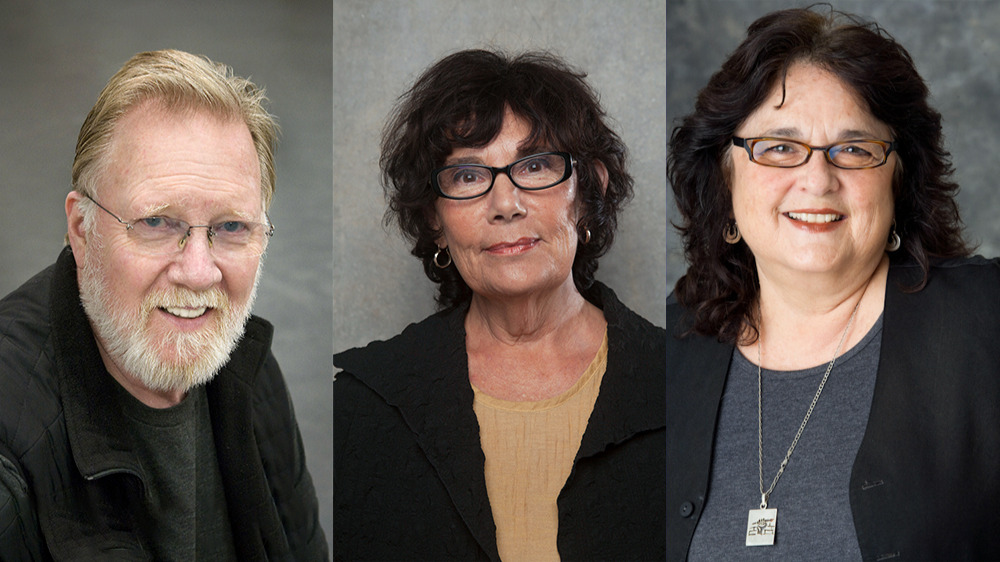
At the end of the academic year, we bid farewell to three esteemed faculty members who retired from the UCLA School of the Arts and Architecture (UCLA Arts): Department of Art Professors Barbara Drucker and Adrian Saxe and Department of World Arts and Cultures/Dance Professor Judy Baca.
Their collective dedication to the institution spans an amazing 103 years, and they each leave an indelible mark and inspiring legacy through the research they undertook, the students they taught, and the programs they shaped.
Adrian Saxe is a Los Angeles-based artist who has had a major impact on the development of 20th and 21st century ceramics over the course of more than five decades. He taught at UCLA for 45 years. Throughout his tenure at the university, Professor Saxe’s commitment to the Department of Art and his preeminent place in the field played a major role in attracting talented students seeking a rigorous education in which they could push the boundaries of their respective media within a critical and interdisciplinary studio context.
Saxe’s work incorporates wit and humor alongside vibrant color and impeccable technique, and is highly regarded by critics, curators and collectors. His innovative approach is to use the platform of the decorative arts—and the history of ceramics—in a manner that can be characterized as “polymorphous perverse.” A Fellow of the American Craft Council, Saxe has received a National Endowment for the Arts Artist’s Fellowship; U.S./France Exchange Fellowships; and a Visiting Artist Fellowship at the Manufacture National de Sèvres, Paris. Saxe is recipient of a Flintridge Foundation Visual Artists Award, and he received a Guggenheim Foundation Fellowship. At age 50, he was honored by a retrospective exhibition organized by the Los Angeles County Museum of Art, and was commissioned to make a major work by the Getty Museum at age 57. His work is in the permanent collections of the Metropolitan Museum of Art, New York; Brooklyn Museum; Cooper-Hewitt Museum, New York; Los Angeles County Museum of Art; Victoria and Albert Museum, London; De Young Museum, San Francisco; Seattle Art Museum; and Musée National de Céramique, Sèvres, France; among over 20 museum collections worldwide.
Barbara Drucker received both her B.A. and M.F.A. from the UCLA Department of Art. She returned to UCLA as a lecturer in 1983 and worked her way up through the ranks of the department—earning tenure, becoming department chair, and associate dean of academic affairs of the School of the Arts and Architecture, and later associate dean of community engagement and arts education. Amongst her many contributions to the institution, her pioneering work in arts education and community engagement stand out. Barbara transformed the university’s approach to arts education by developing the Visual and Performing Arts Education program (VAPAE)—a unique and innovative schoolwide minor and community engagement initiative—and FORM Academy, a free summer arts program in which high school students from across the city, many from underserved communities, participate in a week-long studio program led by UCLA Arts faculty and recent graduates.
Drucker's studio practice includes painting, installation, sculptural objects, photography, video, and artists' books. She has shown her work nationally and internationally at venues including the Mazzocchi Gallery, Parma, Italy; Libera Academia di Belle Arti, Brescia, Italy; Kulturzentrum bei den Minoriten, Graz, Austria; Kennedy Gallery, Hellenic American Union, Athens, Greece; Bouzianis Gallery, Athens, Greece; Art Centre of Hasselt, Belgium; Gallery SIDAC, Leiden, Holland; Biblioteca Rionale Affori, Milan, Italy; Center for Book Arts, New York; LA Contemporary, Los Angeles; 18th Street Arts Complex, Santa Monica; Patricia Correia Gallery, Santa Monica; Mount St. Mary's College, Los Angeles; Minnesota Center for Book Arts, Minneapolis; Rutgers University Gallery, Camden, New Jersey; Gallery 10, Washington, D.C.; and Kathryn Markel Gallery, New York. Drucker's work is included in the following public collections: Smithsonian Archives of Contemporary Art, Washington, D.C.; Ruth and Marvin Sackner Archive of Concrete and Visual Poetry, Miami, FL; National Museum of Women in the Arts, Washington, D.C.; University Research Library, Special Collections/Artists' Books, UCLA; Museum of Greek Folk Art, Film Archives, Athens, Greece; and the Museum of Greek Popular Instruments, Center of Ethnomusicology, Athens, Greece. Drucker is a recipient of the George A. and Eliza Gardner Howard Foundation Fellowship in Visual Art, Brown University, Providence, RI. In 1996 Drucker founded and directed The Living Room: Special Projects in Contemporary Art, Santa Monica, CA (1996-2001).
Judy Baca is best known for her large-scale public murals. Her artwork involves extensive community organizing and participation, addressing multicultural audiences. Baca’s internationally known Great Wall of Los Angeles mural in the Tujunga Wash Flood Control Channel incorporated 40 ethnic scholars, 450 multi-cultural neighborhood youth, 40 assisting artists, and over 100 support staff to paint a half mile long mural on the ethnic history of California. Painted over five summers between 1974 and 1979, the mural depicts the contributions and struggles of California's diverse peoples from prehistoric times to the 1950's. Baca's work has been exhibited nationally and internationally, published in numerous periodicals, journals, and books, and documented in several films. She has received awards and recognition for her work from community groups such as the California Community Foundation, the Liberty Hill Foundation, the AFL/CIO, the California State Assembly, the United States Senate, the U.S. Army Corp of Engineers, United States Artists, Americans for the Arts and the Public Art Network, AFLCIO (Los Angeles County Federation of Labor), the American Association of Hispanics in Higher Education, the National Hispanic Heritage Awards, and she received a Guggenheim Fellowship in 2003. Baca was a founding faculty member of CSU Monterey Bay, where she helped to develop a Visual and Public Art Institute. She went on to teach studio art at UC Irvine for 13 years before joining the faculty of the UCLA Departments of Chicana/o Studies and World Arts and Cultures/Dance in 1995 and 2001 respectively. To advance the field of muralism, in 1996 Baca created the UCLA/SPARC Cesar Chavez Digital/Mural Lab, a research, teaching and production facility based at SPARC, which Judy founded in 1976.
Stay engaged. Use #UCLAarts to stay connected.


