Adrian Piper: The Thinking Canvas
Adrian Piper, on view at MOMA in New York, will travel to the Hammer Museum in October 2018
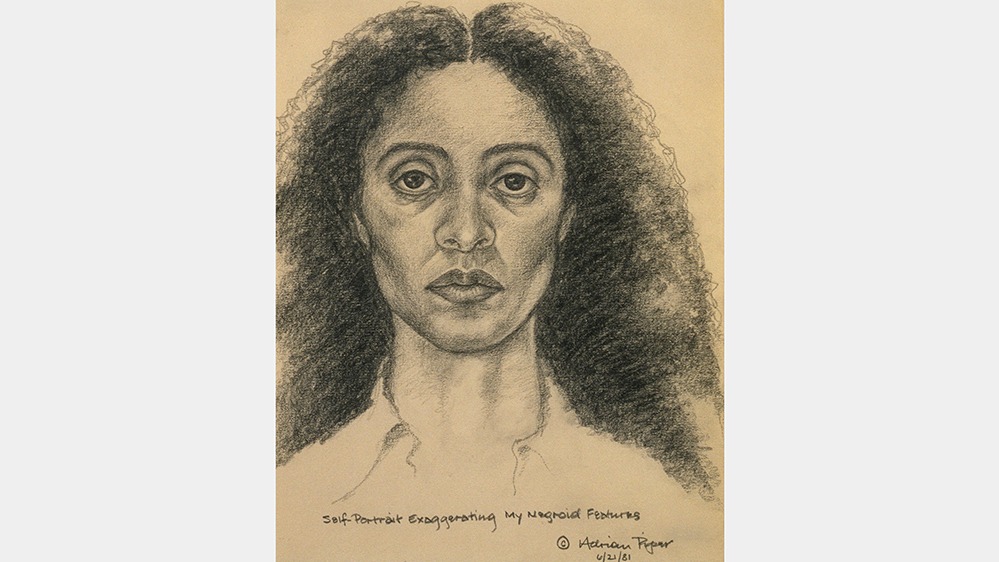
Adrian Piper: A Synthesis of Intuitions, 1965-2016 is a selection from the most comprehensive exhibition to date of the work of Adrian Piper (b. 1948, New York), the result of a four-year collaboration between Piper, the Hammer Museum at UCLA, and The Museum of Modern Art’s Department of Drawings and Prints. This inclusive retrospective comprises over 270 works gathered from public and private collections around the world. The exhibition will encompass the wide range of diverse mediums that Piper has explored for over 50 years: drawing, photography, video, multimedia installation, performance, painting, sculpture, and sound. The exhibition will be Piper’s first American museum exhibition in over 10 years, and her first since receiving the Golden Lion Award for Best Artist in the 56th Venice Biennale of 2015 and Germany’s Käthe Kollwitz Prize for 2018.
“Adrian Piper: A Synthesis of Intuitions, 1965-2016” at the Museum of Modern Art is a clarifying and complicating 50-year view of a major American artist’s career. It is also an image-altering event for MoMA itself. It makes the museum feel like a more life-engaged institution than the formally polished one we’re accustomed to.
Despite the show’s retrospective cast, we find fiery issues of the present — racism, misogyny, xenophobia — burning in MoMA’s pristine galleries. The reality that art and its institutions are political to the core — both for what they do and do not say — comes through. And the museum, for once, seems intent on asserting this. For the first time it has given over all of its sixth floor special exhibition space to a single living artist. The artist so honored is a woman, who has focused on, among many other things, the hard fact of racism and the fiction of race.
Ms. Piper was born in New York City in 1948 to parents of mixed racial background. (Her father held two official birth certificates. In one he was designated white, in the other octoroon, one-eighth black.) Raised in a cosmopolitan environment, she studied at the Art Students League in her teens, and in 1966 enrolled at the School of Visual Arts. The MoMA show opens with a salon-style hanging of figurative paintings, including self-portraits, from that time, influenced by 1960 psychedelic graphics and by her youthful experiences with LSD.
The idea of consciousness altering — and raising — would remain essential to Ms. Piper’s thinking. While at art school she immersed herself in the practice of yoga, a lifelong pursuit that would lead to an intensive study of Hindu thought. In 1967, she dropped out of the School of Visual Arts and enrolled in the City College of New York, where she majored in philosophy. (In 1981 she completed a doctorate in the field at Harvard.) More or less simultaneously, she shifted from figurative to Minimalist-style abstract painting and sculpture. Then, attracted to Conceptualism’s privileging of ideas over conventional forms, she began using arrangements of words, sometimes as instructions for actions, as a medium."— Holland Cotter, Apr. 19, 2018

This post is an excerpt, read the full article on the New York Times website.
Stay engaged. Use #UCLAarts to stay connected.


