A ‘Witch Hunt’ in Pursuit of Intersectional Feminism
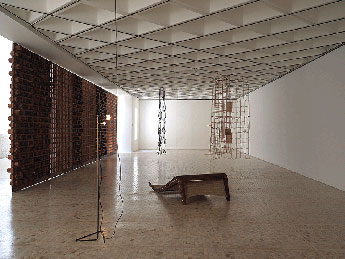
Leonor Antunes, Discrepancias con C.P. Leonor Antunes, 2018, Museo Tamayo, Mexico City, mixed media, dimensions variable. Courtesy: © the artist and kurimanzutto Mexico City and New York Several years in the making, ‘Witch Hunt’ is ambitious in both size and scope. The exhibition, part of an initiative by the Feminist Art Coalition, spans two venues and brings together 16 mid-career women artists from 13 countries in an effort to use, as the catalogue states, ‘feminist, queer and decolonial strategies to explore gender, power and the global impacts of systemic patriarchy’. While this broad description deliberately invites different interpretations of feminism, the show coheres in its collective resistance to systemic sexism and the normalization of misogyny and white nationalism under former US President Donald Trump.
These politics are clear in the emphasis co-curators Connie Butler and Anne Ellegood place on non-white and queer perspectives from a global roster of artists, each of whom receives an individual platform. The drawback to this approach is that it leads, in some cases, to juxtapositions that don’t speak to each other: for instance, Leonor Antunes’s textile installation paying homage to women omitted from design history (Discrepancias con C.P. Leonor Antunes, 2018) and Teresa Margolles’s 2021 series of emotionally charged photographs of trans- and cisgender women in Juarez. Yet, the commonalities that do emerge illuminate the extent to which issues of erasure and exploitation are entrenched in diverse cultures and histories.
Erasure of women’s labour threads through several works and, with it, the paradox of being seen (as a body) and unseen (as a subject), casting into relief the violence concomitant with the heightened visibility of the (particularly non-white) female body. To that end, Margolles produces one of the exhibition’s most affecting statements. But the sentiment is echoed in works such as Laura Lima’s Alfaiataria (Tailor Shop, 2014/2021) – a fabric workshop in the Hammer galleries that foregrounds the largely invisible labour of women – and Beverly Semmes’s blow-ups of Penthouse magazine pin-ups, overpainted with abstract biomorphic forms (‘Feminist Responsibility Project’, 2011–ongoing). Acknowledging conflicting feminist ideologies, Semmes’s paintings crystallize divergent perceptions among different generations of feminists as to whether pornography is exploitative or empowering... — Natalie Haddad, Dec. 14, 2021


This post is an excerpt. Read the full article on the Frieze website.
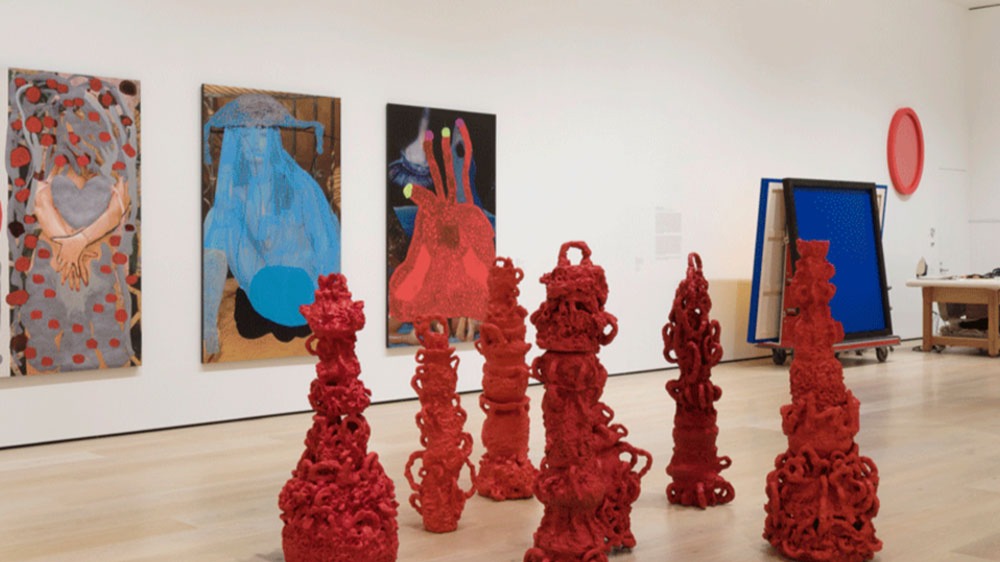
HEADER IMAGE: Witch Hunt, 2021, installation view. Courtesy: © Hammer Museum and Institute of Contemporary Art, Los Angeles; photograph: Jeff McClane
Stay engaged. Use #UCLAarts to stay connected.


