A Conversation with Lisa Hanawalt & Yumi Sakugawa
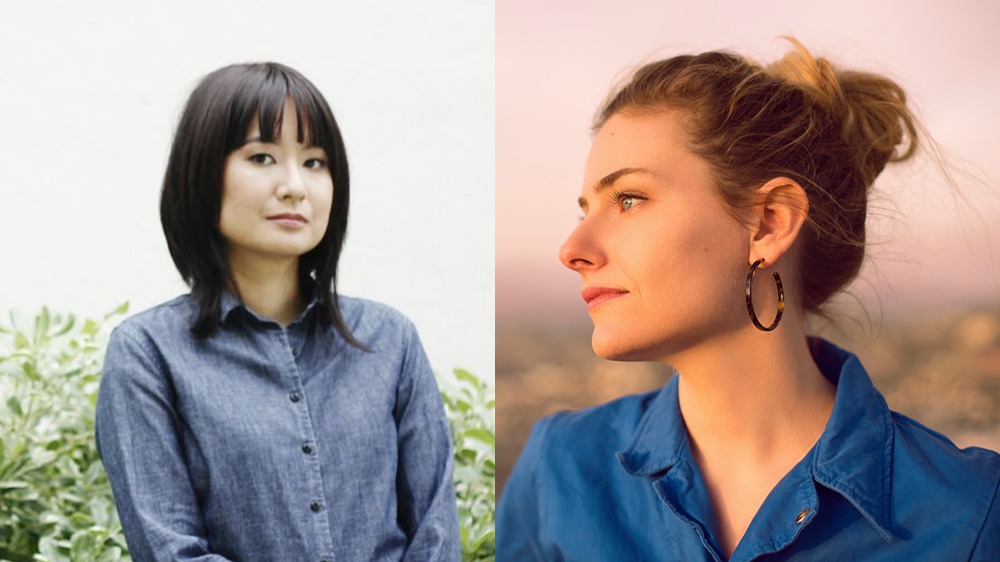
While Lisa Hanawalt ’06 and Yumi Sakugawa ’07 were students in the UCLA Department of Art at the same time, they only met when they became internet friends and shared a literary agency years later.
Last week, Lisa (artist, writer, and creator of Tuca & Bertie and production designer/producer of award-winning Bojack Horseman) and Yumi (artist, writer, and author of I Think I Am In Friend-Love With You and Your Illustrated Guide To Becoming One With The Universe) had a conversation with UCLA Arts about their creative practices, the importance of community, their art school experiences, and what lies ahead for them in 2020.
UCLA Arts: It’s the first month of a new decade, a time of year when a lot of people are setting intentions and goals. What guides your creative practices? How do you set intentions for your work or decide what to work on next?
Yumi: I always want to explore something that is scary for me through my work. With a lot of my creative projects, I'm working through healing some aspect of myself. I'm always thinking about how a creative project can be an exploration of something I'm feeling within myself as well a conversation with the readers and audiences who are going to be interfacing with the work.
Lisa: Do I do that? I’m not sure I’m so structured with my intentions. But yeah, I’m usually seeking out projects that explore something vulnerable about myself, an interest I have, or something that I haven't quite seen before.
I feel proud whenever my work is connecting with other people. I'm making it to communicate ideas, visuals, and feelings that I've had. It's really gratifying when people really connect and say, “This is how I feel on the inside, but I've never been able to express it, I've never seen it before.” Sometimes that happens in person with animators who I've been working with on a project, and sometimes it happens with strangers online. It always feels really good.
Yumi: I agree. I have a soft spot for when young Asian American women come up to me to say that my work really resonated with them. Growing up, and even during my college days, I wish I would have seen more Asian American women represented in narrative, comics, and storytelling. One example that comes to mind actually has to do with a short comic story I made loosely based on my UCLA art school days. It’s called Ikebana, and it's about a Japanese American art student who does a performance art piece. It sort of pokes fun at the art school environment. It was a super specific story that I really wanted to make just for myself, but a Japanese American woman told me that she came across this mini comic at Skylight Books, and it made her cry because she had never seen an Asian American woman going through art school depicted in a comic depicted in a comic.
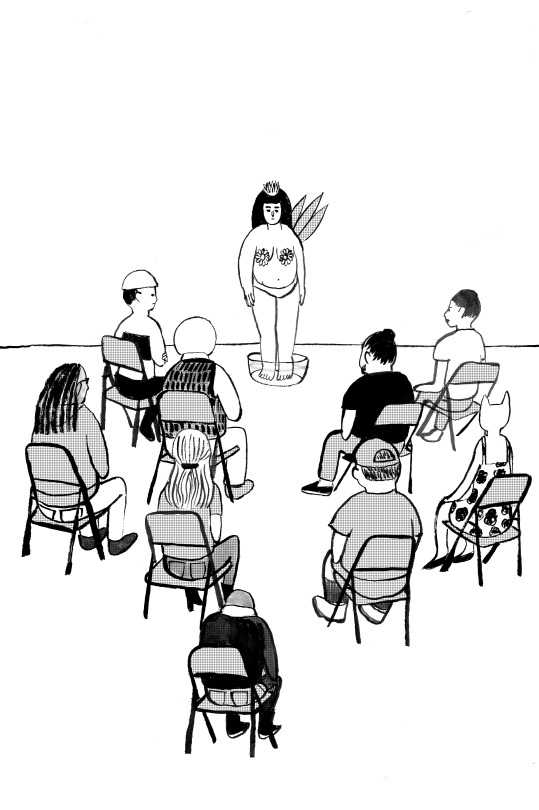
Image from Ikebana by Yumi Sakugawa
Lisa: That’s wonderful. Making the work that I wish would have existed when I was younger is a North Star for me as well. I ask myself, “What do I wish existed in the world to inspire me and encourage me when I was younger?”
Yumi: I love your work for many reasons, but one aspect that really inspires me is your frank openness around things like boobs and sex. That’s just something I haven’t given myself permission to fully embody and explore. It's not just your comics, but also in Tuca & Bertie, there are all these really frank, vulnerable depictions of sex and erotic energy. Does it scare you to put those kinds of works out there? Is it challenging? Is it fun? I'm just so curious.
Lisa: It's really scary. It's much, much, easier when I'm working on a solo project because then I don't have to run those ideas by anyone. If they are interesting to me, I figure they'll be interesting to other people. Whether it's about sex, a memory, or just something I've experienced, it's really cathartic to express those ideas.
But, when it's a TV show and I want to write a storyline about a character masturbating to something inappropriate, for example, I have to pitch that out loud, with my mouth, to a room of 20 people who are shocked. Then when the animators are drawing it, I have to say, “Could you actually have her hand going into her jeans like this?” There are so many conversations that need to happen around every detail, and my face is just red the whole time. But then at least you know that I really believed in that idea. Seriously, that scene in episode five of Tuca & Bertie where she is jerking off in the bathroom, I was like, “This has to happen.”
Yumi: Oh my God. Hearing about that process just gave me so much appreciation for that scene. I love it. That was my favorite moment in the show.
Lisa: Mine too! But I was mortified the entire time I was working on it and am even now when I watch it. But that discomfort and that strong feeling is also what makes something good sometimes. It's not just for shock value. I don't want to shock people. I want them to be thinking, “I relate so strongly to this.” Or “I didn’t know this kind of thing happened.” And then they’re learning something.
UCLA Arts: How do you deal with criticism? How do you know who to listen to?
Lisa: Everyone who criticizes me is bad, and everyone who says nice things about me is great.
Yumi: Yeah, I agree with that.
[Laughter]
Lisa: If critics say mean things about me, I do hold on to it for a long time and don't forget it even though it's their job to criticize me. But you have to block all of that out. If they give you truly constructive criticism, then that's what you listen to and actually change your work in response to—if you want.
Yumi: What helps me is to remind myself that my work is not meant to be liked by everyone and I’m not trying to please everybody. I trust that my work will be received by the people who are meant to receive it, and if people really don't get it, I'm not going to try to change their minds.
Even when it comes to constructive criticism, I choose who to listen to carefully. If it's coming from a trusted colleague or from somebody who’s really taken the time to critically interface with my work, then that's something that can be worth listening to. But if it's just like random internet trolls, then I just don't care. I mean, I do let it get under my skin, but I don't interface with it.
Lisa: Yeah, you're not going to change your work in response to it.
Yumi: Right, exactly.
UCLA Arts: What about self-doubt?
Lisa: Sometimes you just have to treat your own brain like it's an internet troll and tell yourself, “Wow, you're being really mean and just saying horrible things to me, and I just have to ignore you and continue doing my work.” I'm really hard on myself and it's not always helpful.
Yumi: That's where the importance of community comes in. Sometimes I just need friends to tell me nice things about me and my work. I also recognize that self-doubt kind of is part of the process because, as artists, we are creating something that hasn't been created before. I'm definitely going through that with a book proposal I'm working on right now.
Lisa: Me too! The beginning is always easy because you're excited and you think, “This is the best idea I've ever had!” You see it in your mind as this perfect thing. And then the hard part is the middle where you start to question yourself and realize “Oh wait, now I have to do all the boring parts and just kind of trudge through the thing and finish it.”
Yumi: I agree completely.
Lisa: I hate that part. It happens with every project. It gets to point where I'm think, “I'm a little embarrassed to send this to anyone, and I feel like it should just go straight in the trash, but there's so much of it that I can't just throw it all away.” At that point, it usually is helpful to send it to my agent or show it to my partner, and they'll say, “You're being crazy, this is great. There is something here. It just needs more work.” And then I can keep moving.
Yumi: Yeah, and I also think it helps for me to remind myself that in the beginning, all the works are sort of ugly, ugly, malformed babies.
Lisa: It's like a lump of clay that you're just hacking away at. But that's the part that makes us good at what we do; we stick it through for all the polishing bits. You could just turn something in and be like, “It's done. Okay, that's as good as it's going to be.” But we're combing back through it over and over again. I've had scripts that I've rewritten 40 times.
Yumi: There’s also this sunk cost fallacy where I feel like I get to this point where I put so much time into it. There's a stubbornness and pride where I think, “Well, I put all of this into it. I would feel so dumb if I don’t finish it.”
Lisa: Yes! I've already done 50 pages, so I have to continue. If I don't finish this thing, then I'm letting it win.
Yumi: Right, exactly. When I was younger, I had this unrealistic idea that “Oh, real artists, they're inspired all the time.” And that is definitely not the case. Towards the end, it almost becomes a chore. I just want to get it over with. Sometimes that's fine if that’s what propels you towards getting something done. I also kind of love overwhelming myself with other side projects.
Lisa: I always need some little side projects because the bigger stuff has so many different steps, and needs to be broken down so much, and takes so long. I need quick little side things that don't mean as much because then, at least, I can finish them quickly. That gives me that spike of accomplishment to remind myself that I can actually finish stuff and have the satisfaction of having completed something.
Yumi: Oh yeah, I definitely need that too, which is why I challenge myself to post at least one drawing a day on Instagram no matter how simple.
Lisa: I love your Instagram, by the way, and the work you've been doing. There’s the self-care trend right now in posting comics and writing, but the work you're doing, I think, is actually helping other people and building community. It's not just like, “Drink water!” It's actually encouraging self-examination in a really interesting way.
Yumi: Thank you! Yeah, those side projects that don't have any professional or public stakes, lots of walks, taking breaks all help us get through the tough parts of a project. Complaining to friends also really helps especially if they're also creative.
Lisa: Right? I love complaining!
Yumi: It's wonderful. That could be the takeaway of this interview. Complaining is wonderful. I'm thinking so much about UCLA days because of this interview and re-examining all these unrealistic ideas I imposed on myself at the time—about what it meant to be an artist. I had internalized this machismo idea that artists just toil away in the studio alone. They're lone wolves, and they don't need anybody.
Lisa: Same. When I was in art school I thought that I just needed to be alone in my studio all the time.
Yumi: I guess that's why we never met each other at UCLA!
Lisa: Yeah! I didn't start sharing studio space until my late 20's and now I've worked in production studios with other people on collaborative projects, which I never thought I'd enjoy. And now I'm like, “Oh wait, this is wonderful.”
Yumi: Right. It really wasn't until well into my late 20's that I really became conscious of how important friendships are. Not just for mental health, but also for my creative path. I'm really grateful that over the years living in Los Angeles, I've formed a lot of strong bonds with other artists and not just cartoonists, but other artists of different mediums. I think it's such a weird, specific journey to be an artist, but it's just so helpful to be able to talk about it with other people.
Lisa: You need to be able to bounce things off other people to check in and make sure you're not insane.
Yumi: Yeah, yeah. It’s both the macro questions like, “What does it mean to be an artist?” and the micro like, “Hey, is this person asking for a ridiculous claim on my time and services?”
Lisa: To be able to bounce those questions about that nitty gritty boring stuff off other people is so important. Just the basic business stuff like, does this invoice look normal? Things like that…
Yumi: Because we didn't learn that in art school!
Lisa, I'm curious about what you thought art school would be like versus what the experience of it actually was. And I'm also curious about what career aspirations you had going into art school, and how that changed over the course of going through it.
Lisa: I thought I was going to be a gallery painter with solo shows in Chelsea, and I didn't have any concept of how tricky that art world actually is. I liked UCLA, and I applied to it specifically because it was a conceptual school versus a traditional, conservatory school where you learn to draw in perspective. At UCLA, you could get through a critique by justifying your work verbally. You could get away with a lot of stuff.
Yumi: Yes, I definitely remember that.
Lisa: It’s really a helpful skill! That's what a pitch meeting is, right? It's defending your work and saying “No, I chose to do this for this reason.” I'm shy and I don't like public speaking, but I can bullshit my way through anything, thanks to UCLA! [laughter] The teachers were really good. They’d call me out on my bullshit sometimes and ask why they should care about a piece I did. Having those arguments and talking about art on that high level was really useful to me.
And then professionally, after I graduated, I thought “Okay, what now?” I went straight into doing comics and illustration, which were sort of frowned upon at UCLA in the art department. Those things were considered very separate from being a fine artist, which is sort of odd because, I don't know, I had to make a living somehow, and pet portraits and comics were it for me. I wonder if you feel similarly about it at all.
Yumi: I went into UCLA undeclared and got into the art department my sophomore year. Similarly, I thought, “I'm going to be a painter.” When I was in school, what was sort of expected was that you finish your art undergrad program, and then you apply to graduate school, and then you become an art professor, and then you're showing at the MoMA. At a certain point, I was just very torn up because I realized that that trajectory just did not really appeal to me.
Being at UCLA allowed me to engage with things beyond just the art world. I was in the Asian American collegiate theater group [Lapu the Coyote that Cares Theatre Company] that Randall Park and Ali Wong also used to be a part of. I would go to Giant Robot where I got a lot of mini comics and zines and I also had a live journal with insane drawings.
Lisa: I also had a live journal and went to Giant Robot!
Yumi: Woohoo! The friendship that could have been.
Lisa: I know!
Yumi: I'm so grateful for these other influences that came from beyond the art school because those also really informed my creative processes and gave me permission to pursue art that wasn't just that gallery or educational institution path.
Lisa: Yeah, and within the art department, they really let us play around a lot. I was really into ceramics for a while, and then I was really into photography, and it was just nice to have a space to just kind of do whatever and not worry about how commercial it was. I think that was really valuable.
I think part of the beauty of art school is that you can be completely self-indulgent for those years and just be a child.
Yumi: Definitely.
Lisa: Because it's sort of important to art to be a big, adult baby. But from the outside it can really look so stupid. I think the fact that UCLA is a public school is part of this too. UCLA was accessible for me because I was in state and...I might feel differently about being self-indulgent if I went to a really expensive or a private art school.
I also liked UCLA because we could take classes in Biochemistry or History. It's just nice to be able to step out of the art bubble. There were non-art students in some of our classes, and that was really fun too. I remember in one of my drawing classes with Don Suggs...did you ever take one of his classes?
Yumi: No, I really wanted to take a class with him, but I never got the chance.
Lisa: He was my favorite. I loved him so much. There was a math major in that class. He'd never drawn before. His drawings were so weird, and they were the best drawings in the class, I think. He wasn't all wrapped up in his ego about trying to make his drawings look good from an artist's perspective, they were just so pure, and I think that was just really cool to see. I don't think I would have gotten to see that at a fancy, private art school.
UCLA Arts: That's a great point, and something that's really important to us as a school. UCLA is also a research university where pushing boundaries, experimenting, and creating new work and knowledge is pervasive across all fields—from math to the arts.
Yumi: The work you do, Lisa, is about pushing the boundaries and taking audiences to these uncomfortable vulnerable places, so I'm curious if there are any topics or scenes or emotions that you're exploring next that are really scary or intimidating or uncomfortable for you?
Lisa: I want to keep doing more about sex and also about emotional trauma, and how we process it, and how difficult that is, and therapy, and all that stuff. I really want to keep going down that road. It's hard because I don't want to trigger anyone. I want people watching my stuff or reading my stuff to have a nice experience overall. But one thing I've learned is that I can't guess what's going to offend people and I can’t guess what's going to trigger them so, I just do my best to talk everything out and be really considerate of how things might come across. But you can't protect every person who comes across your work.
What’s coming up for you?
Yumi: I have the book proposal that I mentioned. And I've also been challenging myself to facilitate at least one webinar and one workshop a month. And on the personal end, I really do masochistically want to try all these things that make me super uncomfortable. I really want to sign up for a comedy stand up writing class. Just the idea of doing a comedy set makes my stomach churn, and I want to throw up, but I feel like that's more reason for me to do it. I also have a friend who seems to be loving these feminine embodiment pole dancing classes that I want to try out even though that idea also really terrifies me. But again, I feel like that's just more reason for me to do it.
Lisa: I've been wanting to try those classes too even though they really frighten me. I think that something about being in your body in that way is so terrifying.
Yumi: Right? Yeah, like wearing sexy clothes, and swiveling around on a pole, and looking sexy in front people…
Lisa: …in front of people!
Yumi: That just makes me want to crawl under my bed and die. But there's just a part of me that's like “Well, now I have to do it and see what happens.”
Lisa: You're unleashing a new part of yourself. Mining inside yourself and digging out rare ore.
Yumi: That's how I feel!
UCLA Arts: We’re so excited to see what you both do next. Thank you. It’s been such a pleasure.
LISA HANAWALT ’06 is the creator of Tuca & Bertie, an animated series for Netflix. She's the production designer/producer of the Netflix series, BoJack Horseman. She has written and illustrated three books published by Drawn & Quarterly: My Dirty Dumb Eyes, 2013, Hot Dog Taste Test, 2016, and Coyote Doggirl, 2018. She co-hosts a podcast called Baby Geniuses with comedian Emily Heller. Lisa has worked on illustrations, book covers, animation, comics, murals, music videos, patterns, apparel, and exhibits her artwork in galleries.
YUMI SAKUGAWA ’07 is an Ignatz Awards nominated interdisciplinary artist and the author of I Think Am In Friend-Love With You, Your Illustrated Guide To Becoming One With The Universe, and The Little Book of Life Hacks. Her comics have also appeared in BuzzFeed, The Believer, Bitch, the Best American NonRequired Reading 2014, The Rumpus, Folio, Fjords Review, and other publications. She has also exhibited multimedia installations at the Japanese American National Museum, Peabody Essex Museum, and the Smithsonian Arts & Industries Building.
Stay engaged. Use #UCLAarts to stay connected.


