4 Questions: Rodney McMillian
Art Associate Professor Rodney McMillian answers four questions from Forbes
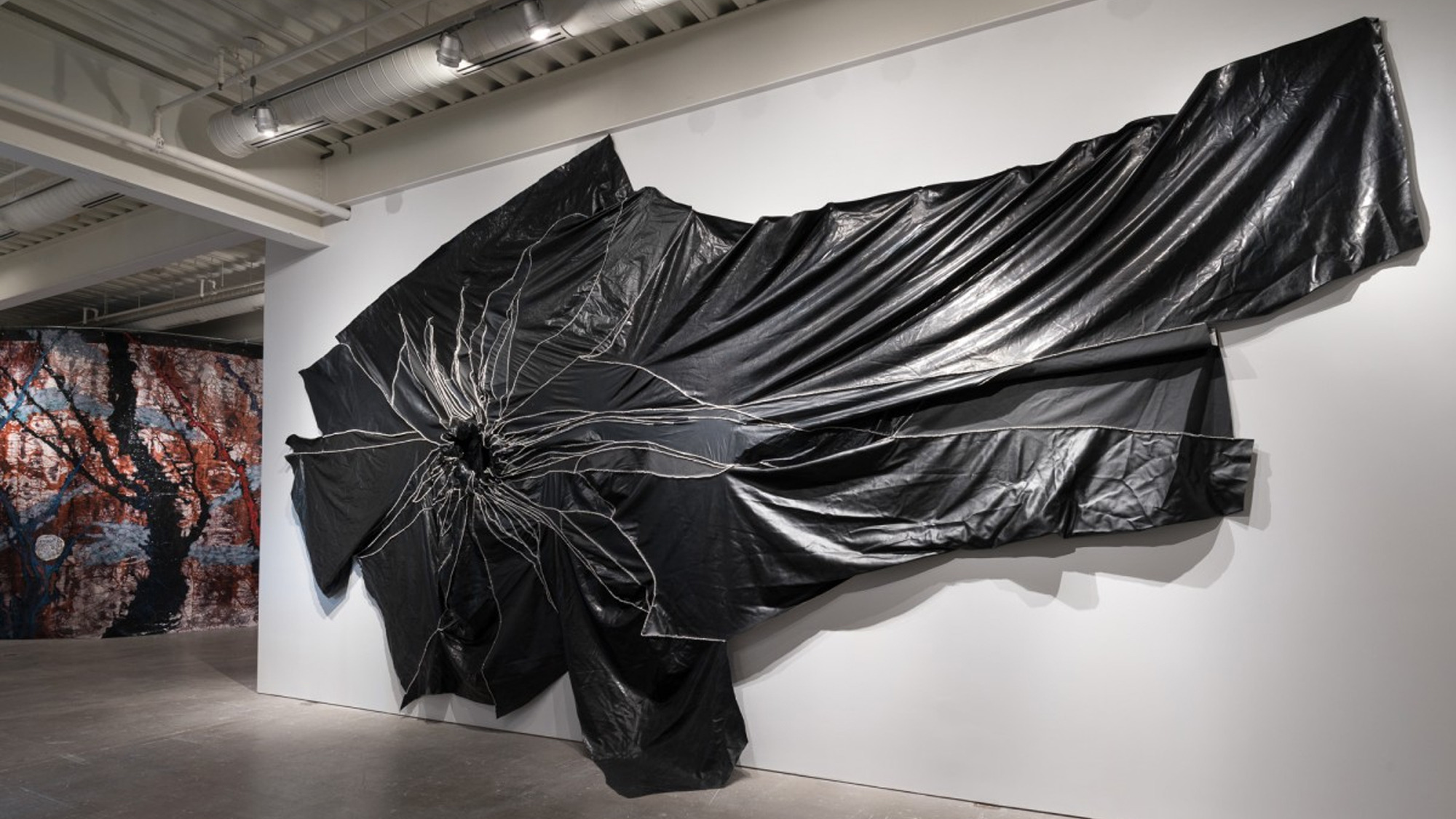
Associate Professor Rodney McMillian tells Forbes about his work and what it's like to have three solo exhibitions up at one time.
 "When you cross the threshold into 'The Black Show,' the first thing you encounter is an oversized sheet of black crawling across the wall, it’s veins stretching out paining for more growth. And then the black lung. It’s to your left, and it’s purposefully asymmetrical and lopsided with spurts of red outlining its inflated being. The entire exhibition feels bodily, from the painting installation taking up half the room as a biological landscape to the robe-like wall piece that evokes a boxer’s stature or an unarmed boy’s hoodie. It’s vastly different from the showing of works 115 miles north in “Views of Main Street,” a survey exhibition at the Studio Museum in Harlem, which confronts domesticity, consumption, and economics with punctured refrigerators, torn love seats, and melting paper pavilions.
The trifecta exhibitions of Rodney McMillian in New York and Philadelphia— at the Studio Museum, MoMA’s PS1, and ICA Philly— are deliberate and resolute. From the landscapes in Long Island City to the survey in Harlem and the new work at Penn, the shows present the work of an artist who is as witty as he is whimsical. We spoke with the artist during this critical moment in his career to hear him breakdown blackness, his approach to making, and the value of familiarity, belonging, and ownership.
This is quite a significant moment for you in regards to visibility—three solo shows at the same time and within a fairly short distance from one another. You (and other important California-trained or based artists) have seemed to largely reject the idea that endless exhibitions in some way legitimize artistry. What is this moment like for you? Did you have any hesitations to three major solo shows at once? Many artists are eager to pursue major exhibitions of their work— it’s what creates a market for them and visibility. Saying it plainly, museum and gallery exhibitions are thought to legitimize any artist as being a “true” artist or at the very least, a professional artist. However, there seems to be a number of artists, particularly from California, who reject this idea, such as David Hammons and I believe Charles Gaines as well. They are less concerned with pursuing exhibitions of their work if not flat out saying no to them. I really want your thoughts on this idea of rejecting or accepting an invitation to exhibit work, of rejecting or accepting the weight of exhibitions for an artist’s career, and how this moment in particular for you may relate to this behavior or philosophy. Also interesting, but maybe an aside, is that all three of these artists currently have shows occurring in New York."— Courney Willis Blair, June 23, 2016

Read the full article at the Forbes website.