100 for 100: Victoria Marks
On the occasion of UCLA’s Centennial, UCLA Arts is proud to present 100 for 100—a collection of stories that celebrate the rich history of the arts at UCLA over the past century. Each monthly newsletter throughout the yearlong celebration will feature a new story that reflects on our past and imagines what’s possible for our future. We invite our community to explore these stories and contribute their own to the collection.
This month's contribution is by Victoria Marks, Professor, UCLA Department of World Arts and Cultures/Dance and Associate Dean, School of the Arts and Architecture
Dancing is often looked upon as a kind of aesthetic athleticism: beautiful bodies doing amazing things; a taste of the sublime. Whereas in the Renaissance when sculpted perfection was the composite of the best features of all the human subjects accessible to the artist, today’s dancers, like our athletes, are—in themselves—the closest we will come to perfection. Michelangelo’s David never was a real person. He, (like Barbie) was the sculptor’s imagined ideal. Today we mostly look for beauty and remarkability amongst the real, living, dancers, models, athletes, actors, etc. that populate stages, film, and photography. There is something affirming about viewing the best humanity has to offer. There is also something troubling. Actually, a few things are troubling.
For one, the love of perfect or perfected bodies is an obsession with something that doesn’t exist. I often feel “too this”, or “not enough that”. I am aware of my limitations. I strive for things my body will never do. (This said, I can almost do a handstand.) In this coveting of a body I will never have is an invitation to think about how I subjugate and even denigrate my real, lived experience for an ideal. What if we loved our real bodies doing (sometimes) amazing and (most often) ordinary things?
Outside In, choreographed by Victoria Marks in 1992
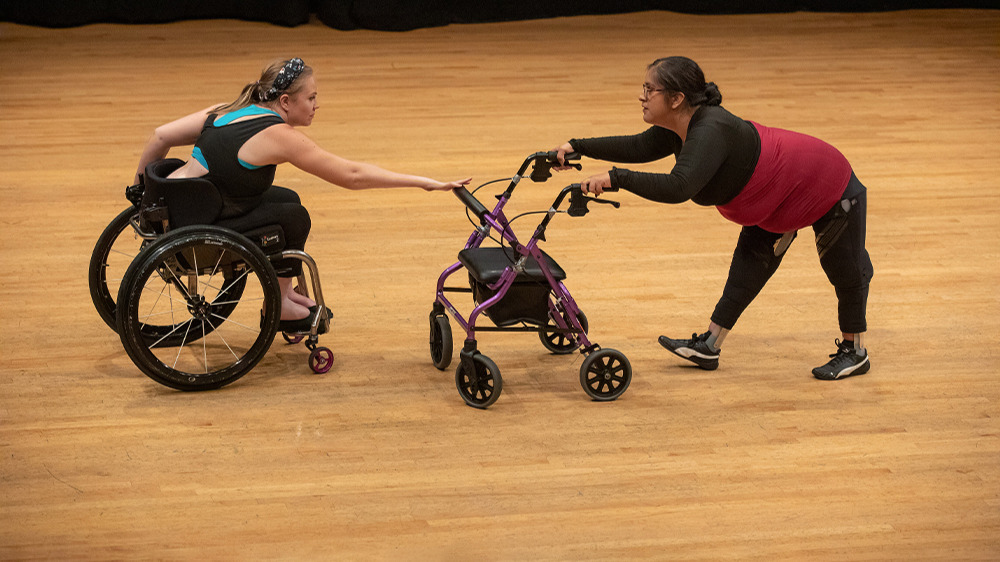
On the occasion of UCLA’s centennial, I’d like to suggest that maybe dancing can change the way we see; alter perceptual habits; re-organize the strands that tie beauty to power. And maybe the university can help spur this on. In 1992 I made a dance with and for a group of dancers, some with physical disabilities, and some non-disabled (see above). The dancers were all witty and sexy. The piece was playful and not pious. It was also a dance that demanded a viewer’s attention. Making it changed me. Years later, at UCLA, I became involved in the Disability Studies minor which I now chair. It was through my research in this field that I began to understand intellectually that which I had already begun to articulate through dance. Reading and listening to scholars who were challenging able-ism; thinking through the origins of “normal;” and grasping the ways “disability” is so much more than a medical category, can be a social identity held with pride, and is often determined by the way we build the environments we inhabit turned my work in dance into a passion for disability rights.
For years, a small group of artists and arts administrators have been diversifying the dance field, producing and presenting performances of what is most often called “physically integrated” dance. Companies composed of physically disabled and non-disabled dancers, a utopian vision of community, suggest a world where all bodies (all of us) dance together, strengthening the bonds of personhood across physical difference. The choreographies these companies have produced are of intrinsic value to the field. Some of our most celebrated choreographers have left an indelible imprint through their creations for these dancers.
And yet, as the “physically integrated” dance field matures, there are new questions to address. To what degree has dance training and dance making continued to reference paradigms of ability, requiring disabled dancers to adapt their movements to those of non-disabled dancers? To what degree have notions of virtuosity (albeit alternate virtuosities) dominated the aesthetics of this dance subfield? Do you still have to be great (in conventional ways), to be good? Finally how can dancers with disabilities guide us to see differently, based upon their embodied experience? What new values about our human experience might we encounter? Could this formulate a notion of disability aesthetics?
This past summer (June 2019) I launched the Dancing Disability Lab at UCLA. Combining the resources of the Department of World Arts and Cultures/Dance and the Disability Studies minor, support from the School of the Arts and Architecture and the office of Diversity, Equity and Inclusion, we hosted a week-long intensive lab bringing together experienced and emerging disabled dance artists from across the world to engage in the creation of new performance work that challenges “ability paradigms.” I invited Rosemarie Garland-Thomson, a renowned critical disability studies scholar, bio-ethicist, and disability justice activist and Alice Sheppard, a choreographer, dancer, and disability aesthetics provocateur to join me in leading the Lab.
We combined small group study of the histories and social discourses surrounding disability justice, aesthetics, and culture with movement exploration and the creation of new choreographic work. Participants from South Africa, New Zealand, Canada, and throughout the U.S. engaged one another through choreographic study and improvisation sessions to expand and deepen action languages while they considered how we represent, view, transform, and challenge ideas about the body and personhood. At the center of the program is the notion that aesthetic production (dance) can serve as a change agent for the continued progress of disability justice.
What I mean is:
What if dancing isn’t about the perfect-ability of the body and the actualization of control, strength, flexibility, and balance (in short, beauty and grace)? What if, instead, dancing is about our daily navigation of living, our shifting states of consciousness, our experiences of disrepair and repair, our different sensory encounters with the environments within and outside of us, our different ways of moving, of being in time and through space? What if we dismantled the controls that cause us to continuously and futilely reach for perfection? How about well-being, instead?
What’s next? We will continue to imagine what’s possible and create new, inclusive spaces and models. We will carry with us and build on what we have learned in the first iteration of the Dancing Disability Lab, just as we carry with us the breakthroughs and lessons of UCLA’s first century as we head into the next. Mark your calendars and join us on June 27th, 2020, as we share the work we create.
Watch a short documentary on the 2019 Dancing Disability Lab:
Stay engaged. Use #UCLAarts to stay connected.


