100 For 100: Jessa Calderon and Tria Blu Wakpa
On the occasion of UCLA’s Centennial, UCLA Arts is proud to present 100 for 100—a collection of stories that celebrate the rich history of the arts at UCLA over the past century. Each monthly newsletter throughout the yearlong celebration will feature a new story by a member of our community that reflects on our past and imagines what’s possible for our future. We invite our community to explore these stories and contribute their own to the collection.
This month’s contribution is by Jessa Calderon, a Tongva and Chumash mother, healer, and internationally-renowned artist, and Tria Blu Wakpa, assistant professor, UCLA Department of World Arts and Cultures/Dance with an affiliation in American Indian Studies.
This conversation features the insights and art of Jessa Calderon, a Tongva and Chumash woman, indigenous to the unceded lands that the University of California, Los Angeles currently occupies. In their discussion, Calderon and Tria Blu Wakpa highlight the important steps that UCLA has taken towards building respectful relationships with the Tongva nation and people, and conversely, the ongoing conflicts between UCLA, the Tongva, and other Indigenous peoples, which compromise Native lifeways and the wellbeing of human and other than human relatives. Calderon and Blu Wakpa also outline practical ways that UCLA, in particular, and academia, in general, might work to improve the relationships between universities and Indigenous peoples. They conclude by reflecting on “mommy-life” as an artistic inspiration and recognizing the valuable contributions of Native hip-hop artist, Andrew “Wake Self” Martinez. Wake Self recently released a new album, Ready to Live, before he unexpectedly passed away on November 5, 2019.
Blu Wakpa: Thank you so much for speaking with me today, Jessa. The School of the Arts and Architecture reached out to me because they're looking for people to reflect on the past 100 years at UCLA. And I thought, instead of writing about your powerful art, which I think does this critique on its own, maybe it would be good to give you the platform and center your perspective as a Tongva and Chumash woman. So, thank you.
Calderon: Thank you for having me.
Blu Wakpa: As we know, but it might be new to other people, UCLA continues to occupy the indigenous lands of the Tongva people, one of the Native nations that you descend from. And so, I was wondering, what comes to mind when you're asked to reflect on the last 100 years?
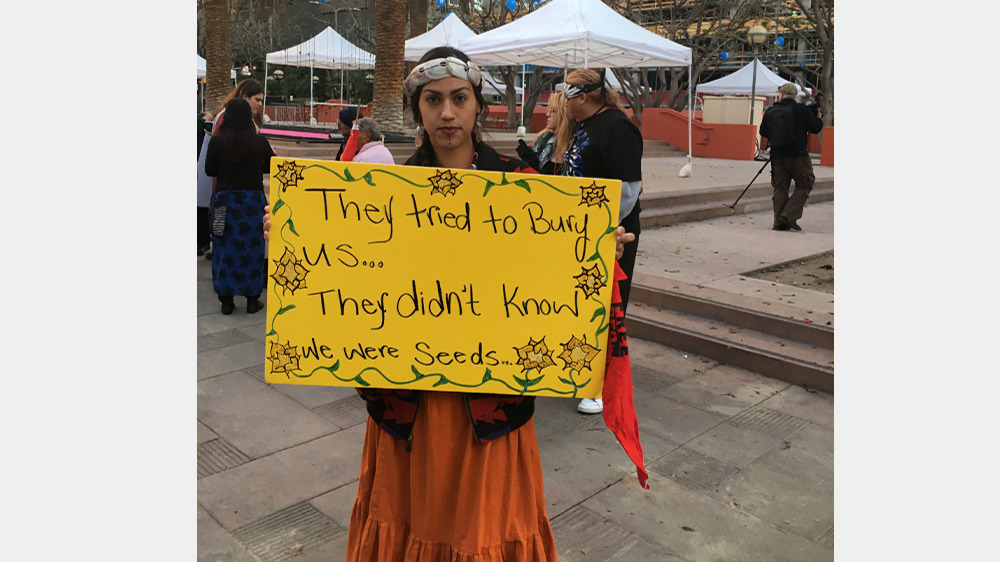
Calderon: When I think of the last 100 years, I know it's been a painful thing, being indigenous to [Southern California]. We have been pushed back, pushed off of our lands. We are constantly being erased through histories and stories and at war with our own local California governments. Our ancestors are desecrated, and we have no say over them. And I would say it's maybe only been the last 20 years or so that things have begun changing, and that's due to Tongva people and other Native peoples stepping up and continuously pushing the boundaries, getting their foot in the door, and seeing to it that our ancestors are being rightfully returned. And that's still something that we're facing today. So, when I think of the last hundred years, it's been a struggle to live in our own lands.
Blu Wakpa: I think your video Injustice [watch the video below], clarifies not only the ongoing oppressions that Tongva and other Native peoples endure, but also the ways in which settler colonial narratives obscure U.S. violence and Indigenous peoples’ ongoing presence, resistance, and resilience. Native peoples and issues are often excluded from elementary school education, secondary education, and people might even get through the university and graduate school without learning about Indigenous peoples and nations. That Native tribes are actually nations with inherent sovereignty.
Calderon: And you know, when people think of a brown person in Los Angeles, they first go to the idea that they must be a Mexican person. But being that this is Tongva land, their first thought should be that the brown person is Tongva. So, that illustrates how deep the erasure of Tongva people is.
Blu Wakpa: How would you describe the historical and the contemporary relationship between the Tongva nation and UCLA?
Calderon: I don't know enough about the historical relationship with UCLA, but I would imagine given the fact that they own so much acreage, and we don't have a safe space at the university where we can have gatherings, free parking, a place to pray. I would imagine we might not have the best relationship.
Blu Wakpa: Yes, it’s important to consider the ways that settler colonialism extends into the present day, and UCLA can still be inaccessible to the Indigenous people whose lands the university occupies.
Calderon: If they want a good relationship, I think that's something UCLA should definitely look into. Helping Tongva people go to their school, discounted Tongva rates, things like that would show me that there's a good relationship between them and the nation.
Blu Wakpa: In collaboration with Tongva people, UCLA’s American Indian Studies has taken some important steps in building better relationships with the Tongva people, such as returning Native ancestors and adopting the Tongva land acknowledgement at a university-wide level. Are there specific ways beyond what you’ve already offered that UCLA might continue working to create respectful and reciprocal relationships with the Tongva people?
Calderon: I think UCLA adopting the land acknowledgement is a beautiful thing, and it's one step forward in the right direction. But as long as they have their hand in the desecration of Mauna Kea in Hawaii, for the sake of their education, for their telescope, UCLA still proves to me to not understand what it is to walk the Native way, to understand the Native way. As long as they are applying for grants to tell the story of my people and not inviting us to tell our stories when they receive these million-dollar grants, it shows to me that they lack respect for our nation and for all Indigenous nations. And as Native people, we consider Hawaiians our cousins, and they deserve to have a safe space too. And if they say that their mountain is a sacred place, like a church, then UCLA should respect it as such.
Blu Wakpa: I agree. It’s vital that we recognize and respect what is sacred beyond Eurocentric frameworks. In the academy, Native scholars have been forefront in thinking about how to do research in respectful and even ceremonial ways and the necessity of community-engaged and community-responsive work. What are some practical steps that people who are non-Tongva could take to build good relationships with you, to do research with you in a good way?
Calderon: That’s it right there—the word “relationship.” Because too often we end up being the token Native. We need to be in communication with each other, get to know each other. And if you don't know, ask. Ask what's offensive, what's not offensive. And also keep in mind that I speak for myself. I don't speak for every Tongva person. But definitely that word “relationship” has to be just that. We have to work together. Don’t just bring us to the podium to do the land acknowledgement and then let us be on our way. Bring us to the table, allow our voice to be a part of the conversation.
Blu Wakpa: Folks in the university and in the educational system more broadly need to recognize the lifelong expertise that you have as a Native person. In a way, that experience is a Ph.D. that the university can't give. If people are sharing their knowledge and expertise, we expect them to be compensated. I think that when it comes to Indigenous people being invited in, we don't see them compensated enough for their time and knowledge.
Calderon: That would be a part of that relationship and respect.
Blu Wakpa: To survive in the academy, we're required to publish single authored articles and books, but the idea that non-Tongva people would be doing research with Tongva people and Tongva people wouldn't be substantially contributing is absurd. So, the university models that we have need to shift in order to allow these good relationships to happen.
Calderon: Yes, thank you for saying that. That's exactly it.
Blu Wakpa: I was wondering if you might speak some about your artmaking, which in itself is an act of resistance and resilience given the ways that U.S. policies and institutions prohibited Indigenous dances, languages, and spiritualities as a way to assimilate Native peoples. Because you are such an incredible artist, versed in so many different mediums: singing, dancing, rapping, regalia-making. What else am I forgetting?
Calderon: Mommy-life.
Blu Wakpa: Yes! As a mommy myself, I know that motherhood requires a lot of creativity! So, maybe you could also talk about the roles that motherhood and your other artistic endeavors play in reflecting on the past and imagining or nurturing a more just future? A more just, Indigenous future?
Calderon: I wish that I could be that rapper that just talks about the everyday stuff today. But I can’t as somebody who was part of the LAUSD school system and seeing how greatly that failed in addressing who I am and my background as a Tongva person. Throughout school, I was always being told where we came from and that we were extinct and all these things that were totally inaccurate. So, I view it as my responsibility to use my platform, to use my art to tell the truth. When I bring my regalia and my indigenous background into my music videos, it's not to show off. It’s to say that we are still here. For people to understand, Tongva people are still here. That’s why I like to merge hip hop and my background as a Tongva woman, to bring that reminder. And by doing so, hopefully create an awareness, which opens the public’s hearts and minds and helps this more just future come into fruition.
Blu Wakpa: What is the feedback that you receive from audiences? Is there a sense that they’re learning through what you offer?
Calderon: The majority of the time I actually perform for a huge Euro-American crowd and they love coming up to me and explaining that they had no idea about Native peoples. And then they feel horrible about the fact that they had no idea. So, I get really good feedback, a lot of thanks and praise for bringing this information to the forefront because people who grew up in America still had no idea of the truth of what has happened on these lands.
Blu Wakpa: That is powerful. Did you want to speak a little more about the ways that motherhood inspires your art making and artistic aims?
Calderon: The way that my son looks at me as his role model is everything to me, which is why I'm taking my music in the direction that I am. No disrespect to Nicki Minaj-type artists, but I want my son to have positive role models in his life. I want him to be very well aware of his culture and be proud of it. And I realize that there's so many more children out in the world, just like my son. So therefore, I feel the responsibility to be a proud Native woman in the music scene. I'm not backing down to people who are otherwise trying to shut me up and prevent me from speaking my truths and educating for the sake of these babies. So that unlike our great grandparents, Native children today can take pride in being a Native person.
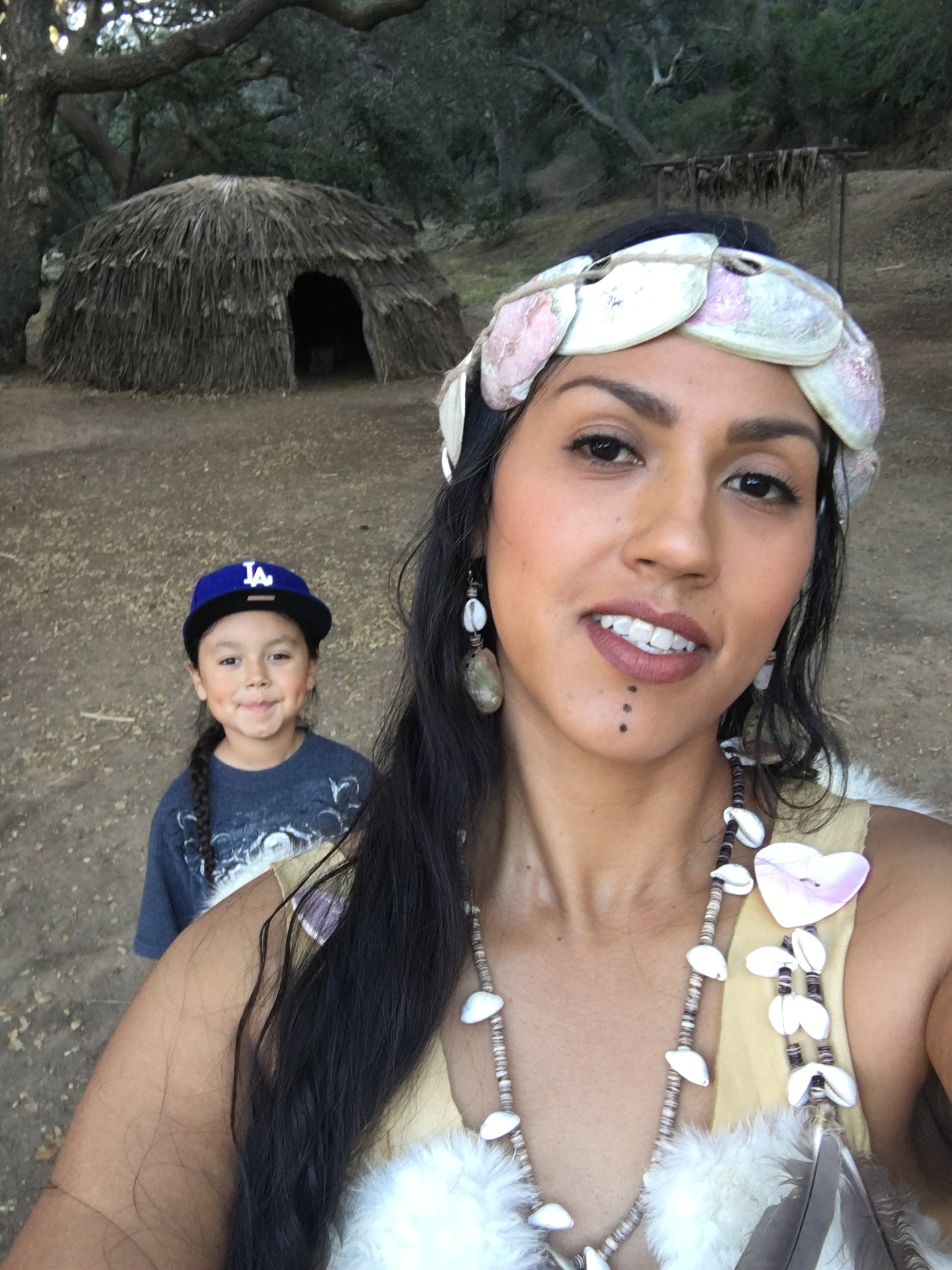
Jessa Calderon with her son.
Blu Wakpa: That’s very inspiring. And what you've said really highlights the stakes of our responsibilities as mothers and educators, to illuminate and alleviate these ongoing injustices for the next generation. Is there anything else I didn’t ask you that you’d like to add?
Calderon: Today is actually a very sad day because a Native brother named Wake Self from Albuquerque, New Mexico who is very, very talented just passed away today. He was hit by a drunk driver. So, I think it would be only right to acknowledge that and let people know that Wake Self is an amazing artist with positive stories to share with us and may he shine bright as the star that he is.
Blu Wakpa: Thank you for sharing that and I'm so sorry for your loss. I look forward to learning more about Wake Self and his art and I hope that others who read this will as well.