10 Thoughts to Explore About Nature
As part of UCLA’s centennial celebration, the UCLA School of the Arts and Architecture is holding a series of conversations called 10 Questions: Centennial Edition. Every Tuesday evening for ten weeks, experts from diverse disciplines are exploring answers to some of life’s biggest questions, including “What Is Community?,” “What Is Citizenship?,” and coming up next week “What is Creativity?” The discussions, held at Kaufman Hall on UCLA’s campus, are open to community members, free with RSVP. Can’t attend? KCET shares weekly highlights.
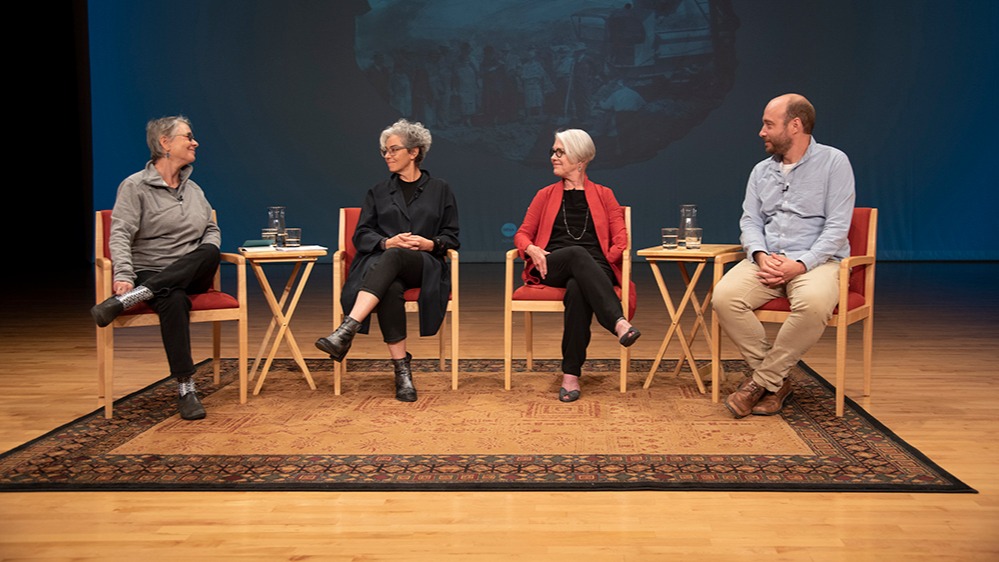
"What is nature? On Tuesday, November 12, Victoria Marks, professor of choreography and associate dean of academic affairs for the UCLA School of Art and Architecture, moderated a talk that featured Evan Meyer, botanist and assistant director of UCLA’s Mildred E. Mathias Botanical Garden; Rosemarie Garland-Thomson, disability justice and culture expert, bioethicist, and humanities scholar; and Rebeca Méndez, a designer and artist whose work addresses climate change. Here are ten ideas that came up during the discussion.
Rebeca Méndez’s CircumSolar, Migration 3 1. Today, about 25% of the earth’s land is considered wilderness — but that doesn’t mean those places are pristine. Evan Meyer explained that humans have subtle impacts even on places that are still wild, and we can see those effects in things like air pollution. He said, “When smog goes up in the air, it has to come back down. It comes back down and changes the ecology of those areas. So these areas, although they are important and should be preserved, they're not untouched by humans.”
2. Seed banks are an effort to preserve biodiversity in ex situ (off-site) collections. Before coming to UCLA, Meyer managed Rancho Santa Ana Seed Bank, the world's largest collection of living seeds of rare and endangered California plants. He said, “These freezers are full of the rare and endangered flora of California, and in these freezers you can keep seeds alive for hundreds of years under the right conditions. Many of the plants maintained here represent places that no longer exist.” Those places may now be a Walmart parking lot or a shopping center, but the plants that once lived there could be used to re-diversify future landscapes.
3. In previous centuries, the phrase “freak of nature” had positive connotations. Rosemarie Garland-Thomson said, “Freak was not imagined as something abnormal, but rather as a demonstration of divine variation and the power that the divine or superstition may have had to create these amazing and interesting different rare forms.” She shared images of Matthias Buchinger, a German man born without arms or legs in the 17th century. Today, he would’ve been considered to have a congenital disability or some kind of deformation, but back then, he was understood as a wonder. He became a famous calligrapher, marksman, and entertainer."— Lisa Beebe, Nov. 8, 2019


This post is an excerpt. Read the full article on the KCET website.
Stay engaged. Use #UCLAarts to stay connected.


