10 Things to Love About Love
As part of UCLA’s centennial celebration, the UCLA School of the Arts and Architecture is holding a series of conversations called 10 Questions: Centennial Edition. Every Tuesday evening for ten weeks, experts from diverse disciplines are exploring answers to some of life’s biggest questions, including “What Is Creativity?,” “What Is Citizenship?,” and coming up next week “What Is Nature?” The discussions, held at Kaufman Hall on UCLA’s campus, are open to community members, free with RSVP. Can’t attend? KCET shares weekly highlights.
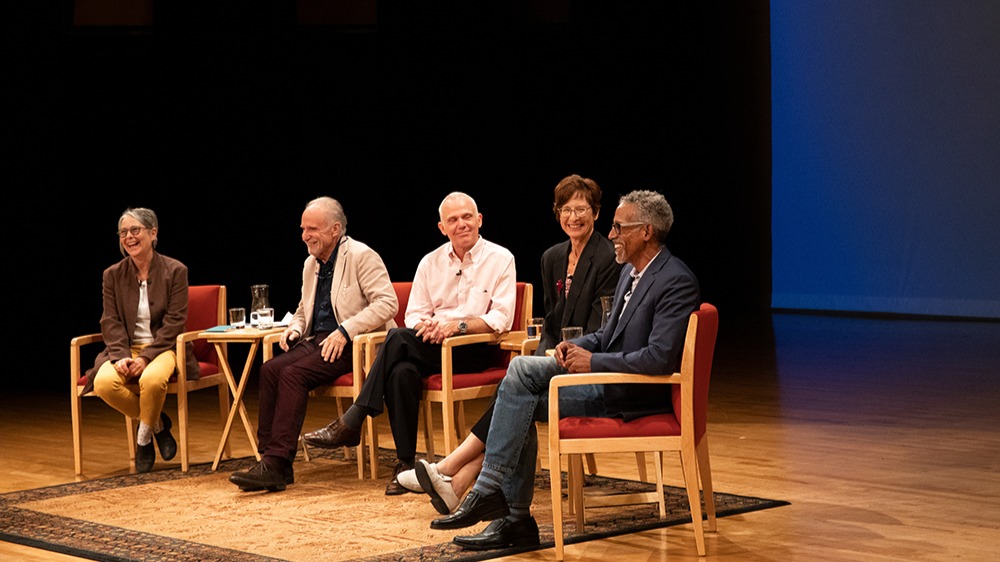
"On October 29, a team of experts took on the toughest question yet: What is Love? Victoria Marks, professor of choreography and associate dean of academic affairs for the UCLA School of Art and Architecture, introduced Thomas Bradbury, co-director of the UCLA Marriage Lab; Massimo Ciavolella, professor of Italian; Meryl Friedman, director of education and special initiatives for the Center for the Art of Performance at UCLA; David Roussève, choreographer, writer, director and performer. They each gave a short presentation, participated in a discussion and answered questions from the audience. Here are ten things we found out about love.
Victoria Marks, choreographer and Associate Dean, Academic Affairs at the School of the Arts and Architecture, (left) was joined by (from left to right) Massimo Ciavolella, professor of Italian; Thomas Bradbury, co-director of the UCLA Marriage Lab; Meryl Friedman, Director of Education & Special Initiatives for the Center for the Art of Performance at UCLA; and David Roussève, choreographer, writer, director and performer 1. Love has been confusing people for a long time. Massimo Ciavolella talked about understandings of love at different times in history. He said, in the 1700s, “The brain was considered to be a kind of wax. And as you know, when you warm wax, you can put something there — a scene, for example — and as it gets colder, the image remains there, impressed.” Back then, people believed obsession meant you had an image stuck in your head. He told a story about someone trying to help an obsessed man by putting a bronze bed-warming device on his head. They were trying to melt the image that was stuck in his brain so that he could move on, but instead, badly burned him.
2. Love is a deeply personal experience, but that doesn’t mean scientists can’t study it. Thomas Bradbury said, “We study invisible natural forces all the time — when we study things like gravity, which we can't see, but has an effect; when we study things like the wind, which we can't see, but has an effect; and we can do the same thing with love. We can say love is that which love causes. Love is its consequences.”
One of the things scientists have learned: Love is good for us. Bradbury said, “The presence of love is the best predictor of our happiness in our lives. People who report having loving relationships, close confiding relationships, are people who enjoy better physical health, better mental health, who are more successful at school. They're more successful at work. They go on to raise happier and healthier children of their own.”
3. Dr. Bradbury said psychological scientists have found that there are several key ingredients that generate love:
- People need to disclose things about their authentic selves to each other.
- They have to understand each other on a deep level.
- They have to validate each other’s disclosures. (Not only do they get you, they think you’re a good person.)
- They have to care about each other deeply and be willing to respond to each other in times of need.
"— Lisa Beebe, Nov. 4, 2019


This post is an excerpt. Read the full article on the KCET website.
Stay engaged. Use #UCLAarts to stay connected.


