10 Things to Consider About Citizenship
As part of UCLA’s centennial celebration, the UCLA School of the Arts and Architecture is holding a series of conversations called 10 Questions: Centennial Edition. Every Tuesday evening for ten weeks, experts from diverse disciplines have gathered to explore answers to some of life’s biggest questions, including “What Is Knowledge?,” “What Is Nature?,” and “What Is Creativity?” The final talk in the series, “What Matters?” will be held Tuesday, December 3, at Kaufman Hall on UCLA’s campus, and it’s free to the public with RSVP. Can’t attend? KCET shares weekly highlights.
"On Tuesday, November 26, Victoria Marks, professor of choreography and associate dean of academic affairs for the UCLA School of Art and Architecture, moderated a discussion around the question “What is citizenship?” It featured Leisy Abrego, immigration rights movement scholar; Marike Splint, theater artist and educator; and Hiroshi Motomura, scholar and teacher of immigration and citizenship law. Here are ten things we learned along the way.
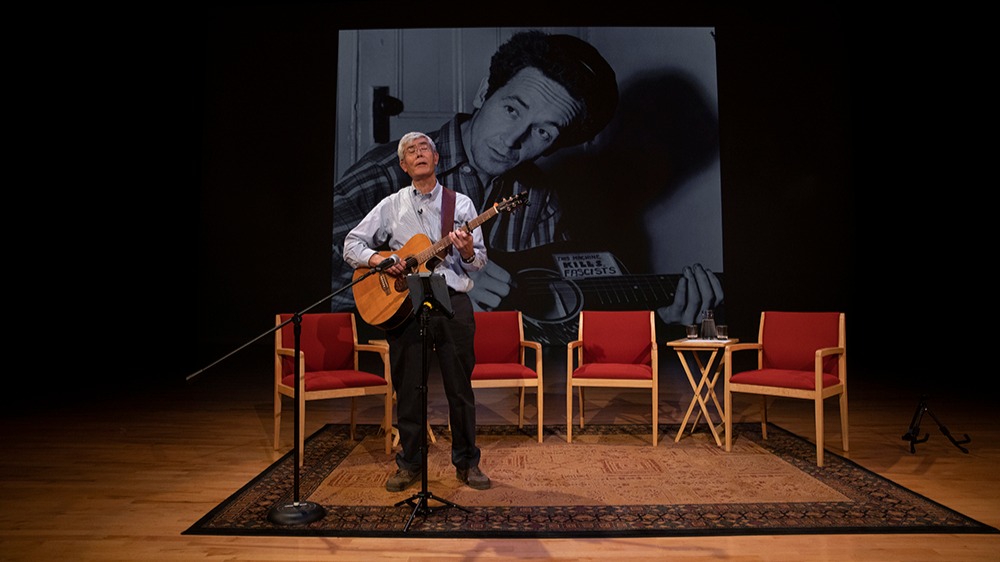
Hiroshi Motomura plays Woody Guthrie's This Land is Your Land on stage at the 10 Questions: What is Citizenship lecture 1. Immigration often stems from personal trauma or safety concerns. Victoria Marks read an excerpt from British Somali poet Warsan Shire’s poem “Home,” which begins:
no one leaves home unless
home is the mouth of a shark2. Citizenship affects people’s lived experiences, and mixed-status families — families in which at least one parent is undocumented — face special challenges. Abrego offered the example of children who have citizenship starting to drive at age 13. She said, “They know that if the police stops one of their parents while driving, that parent might be detained and deported.” But if the 13-year-old driver is stopped, they’ll get a ticket, and not have to separate from their family.
3. Transnational families — families in which two or more core members live across borders — may not be capable of engaging as citizens of either country. Abrego shared that her grandmother moved to the United States in the 1960s in order to provide for her children, who were back in El Salvador. Abrego said, “It took a very long, expensive, and bureaucratic process for this family to be reunited again. And in the meantime, as a working class migrant, my grandmother did not participate in the promises of citizenship. She was busy working, and all that citizenship meant for her was the chance to be able to reunite with her children. Meanwhile, my mom and my aunt, who were legal citizens of El Salvador, had access to limited schooling and all of the limited rights that are guaranteed by a rather politically unstable nation state, but they were constantly missing their mother and only thinking about a future in which they could be together, which prevented them from participating in the society that they lived in.”"— Lisa Beebe, Dec. 2, 2019


This post is an excerpt. Read the full article on the KCET website.
Stay engaged. Use #UCLAarts to stay connected.


