10 Mold-Breaking Ideas on the Concept of Justice
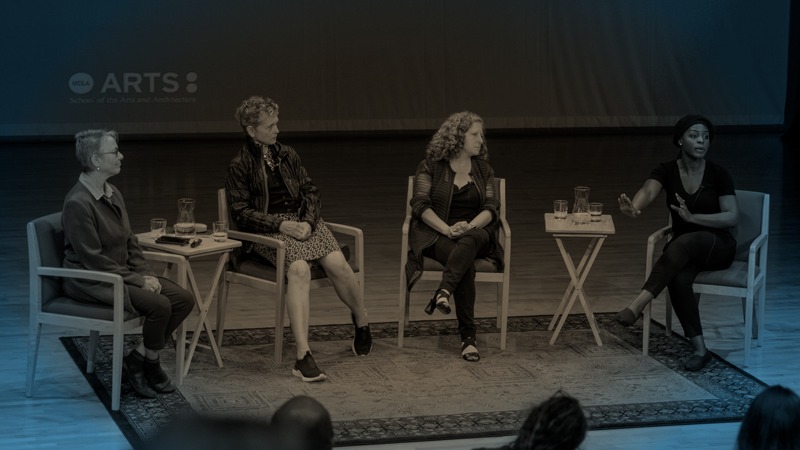
As part of UCLA’s centennial celebration, the UCLA School of the Arts and Architecture is holding a series of conversations called 10 Questions: Centennial Edition. Every Tuesday evening for ten weeks, experts from diverse disciplines are exploring answers to some of life’s biggest questions, including “What Is Justice?”, “What Is Truth?” and “What Is Love?” The discussions, held at Kaufman Hall on UCLA’s campus, are open to community members, free with RSVP. Can’t attend? KCET will be sharing weekly highlights.
"What is justice? On October 15, Victoria Marks, professor of choreography and associate dean of academic affairs for the UCLA School of Art and Architecture, moderated a discussion on the topic between Funmilola Fagbamila, artist, playwright, and activist; Jennifer Mnookin, evidence scholar and dean of UCLA School of Law; and Stephanie Pincetl, founding director of UCLA’s California Center for Sustainable communities. Marks started by saying, “It will not be our goal this evening to answer the question ‘What is justice?’ It's simply too big.” Instead she suggested that panelists consider how we can live well — or better — together. Below are some of the ideas that came up.1. Wrongful convictions happen more often than we suppose. Before DNA, most people believed wrongful convictions were extremely rare. Dean Mnookin talked about how ideas about wrongful convictions have opened the door for a broader conversation about the criminal justice system. With the rise of DNA testing, she said, “There began to be DNA exonerations that showed that, in fact, there were people who had been behind bars for very lengthy periods of time, who DNA evidence now proved dispositively hadn't done the thing that they were accused of.”
While there are still lots of questions about how often wrongful convictions occur, we now understand that innocent people are regularly being convicted of serious crimes, and that the “protections” of the justice system may not be protecting them. Mnookin said, “That changes how we think about criminal justice and justice more generally.”
2. Our understanding of justice has grown more complex. Mnookin said, “This wrongful conviction space, which began in a narrow way, has opened up some spaces for these important broader stories about our criminal justice system and bigger questions about how do we do justice? What counts as injustice? How do we create a system that we believe can be fair to all?”
She went on to say, “It's created a space where we're beginning to see some real traction for criminal justice reforms, ranging from transformation of the bail system, for example, to a new engagement around the death penalty and the appropriateness of those kinds of punishments, to the creation of the progressive prosecution movement where there are starting to be prosecutors who are interested in questions like the integrity of convictions, and are there ways to go about this that would reduce mass incarceration? Wrongful convictions have begun to change that narrative.
3. Justice guides how we treat the natural world. Stephanie Pincetl’s work focuses on social and environmental justice and finding equitable ways to reduce human impact on the planet. She pointed out that as we develop new technologies, we need new kinds of elements, and said, “Those elements are found in places like the Congo, like Mongolia, places where there's an enormous environmental and social impact and there's no accountability about those impacts.” She offered the example of an open pit copper mine, and said, “What’s happened is we’ve scraped off the best. The best copper has already been mined. That is beginning to happen for a number of these really important elements. What does that imply? It means that the next layer, the next level of quality is going to require a lot more energy resource to extract.” — Lisa Beebe, Oct. 18, 2019

This post is an excerpt. Read the full article on the KCET website.
Stay engaged. Use #UCLAarts to stay connected.


