10 Big Ideas on the Meaning of Community
UCLA celebrates its 100th anniversary this year, and as part of the festivities, the UCLA School of the Arts and Architecture is holding a series of conversations called 10 Questions: Centennial Edition. Every Tuesday evening through December 3, Victoria Marks, professor of choreography and associate dean of academic affairs for the UCLA School of the Arts and Architecture, moderates a discussion in which interdisciplinary experts take on big questions. On Tuesday, November 26, they’ll attempt to answer “What is citizenship?” Each talk is open to the public, free with RSVP. Can’t attend? We’ll be sharing weekly highlights.
"On Tuesday, November 19, three members of the UCLA community — Jennifer Ferro, president of KCRW; Kevin Kane, arts education and community arts scholar; and Ananya Roy, social justice scholar — responded to the question, “What is community?” Here are ten things we learned along the way.
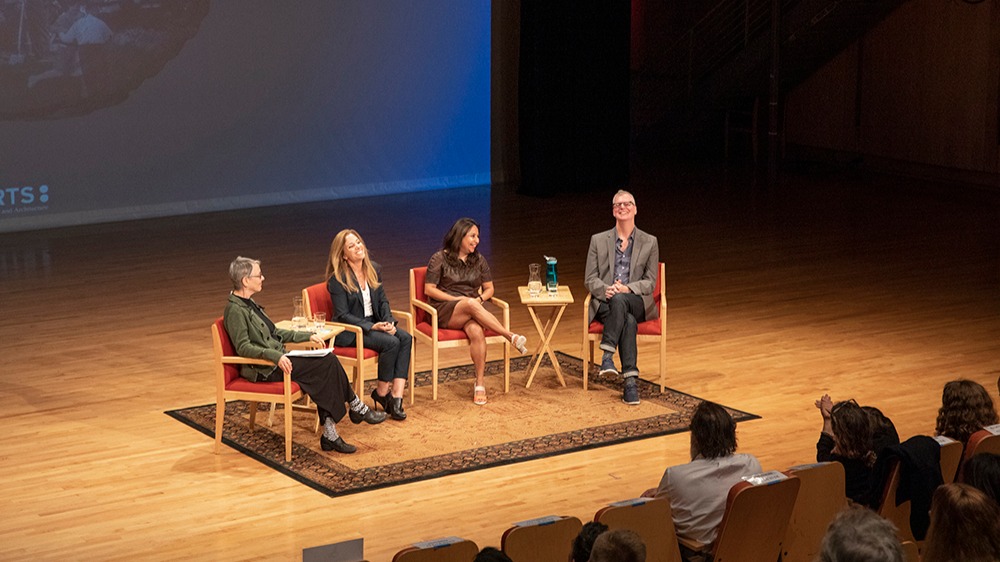
From left to right: Victoria Marks, Jennifer Ferro, Ananya Roy, and Kevin Kane at the 10 Questions: What is Community lecture. 1. Community isn’t something you create on your own. Victoria Marks began the evening with a reading of Maya Angelou’s poem, “Alone,” which repeats the phrase, “Nobody, but nobody / Can make it out here alone." In a twist on that idea, Jennifer Ferro said, "One of the things that KCRW does that I think is really powerful is allow people to be part of a community when they're completely by themselves." Someone can be alone in the shower or in their car, listening to their radio, and feel connected to a broader cultural community.
2. There are some communities that we are born into, but there are others we choose. Ferro quoted author Bill Bishop, who said, "It used to be that people were born as part of a community, and had to find their place as individuals. Now people are born as individuals and have to find their community.” She talked about feeling out of place as a UCLA undergrad until she became one of the editors of a feminist magazine and found a community of people who shared her values.
3. There are different engagement levels in communities. Ferro outlined a hierarchy based on the depth of a person’s commitment and involvement:
Entry-level: You quietly identify with a particular group.
Mid-level: You publicly identify with the group and let other people know that you’re part of this community. (For example, you wear the group’s t-shirt.)
High-level: You not only belong to the community, but you also take action on behalf of the community. (Example: You serve on jury duty because it's your responsibility to the community.)"— Lisa Beebe, Nov. 22, 2019


This post is an excerpt. Read the full article on the KCET website.